Can You Do GEO Yourself? DIY vs a £1,250 Diagnosis

Most GEO advice tells a business to hire an agency or to do everything itself. Neither answer holds up once you separate the work into tasks. Some of it is genuinely DIY. Some of it depends on access a business does not have. We ran our own task audit to find the line, and timed it.
Key takeaways
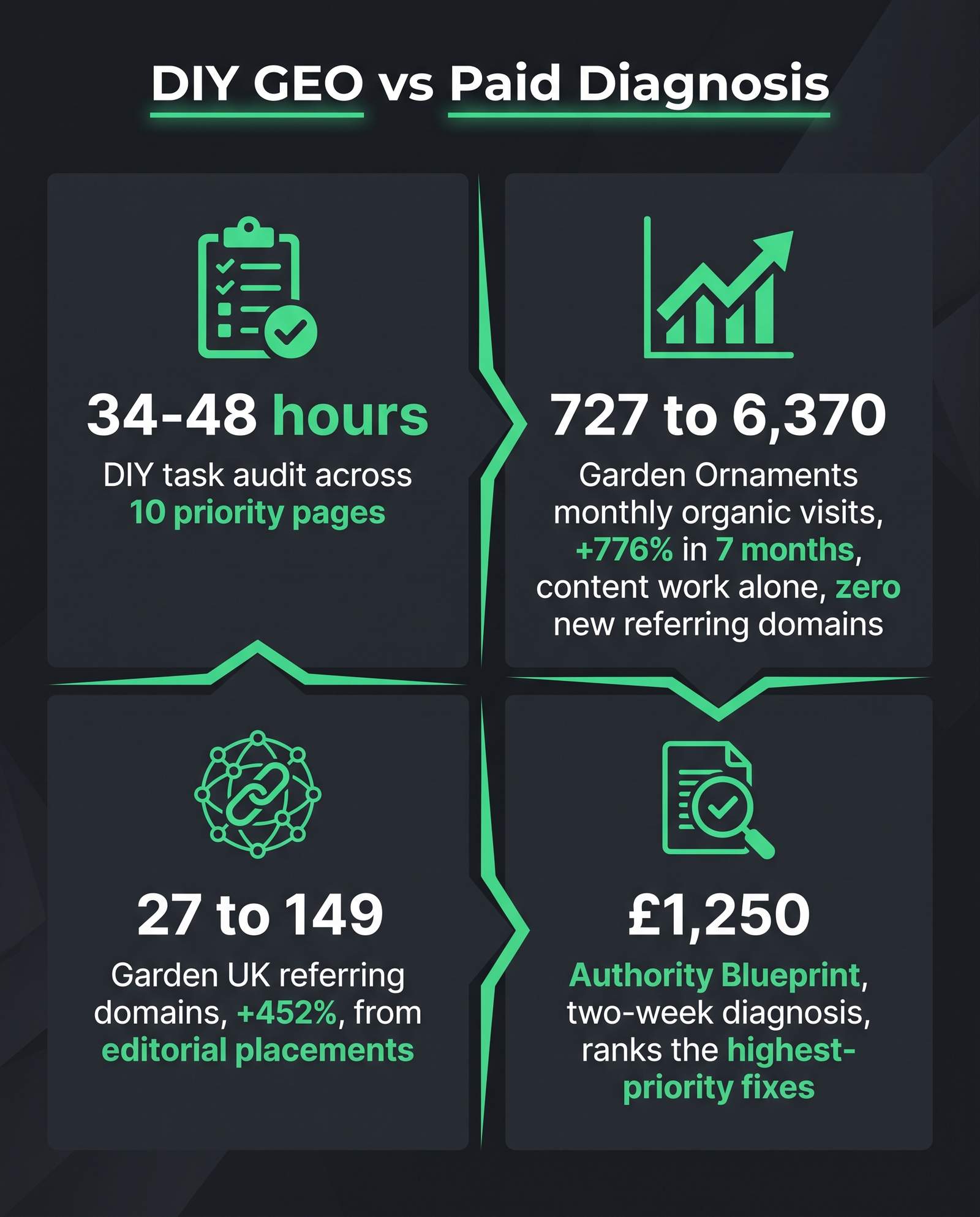
- A first-pass DIY audit across ten priority pages runs 34 to 48 hours of focused work, based on our own task-timing audit.
- Entity clarity, FAQ structure, internal linking and citable numbers are all genuinely DIY: no external access required.
- Independent editorial placements and third-party corroboration are the one category DIY cannot replicate, at any time investment.
- Garden Ornaments gained 727 to 6,370 monthly organic visits (+776%) in 7 months through content and technical work alone, with no new referring domains.
- Garden UK needed the opposite: Domain Rating 0 to 15 and referring domains 27 to 149 (+452%) came from editorial placements a small in-house team could not source alone.
The task list we actually timed
We ran our own internal audit across ten commercially important pages on a live site, logging hours per task rather than guessing at effort. The list below is what came out of it, not a generic checklist copied from a competitor.
| Task | Can it be done in-house? | Approximate time (per priority page) |
|---|---|---|
| Add a specific entity sentence and named numbers near the top | Yes | 20 to 40 minutes |
| Write FAQ answers in a direct, factual first sentence | Yes | 30 to 60 minutes |
| Add Organization, Article and FAQPage schema | Yes, with a template | 15 to 30 minutes |
| Confirm crawler access for GPTBot, ClaudeBot and PerplexityBot | Yes | 10 minutes, one-off sitewide |
| Fix internal links to corroborate the same facts across pages | Yes | 30 to 45 minutes |
| Run a prompt-by-prompt citation check across engines | Yes | 20 minutes per page |
| Secure an independent editorial placement or a named third-party mention | No, needs external access | Not a fixed task; runs on relationship time |
| Rank which of ten fixes matters most commercially | Partial; needs comparative data most teams do not hold | Varies |
Six of eight rows are genuinely DIY. The seventh needs relationships a business rarely builds fast from a standing start. The eighth needs data most internal teams have never collected, because nobody inside the business has audited more than their own site.

What DIY content and technical work can actually achieve
Garden Ornaments, one of the sites Matt has run since 2019, went from 727 to 6,370 monthly organic visits between October 2025 and May 2026. That is a 776% lift, on content and technical work alone. No net-new referring domains were part of that number. It is the clearest evidence we have that the DIY half of the task list is not a watered-down version of the real thing. Run properly, it moves real traffic.
The lift came from exactly the kind of work in the table. Specific entity statements, corroborated internal links, FAQ answers written as direct facts, and schema applied consistently across the priority pages. None of it required an outside relationship. All of it required someone inside the business to work the task list in order, page by page.
Where DIY effort stops paying off
Garden UK needed a different lever. Domain Rating moved from 0 to 15 and referring domains from 27 to 149, a 452% increase, inside 30 days. That came from editorial placements: other sites choosing to mention and link the domain independently. No amount of internal content work substitutes for a third party publishing something about you unprompted. AI engines weight that kind of independent corroboration precisely because a business cannot fabricate it about itself.
This is the boundary DIY guides tend to skip. How to choose a UK GEO agency covers vetting an agency once you decide you need one. The harder question most businesses skip is deciding whether they need one at all, and for which task specifically.

When a paid diagnosis earns its cost back
We covered the wider budget question in the smallest realistic GEO budget for a UK small business and why sub-£1,000 managed GEO forces trade-offs. Neither post answers the DIY-versus-diagnosis question directly, because it is not really a budget question. It is a ranking question.
A business with unlimited internal hours still cannot tell, from inside its own four walls, which of ten pages is losing the most citations. Nor can it see whether a competitor already owns the editorial sources that matter most. That comparative view is what a diagnosis buys. Not the on-page task list itself, which is free to run internally, but the ranking of which task to run first, plus visibility into competitor citation gaps and editorial-source access the business does not have. The Authority Blueprint costs £1,250 for a two-week engagement precisely because that comparative work cannot be done from inside a single business’s own data.
Matt’s Pick: run the DIY list first, then decide if the ranking question is worth £1,250
Work through the six genuinely DIY rows in the table above before spending anything. Add the entity sentence, fix the FAQ structure, confirm crawler access, corroborate the internal links. Expect 34 to 48 hours across ten priority pages, and expect a real result if the work is done properly. The moment the honest answer becomes “I don’t know which page to fix next” or “I don’t know how to get an independent mention”, that is the point a diagnosis earns its cost back rather than a point to guess past. Run the free AI Visibility Check across ChatGPT, Claude, Gemini, Perplexity, Copilot, Grok and Google AI Mode first, then use the AI Authority Scorecard to see which column, content, evidence or editorial corroboration, is actually your weakest before committing further hours or budget either way.
Frequently asked questions
Can a business genuinely do GEO itself, with no agency at all?
Yes, for a defined set of on-page and content tasks. Entity clarity, FAQ structure and citable numbers are all doable in-house.
How many hours does DIY GEO actually take?
Our own task audit puts a first pass across ten priority pages at roughly 34 to 48 hours of focused work.
What can DIY work never fully replace?
Independent editorial placements. AI engines weight third-party corroboration that a business cannot publish about itself.
Did GeoLinks itself grow a site through DIY content work alone?
Yes. Garden Ornaments went from 727 to 6,370 monthly organic visits in 7 months on content and technical work alone, no new referring domains.
When does a paid diagnosis save more than it costs?
When a business cannot tell which of ten possible fixes matters most. A diagnosis ranks the work; DIY effort without ranking gets spent on the wrong page.
What does the £1,250 Authority Blueprint check that a self-audit misses?
Competitor citation gaps, editorial-source access and a commercially ranked plan, not just an on-page checklist.
Is a DIY approach ever the wrong choice even with unlimited time?
Yes, if the business needs off-site editorial corroboration fast. Building genuine third-party relationships takes longer than any internal task list.
Related reading
- How to choose a UK GEO agency covers vetting an agency once the ranking question points you toward one.
- The smallest realistic GEO budget for a UK small business covers the wider spend question alongside the task split above.
- Can sub-£1,000 GEO be a real method? covers why low-cost managed retainers force the same trade-offs a DIY task list does not.
- GEO pricing in the UK covers the market rates once you decide external help is worth buying.
Run the free AI Visibility Check, try the AI Authority Scorecard, or see monthly content and citation work for the tasks this post shows most teams cannot self-serve.