GEO vs SEO vs AEO vs LLMO vs AI Overviews: Plain-English Glossary

Five terms now compete for the same buyer budget: SEO, AEO, GEO, LLMO and AI Overviews. UK agencies use them interchangeably, in stacks, as substitutes, and occasionally as marketing weapons against each other. This guide gives the plain-English definition of each, shows how they overlap visually, and tells you which ones you actually need. Built from the same May 2026 audit of fifteen UK GEO agencies that backs our Best UK GEO Agencies 2026 ranking.
Why disambiguation matters now
In our May 2026 audit of fifteen UK GEO agencies, three patterns emerged that make this glossary necessary.
First, only one agency (ClickSlice) ran genuinely separate AEO and GEO service pages with distinct methodology. The other fourteen either bundled the two terms into one offer or used them interchangeably without explanation.
Second, the term LLMO appeared on four agency sites as a standalone service, but in three of those four cases the service description was identical to the GEO description. The terminology fragmented faster than the underlying work.
Third, every single agency referenced AI Overviews as either a separate optimisation target or as a subset of one of the other four disciplines. No two agencies in the audit drew the boundary in the same place.
If the agencies cannot agree on the definitions, buyers cannot reasonably be expected to. This glossary fixes the agreement layer.
The five disciplines at a glance
| Discipline | What it targets | Primary signal | Year coined | UK market state |
|---|---|---|---|---|
| SEO | The 10 blue links on Google and Bing | Ranking position | 1997 | Mature, commoditised |
| AEO | Featured snippets, voice answers, knowledge panels | Passage extraction | 2017 | Mid-maturity, increasingly bundled with GEO |
| GEO | Citations inside ChatGPT, Perplexity, Gemini, Claude, Copilot | Brand citation share | 2024 | Emerging, fragmented vendor landscape |
| LLMO | Inclusion in LLM training data and retrieval corpora | Entity recognition | 2024 | Largely synonymous with GEO in practice |
| AI Overviews | Google’s AI-generated answer at top of SERP | Citation in the Overview | 2024 (UK rollout 2025) | Single Google feature, not a discipline |
The numbers in the “Year coined” column matter. SEO is twenty-eight years old and has a stable methodology. AEO is eight years old with most of its tactical work absorbed into modern SEO. GEO, LLMO and AI Overviews are all under two years old, which is why the vendor landscape is still fragmenting and the boundaries are still shifting.
How the five disciplines overlap
The cleanest mental model is a stack, not a Venn diagram.
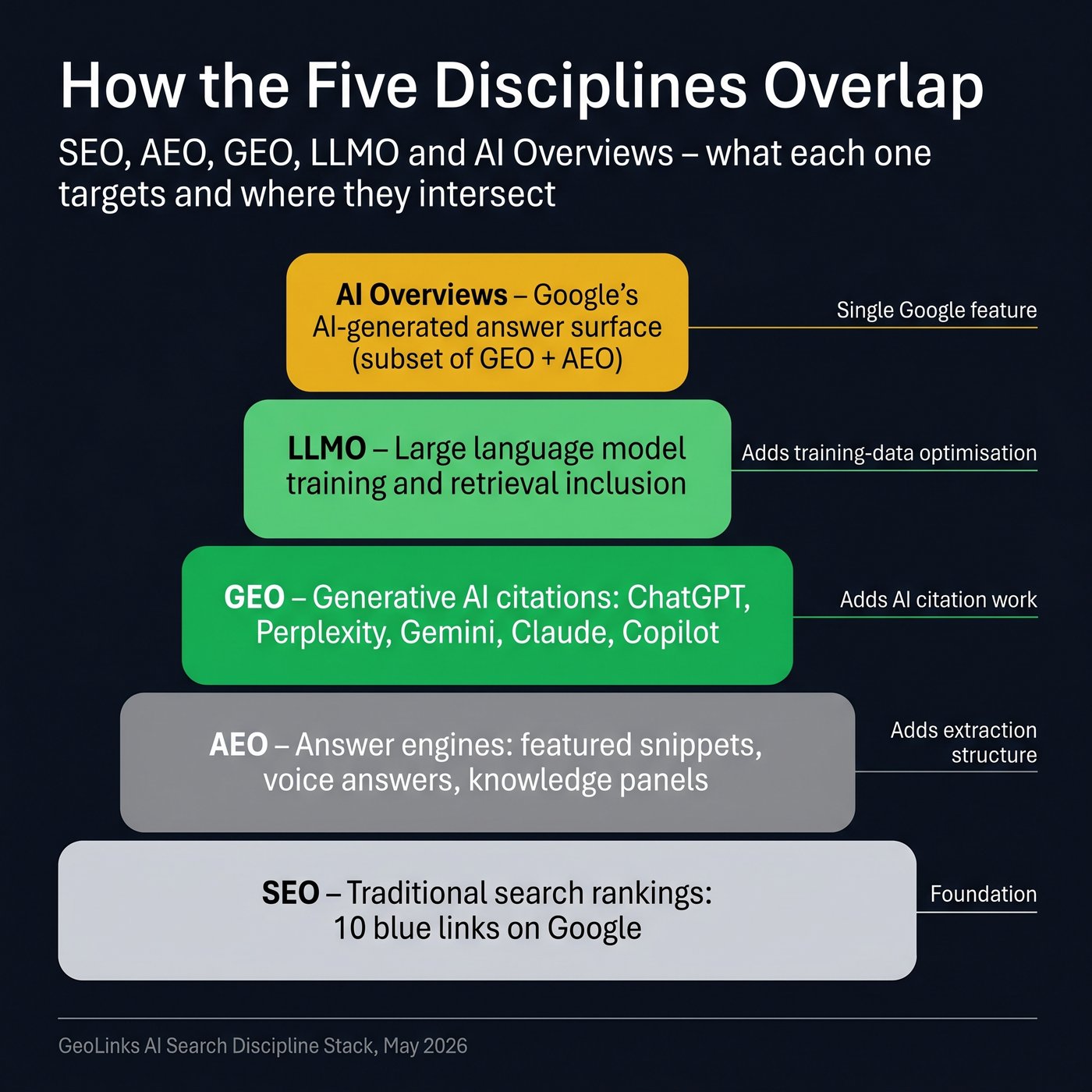
Read from the bottom up. SEO is the foundation: fast pages, clean schema, real backlinks, indexable content. AEO adds extraction-friendly structure: featured-snippet formatting, FAQ schema, 15-word answer leads. GEO adds AI citation work: prompt research, entity reinforcement, chunk-level retrieval optimisation, per-platform citation tracking. LLMO adds the narrower work of optimising for inclusion in training data and retrieval corpora. AI Overviews is a single Google product that draws from work done in the AEO and GEO layers.
An agency selling you GEO without an SEO foundation is selling you a roof without walls.
The five disciplines, defined
SEO: search engine optimisation
Plain-English definition. The work of getting a webpage to rank highly in the traditional list of search results on Google, Bing or another search engine.
What it optimises for. The ten blue links, image and video carousels, knowledge panels, and any other surface inside the traditional results page that is sorted by ranking position.
What the work involves. Technical foundation (crawl, indexation, schema, page speed, Core Web Vitals), on-page optimisation (titles, headings, internal linking, content depth), off-page authority (backlinks, brand mentions, citations), and ongoing content publishing aligned to keyword research.
Who it is for. Every website that wants traffic from Google. SEO is table stakes for any business with a public-facing site.
How it differs from the others. SEO targets the ranking of the page itself. AEO, GEO, LLMO and AI Overviews target what happens to the page’s content after the user has searched, when an answer-extracting or answer-generating system uses it.
AEO: answer engine optimisation
Plain-English definition. The work of structuring a webpage so that answer-extracting systems can lift a specific passage from it and present that passage as the answer.
What it optimises for. Google featured snippets, “People also ask” boxes, voice assistant answers (Alexa, Google Assistant, Siri), and any other surface where a single passage from a page is extracted and displayed verbatim.
What the work involves. FAQ schema, How-to schema, 15-word direct-answer formatting, H2/H3 questions matching common search queries, F-S-A pattern (Fact, Source, Analysis), table formatting for comparison data.
Who it is for. Any business whose customers ask discrete factual questions about its category. Particularly relevant for ecommerce, professional services, healthcare, and educational content.
How it differs from the others. AEO targets passage extraction. The system lifts existing words from your page. GEO targets citation: the system writes its own words and credits your page as the source. Different work, different output.
GEO: generative engine optimisation
Plain-English definition. The work of getting an AI assistant to cite your brand inside the answer it generates for a user.
What it optimises for. ChatGPT, Perplexity, Gemini, Claude, Copilot and any other generative AI assistant that produces synthesised answers and lists or links its sources.
What the work involves. Prompt research (identifying which queries your buyers actually run through AI assistants), entity association (reinforcing your brand-to-topic relationship through structured data, consistent naming, and named-author bylines), chunk-level retrieval optimisation (structuring content so individual passages are extractable into AI answers), per-platform citation tracking (measuring share of voice on each platform separately), and authority building through high-quality backlinks and brand mentions on AI-trusted sources.
Who it is for. Any business whose buyers research the category through AI assistants. In 2026 this includes 94% of B2B buyers and a rapidly growing share of consumer purchases.
How it differs from the others. GEO is the most platform-agnostic of the disciplines. The same work earns citations across multiple AI assistants. SEO targets one search engine at a time. AEO targets specific extraction surfaces. GEO targets the whole AI-citation surface across platforms.
LLMO: large language model optimisation
Plain-English definition. The work of getting a brand and its content recognised as a relevant entity by large language models, either through training data inclusion or through retrieval corpora.
What it optimises for. Entity recognition inside the underlying language models that power AI assistants (GPT, Gemini, Claude, Llama). The aim is for the model to “know who you are” before retrieval ever runs.
What the work involves. Wikipedia presence (where editorially appropriate), Wikidata structured entries, consistent named-entity references across high-authority sites, schema.org markup, and digital PR placements on sites known to be in major LLM training datasets.
Who it is for. Brands with the budget and patience for entity-building work. In practice LLMO is bundled into GEO engagements at most credible UK agencies.
How it differs from the others. LLMO targets the model itself, not the search surface. GEO targets the citation. AEO targets the extraction. SEO targets the ranking. In our May 2026 audit, four UK agencies offered LLMO as a separate service but only one had a meaningfully different service description from its GEO offer.
AI Overviews: Google’s generative answer feature
Plain-English definition. A specific product feature inside Google Search that displays an AI-generated answer above the traditional ten blue links for some queries.
What it optimises for. Citation inside the AI Overview block itself, plus appearance in the source list Google links underneath.
What the work involves. Strong technical SEO foundation (Google generates the Overview using its own retrieval), FAQ and How-to schema for chunk-level extraction, direct-answer formatting, brand presence on LinkedIn and Yelp (which Google AI Overviews favours as sources), and a healthy backlink profile from sites Google trusts.
Who it is for. Any business that ranks for queries where Google now shows an AI Overview. UK rollout was completed during 2025 and now covers an increasing share of commercial and informational queries.
How it differs from the others. AI Overviews is a single Google product. SEO, AEO, GEO and LLMO are disciplines that span multiple products and platforms. Optimising for AI Overviews specifically is more constrained: you are working inside Google’s preferences, not against the wider AI ecosystem.
Which one do you actually need?
The honest answer for most UK businesses in 2026 is “more than one, in this order”.
| Starting position | What you need first | What you need next | What is optional |
|---|---|---|---|
| New site, no rankings | SEO foundation | AEO formatting | GEO once SEO ranks |
| Established site, ranks well, no AI citations | GEO and AEO bundled | AI Overviews tuning | LLMO entity building |
| Already cited in AI Overviews, no LLM citations | GEO across ChatGPT, Perplexity, Claude | LLMO entity building | More SEO |
| B2B SaaS targeting AI-buyer research | GEO + LLMO bundle | AEO for support content | AI Overviews tuning |
| Local services business | SEO foundation + Google Business Profile | AEO for FAQ schema | GEO if competitors are cited |
| Information publisher | AEO for snippets | GEO for AI citation | SEO foundation as table stakes |
There is no rational reason to buy all five as separate retainers from separate vendors. A credible UK GEO agency in 2026 handles SEO foundation, AEO extraction, GEO citation and AI Overviews tuning as one integrated offer. LLMO entity work is typically included implicitly.
How the five disciplines stack inside a single engagement
Inside a credible engagement, the five disciplines run as one workstream. Roughly:
- Weeks 1-2: SEO audit and technical foundation. Crawl, schema, page speed, indexation. Nothing in the AI layers works if the foundation leaks.
- Weeks 2-4: AEO content refactoring. Add FAQ schema, restructure key pages for chunk extraction, rewrite hero answers to lead with a 15-word direct response. This work also feeds AI Overviews.
- Weeks 3-8: GEO citation building. Prompt research first. Then content placements, digital PR, brand mentions on AI-trusted sources, per-platform tracking setup.
- Months 2-6: LLMO entity reinforcement. Wikipedia and Wikidata where editorially appropriate, consistent named-entity work, authoritative third-party citations.
- Continuous: AI Overviews monitoring. A subset of GEO tracking that focuses on Google specifically.
Most engagements run all five layers in parallel after the initial audit. The cadence above is the typical sequence for a fresh engagement.
The terminology test: can your agency tell the disciplines apart?
Use this as a five-minute test on any agency you are shortlisting. The answers matter.
- What is the difference between AEO and GEO? A correct answer mentions extraction versus citation, and lists the specific platforms each targets.
- Is LLMO different from GEO in your delivery? A credible answer is either “no, we treat them as one workstream” or “yes, LLMO is the narrower entity-data work and GEO is the broader citation work”. Vague distinctions are a red flag.
- How do you optimise specifically for AI Overviews? The answer should mention FAQ schema, chunk-level extraction, LinkedIn and Yelp signals, and direct-answer formatting.
- Do you run AEO and GEO as one service or separate? Either answer is acceptable. What matters is that the agency has thought about it.
- Which platforms does your GEO work target? A correct answer names at least ChatGPT, Perplexity, Gemini, Claude and AI Overviews separately.
If you get three or more vague answers, the agency is using the terminology to upsell rather than to describe distinct work. Score them against the full rubric in our buyer’s framework before continuing.
First-hand observation: how UK GEO agencies use these terms
We catalogued how all fifteen agencies in the May 2026 audit used the five terms on their service pages and methodology pages. The results are useful for buyers because they reveal which agencies have actually thought about the distinctions and which are using the words as keyword bait.
| Pattern | Agencies | Notes |
|---|---|---|
| AEO and GEO run as genuinely separate service pages | 1 (ClickSlice) | Distinct methodology described per page |
| AEO and GEO bundled into one offer, distinction explained | 5 | Polaris, Buried, Yellowball, The SEO Works, GeoLinks |
| AEO and GEO used interchangeably with no distinction | 7 | Most common pattern |
| LLMO listed as a standalone service | 4 | Geeky Tech is the only one with a distinct methodology description |
| AI Overviews referenced as a separate optimisation target | 11 | Most agencies mention it; few describe specific work |
| All five terms used without distinction | 3 | Strongest red flag |
The single most useful test in the May 2026 market is whether an agency can articulate how AEO differs from GEO and how AI Overviews relates to both. Eight of fifteen agencies cannot.
Frequently asked questions
Is GEO just a rebrand of SEO?
No. The two disciplines share signals like fast pages, clean schema and a healthy backlink profile, but GEO adds prompt-level testing, entity association, chunk-level retrieval optimisation, and per-platform AI citation tracking. An agency selling GEO that cannot describe those four extras is selling rebadged SEO.
What is the difference between AEO and GEO?
AEO optimises for answer engines that extract a specific passage from a page: Google featured snippets, voice assistants, knowledge panels. GEO optimises for generative AI assistants that synthesise an answer from multiple sources and cite them: ChatGPT, Perplexity, Gemini, Claude, Copilot. AEO targets extraction. GEO targets citation.
Is LLMO the same thing as GEO?
Most UK agencies use LLMO and GEO interchangeably. Strictly, LLMO refers to optimising for inclusion in large language model training data and retrieval corpora. GEO is the broader practice of getting cited inside AI assistant answers regardless of the mechanism. In practice the work overlaps almost completely.
What are AI Overviews and why are they listed separately?
AI Overviews is Google’s specific AI-generated answer feature at the top of some search results. It is a single product, not a discipline. We list it separately because optimising for AI Overviews requires distinct work (FAQ schema, chunk-level extractable answers, direct-answer formatting) that overlaps with both AEO and GEO without being identical to either.
Which discipline do I actually need?
If you have no SEO foundation you need SEO first. If you have SEO but no AI citation work you need GEO. If you sell information products that benefit from being quoted you need AEO. AI Overviews work is a free add-on once you have AEO and GEO. LLMO is essentially included in any credible GEO engagement.
Why do agencies conflate these terms?
Two reasons. Some agencies legitimately treat AEO and GEO as a single workstream because the underlying signals overlap. Others rebadge their existing SEO product to sell into a higher-priced category. The test is whether they can describe per-platform citation tracking, prompt research, and chunk-level retrieval as distinct workstreams.
How many of these does my agency need to handle?
A credible UK GEO agency in 2026 handles SEO foundation, AEO extraction, GEO citation, and AI Overviews formatting as part of a single integrated offer. LLMO is usually included implicitly. If your agency runs them as four separate retainers, you are paying for the same work four times.
Related reading
- Best UK GEO Agencies 2026: The Honest Ranking — fifteen UK agencies scored on a published rubric, with named-client metrics and pricing where available.
- How to Choose a UK GEO Agency: The Buyer’s Framework — the seven-criterion weighted scoring framework plus twelve red flags and twelve sales-call questions.
- GeoLinks pricing - four public programmes, starting prices and capacity limits.
- Free AI visibility check — audit your current citation footprint across ChatGPT, Perplexity, Gemini, Claude and AI Overviews.
About the author
This glossary is written by Matt Ward, founder of GeoLinks. Twenty-plus years building, ranking and selling on his own UK e-commerce sites including Greenhouse Stores (trading since 2012) and Garden Ornaments. Tens of millions in revenue, every line of SEO done in-house, every Google core update navigated since 2012.
- LinkedIn: profile link coming soon
- Email for corrections: hello@geolinks.ai
The full UK GEO market data behind this glossary is published in our companion piece, the Best UK GEO Agencies 2026 ranking. Score corrections, omissions, and methodology challenges can be sent to the email above. We will respond and amend on the record.