ChatGPT Shopping Now Takes Your Google Shopping Feed

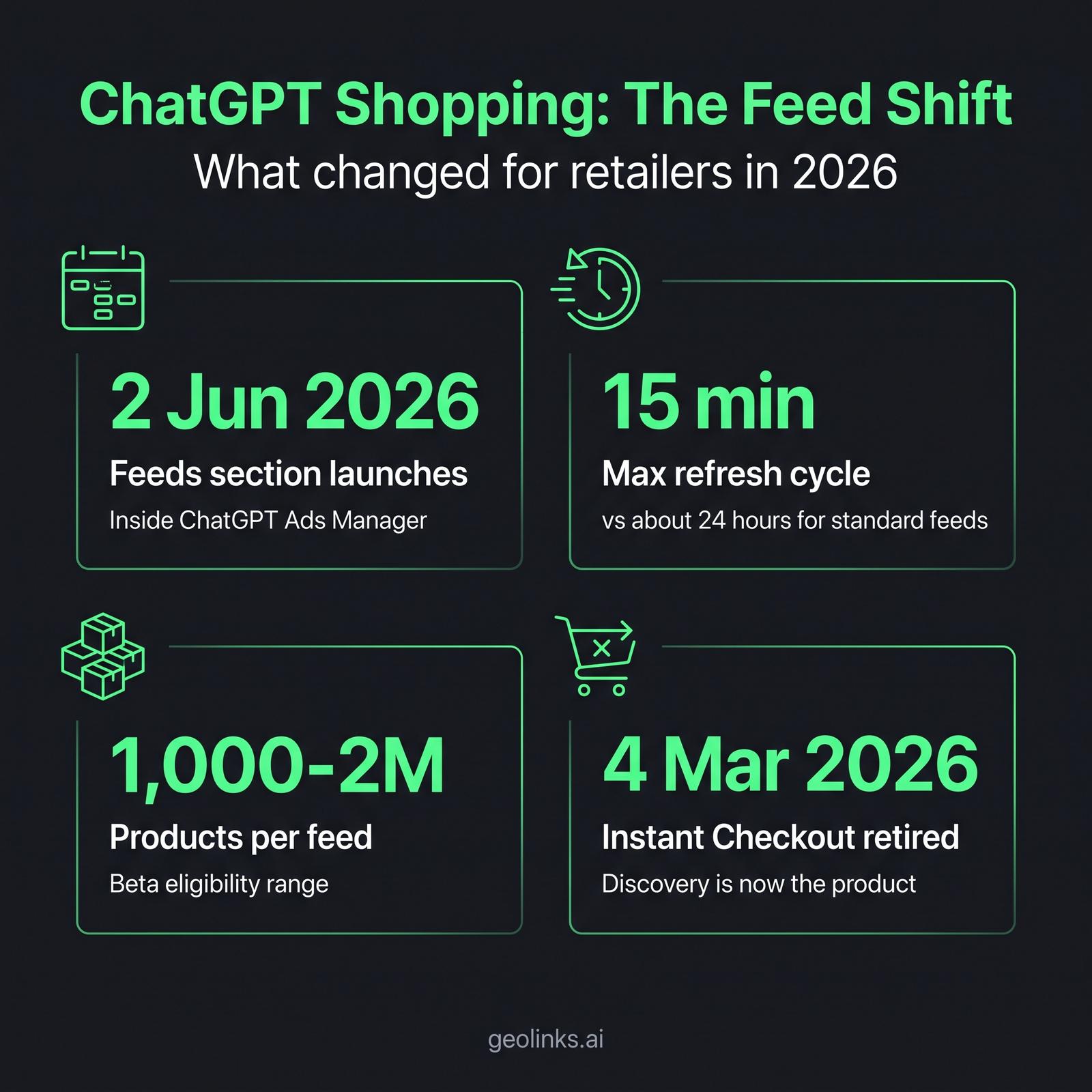
If you already run a Google Shopping feed, ChatGPT Shopping can now take the exact same file. OpenAI moved product feed management into a dedicated Feeds section inside Ads Manager on 2 June 2026, refreshed up to every 15 minutes. Most UK retailers have not connected it yet. Shopify and Etsy sellers already have organic discovery switched on with zero setup. The paid feed and the checkout OpenAI killed in March are two different things worth separating.
Key takeaways
- OpenAI’s Ads Manager gained a dedicated Feeds section (Feed Connection and Upload History tabs) on 2 June 2026.
- The feed accepts JSONL, CSV or TSV (all gzip-compressed) or Parquet with zstd compression, the same catalogue format you already send Google Shopping.
- Refresh cadence is up to every 15 minutes, against roughly 24 hours for a standard Google Shopping feed.
- Shopify and Etsy catalogues are already wired into organic ChatGPT Shopping discovery. No feed upload is required for that part.
- OpenAI retired Instant Checkout on 4 March 2026 after in-chat conversion trailed a normal click-through by roughly 3x. Discovery through feeds is now the durable product, not checkout.

Why this matters now, not six months ago
OpenAI launched Instant Checkout on 29 September 2025, letting Etsy shoppers buy inside ChatGPT via Stripe. It pulled the feature on 4 March 2026, five months later. Walmart measured in-chat checkout converting at roughly a third the rate of a normal click-through to its own site. Real-time inventory sync across thousands of merchants proved harder than the demo suggested, and only a handful of Shopify merchants ever went fully live.
OpenAI has not abandoned commerce. It moved the emphasis to discovery: surface and recommend products well, then send the shopper to buy on the retailer’s own site. The Feeds section inside Ads Manager, and the underlying product feed specification at developers.openai.com, is the infrastructure behind that pivot. A citation inside a shopping answer is now the prize. The checkout button was the distraction.
The two routes into ChatGPT’s shopping results
Retailers keep conflating two separate mechanisms. They use different setup paths and different data.
| Organic discovery | Ads Manager product feed | |
|---|---|---|
| Who qualifies | Any Shopify or Etsy seller | Any retailer, 1,000 to 2,000,000 products |
| Setup required | None, already integrated | Manual feed connection via SFTP |
| Cost | Free | Paid, sponsored placement |
| Refresh | Platform-managed, near real time | Up to every 15 minutes |
| Formats | Handled by Shopify/Etsy infrastructure | JSONL, CSV, TSV (gzip) or Parquet (zstd) |
| Result | Unsponsored shopping research results | Sponsored placements inside chat |
Both routes draw on the same underlying signal: clean, current product data. A retailer on neither platform, with a Google Shopping feed already built, has the raw material for the paid route sitting unused.
The setup, if you already run a Google Shopping feed
For a UK retailer outside Shopify and Etsy, this is the practical path.
- Confirm your existing feed meets the minimum fields. ChatGPT’s spec wants id, title, description, link, image_link, availability, price and brand on every row, the same core fields Google Shopping already requires.
- Check your product count. The beta needs 1,000 to 2,000,000 SKUs. Smaller catalogues are not eligible yet.
- Create the feed inside Ads Manager. OpenAI generates SFTP connection details once the feed is created; there is no manual upload portal.
- Push the file in a supported format. JSONL is the reference format with the fullest attribute coverage. CSV or TSV work for simpler catalogues. Parquet suits enterprise merchants with millions of rows.
- Automate the refresh. Point the same export job that feeds Google Shopping at the new SFTP endpoint. Run it on up to a 15-minute cycle so price and stock never drift between the two.
None of this touches your website. It reuses infrastructure most retailers already built for Google.

What changes beyond ChatGPT
Feed data is not a universal key. Each engine treats product recommendations differently, and a ChatGPT-only fix does not travel.
ChatGPT pulls directly from the merchant feed for both organic and sponsored results. It has no equivalent Instant Checkout replacement live yet. Claude has no comparable retailer feed product. It leans on cited third-party sources, reviews and comparison content instead of a submitted catalogue. Gemini draws on Google’s own Shopping Graph, so a Google Merchant Center feed already does most of the work there. Perplexity favours businesses with a visible presence across several sources rather than one feed submission. Microsoft Copilot inherits Bing Shopping’s own product feed system, a separate submission from either Google’s or OpenAI’s. Grok has no dedicated commerce feed and pulls from X activity and public web content instead. Google’s AI Mode and AI Overviews sit closest to the standard Google Shopping feed, since both draw from the same Merchant Center data.
The practical read: a Google Shopping feed and a ChatGPT feed cover two engines directly and Google AI Mode by extension. Claude, Perplexity and Grok still depend on the third-party citations and structured content that the rest of a GEO programme builds.
What we have seen work on ecommerce accounts we run
We do not sell ecommerce feed management as a standalone service. This launched in June, so we are not claiming to have connected a client’s catalogue to ChatGPT’s Ads Manager yet. What we can show is the underlying discipline. Clean, structured, current product and category data drives AI visibility, whether the destination is a Google feed, a citation, or a shopping answer. Our own Garden Ornaments case study took that site from 727 monthly organic visits in October 2025 to 6,370 by May 2026. That is a 776% lift in 7 months, without a paid feed involved. The mechanism was consistent product data, category structure and third-party citations, the same fundamentals a ChatGPT feed submission depends on.
Matt’s Pick: reuse the feed you already built, then fix the rest
If you already export a Google Shopping feed, connecting it to ChatGPT’s Ads Manager is a same-day task, not a project. Do that first. It is the cheapest visibility you will add this quarter. Then treat it as one input among several, because Claude, Perplexity and Grok are not reading that feed at all. Our niche edits service places contextual mentions on pages those engines already cite, which is the part a product feed cannot buy you. If you are checking where an ecommerce brand currently stands before spending on either, run the free AI Visibility Check first.
The wider context matters too. Sponsored feed placements sit just below an answer that is still organic, a distinction our piece on ChatGPT’s advertising rollout covers in full. Google’s own Generative AI report in Search Console is the free way to see whether any of this moves your own numbers. Both sit inside the wider UK GEO playbook we run for clients.
Frequently asked questions
Does ChatGPT Shopping use the same feed as Google Shopping?
Yes. The Ads Manager Feeds section accepts the same structured catalogue you already send Google Shopping.
What file formats does ChatGPT accept for product feeds?
JSONL, CSV and TSV, all gzip-compressed, plus Parquet with zstd compression, all UTF-8 encoded.
How often can I update my ChatGPT product feed?
Up to every 15 minutes, against roughly 24 hours for a typical Google Shopping feed refresh.
Do I need to do anything if I already sell on Shopify or Etsy?
No. Shopify and Etsy catalogues are already integrated for organic ChatGPT Shopping discovery.
Is ChatGPT Instant Checkout still live?
No. OpenAI retired Instant Checkout on 4 March 2026 after weak in-chat conversion rates.
How many products do I need for the ChatGPT Ads Manager feed?
Between 1,000 and 2,000,000 products during the current beta, per catalogue.
Does a ChatGPT product feed help with organic AI citations too?
Yes. Feed data also powers ChatGPT’s unsponsored shopping results, not just paid placements.
Related reading
- ChatGPT ads hit 2,000 brands: what happens to organic citations covers the sponsored side this feed connects to.
- Google’s Generative AI report in Search Console is the free way to check whether any of this is moving your own numbers.
- The UK GEO playbook covers the wider UK entity and citation picture this feed setup sits inside.
See the Garden Ornaments case study for the ecommerce numbers behind our method, or check current pricing for the services referenced above.