The UK GEO Playbook: How British Brands Get Cited by AI
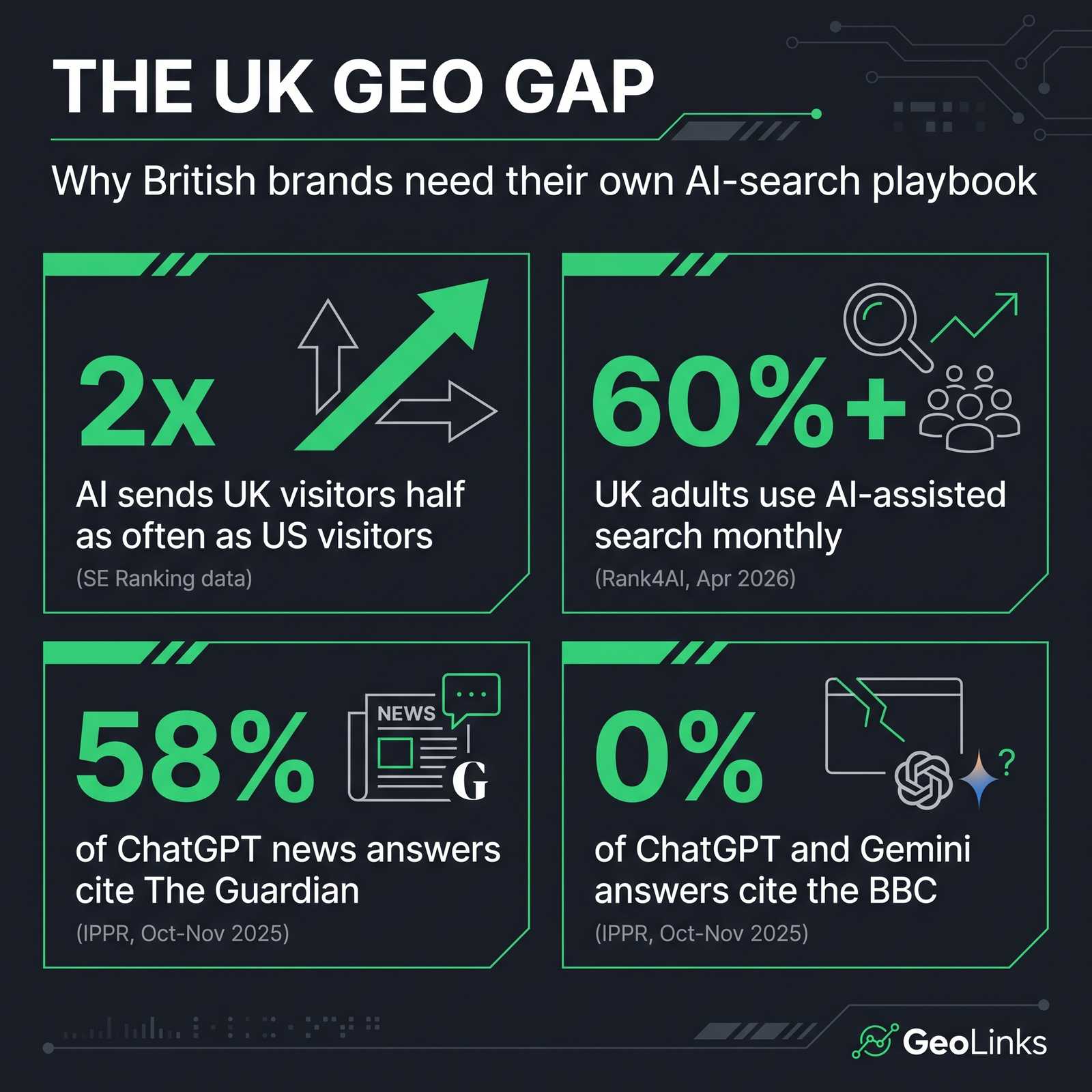
Most GEO advice is written for US brands. It assumes US citation sources, US spelling and US entity signals by default. AI is roughly twice as likely to send a visitor to a US site as a UK one. Over 60% of UK adults now use AI-assisted search monthly. This is the UK-specific playbook: which British publishers AI actually cites, and the entity signals that close the gap.
Key takeaways
- AI sends roughly twice as many visitors to US sites as UK sites (SE Ranking data).
- Over 60% of UK adults now use AI-assisted search monthly (Rank4AI, April 2026).
- The Guardian appears in 58% of ChatGPT news answers. The BBC appears in none (IPPR, Oct-Nov 2025).
- En-GB spelling and a matching Companies House number are entity signals AI systems can check.
- Blocking AI crawlers under UK GDPR is legal, but it removes you from AI answers entirely.

Why UK GEO needs its own playbook
Generic GEO advice defaults to American assumptions. It points to US publishers, US case studies and en-US spelling. That does not match how UK buyers search or how AI cites British sources.
AI is roughly twice as likely to send a visitor to a US site as a UK one. That is SE Ranking’s own referral-traffic data. Over 60% of UK adults now use AI-assisted search monthly, per Rank4AI’s Q2 2026 UK market report. It published on 24 April 2026. UK brands start from lower baseline visibility, against a fast-growing pool of UK searchers asking AI engines directly. Nobody has published a UK-only playbook that addresses both problems together.
Which UK publishers AI actually cites
IPPR analysed more than 2,500 links across 100 news queries. The queries ran on ChatGPT, Gemini, Perplexity and Google AI Overviews, in October and November 2025. The Guardian dominated, appearing as a source in 58% of ChatGPT responses. Reuters, the Independent and the Financial Times followed behind it. The Telegraph appeared in just 4% of answers.
The most striking result: the BBC, Britain’s most trusted news brand, was missing entirely from ChatGPT and Gemini answers.
| Publisher | Share of ChatGPT answers citing it |
|---|---|
| The Guardian | 58% |
| Telegraph | 4% |
| GB News | 3% |
| The Sun | 1% |
| Daily Mail | 0% |
| BBC | 0% (blocked from ChatGPT and Gemini) |
Source: IPPR, “AI’s Got News For You”, Oct-Nov 2025, 2,500+ links across 100 queries.
Licensing disputes and crawler access explain most of the gap. The Guardian holds a content deal with OpenAI. The BBC has restricted AI crawler access instead. Earning organic coverage in these outlets takes months. Our niche edits service places contextual mentions on already-cited UK pages faster, without waiting for a full feature.
How each AI engine treats UK sources
Coverage differs sharply by engine. ChatGPT and Gemini both skew towards the Guardian and away from the BBC, per the IPPR data above. Claude tends to favour long-form UK trade press and government sources such as GOV.UK and the ONS when citing statistics. Perplexity pulls more UK forum and community threads than the others, useful for consumer brands. Microsoft Copilot leans on Bing’s index, which still surfaces the BBC more often than ChatGPT does. Grok draws heavily on X posts, so a UK brand’s own X activity carries more weight there than elsewhere. Google’s AI Mode and AI Overviews sit closest to standard UK organic rankings, since both pull from the same index. No single fix covers every engine. Diversifying citation sources across publishers, forums and X is the strategy that actually works everywhere.
En-GB signals: spelling as an entity signal
American GEO guides never mention this. AI systems read your lang attribute and your spelling as consistency signals. They read those the same way they read a Companies House number or a LinkedIn profile. A site that mixes “optimization” and “optimisation” reads as inconsistent.
GeoLinks runs on lang="en-GB" sitewide, with British spelling throughout: optimisation, colour, aluminium. That consistency costs nothing beyond discipline. It is one of the few UK-specific entity signals a site owner can fix in an afternoon.
The fix: set lang="en-GB" in your HTML, pick British spelling, and hold it everywhere. That means page copy, meta descriptions, alt text and schema. Do not mix conventions across pages.

Companies House and professional-body signals
UK AI engines operate inside a market with an unusually strong institutional-citation culture. A genuine Companies House number is a trust signal AI systems can, in principle, check against a public register. A mismatched or fabricated one does more damage than leaving the field blank.
The number only helps when it matches everywhere: your site footer, LinkedIn page, directory listings and any press mentions. Professional-body memberships, such as the Law Society, ICAEW or RIBA, work the same way. Consistency across every surface is the actual signal, not the presence of any single credential.
ICO, UK GDPR and AI crawlers
The Information Commissioner’s Office ran a five-part consultation on generative AI. It covered how UK GDPR and the Data Protection Act 2018 apply. Its current position leans on “legitimate interests” as the lawful basis most AI developers use for training-data scraping. Developers must stay transparent about the purpose.
None of this changes our standing advice: leave robots.txt open to AI crawlers. UK GDPR governs personal data, not general crawler access. Blocking GPTBot or ClaudeBot removes a UK site from AI answers entirely, without meaningfully improving data protection. Crawler access and personal-data handling are separate questions, and buyers often conflate them.
What changed on our own UK portfolio site
We do not just advise this. Garden Ornaments is a UK e-commerce site in our own portfolio. It sat at 727 monthly organic visits in October 2025, after two quarters of decline. We rebuilt page-level content so AI engines and Google could extract clean answers, without adding a single new referring domain. By May 2026, UK organic traffic reached 6,370 visits a month. That is a 776% lift in seven months, per Ahrefs Site Explorer.
The fix was not more links. Referring domains fell slightly over the same period. The fix was content AI systems could actually cite: specific numbers, clear structure and entity signals matching across every page. Read the full Garden Ornaments case study for the month-by-month breakdown.
Matt’s Pick: three UK quick wins
Set lang="en-GB" sitewide and standardise spelling today. Match your Companies House number and professional-body credentials across your site, LinkedIn and directories this week. Pitch a mention into a Guardian, Reuters, Independent or FT piece before chasing a BBC placement. The BBC blocks AI crawlers, so a BBC mention will not earn an AI citation regardless of coverage quality.
Run the free AI Visibility Check to see which UK and US sources your brand already draws citations from.
Frequently asked questions
What is UK GEO and how is it different from US GEO?
UK GEO targets British publishers, en-GB spelling and UK entity signals instead of the US sources most GEO advice assumes.
Does ChatGPT cite the BBC?
No. IPPR found the BBC missing entirely from ChatGPT and Gemini answers, largely over licensing and crawler-access disputes.
Why does British spelling matter for AI citations?
Spelling and the lang attribute are entity signals. Mixed en-US and en-GB content reads as inconsistent to AI systems.
Does a Companies House number help AI trust my site?
Yes, when it matches your actual business and reads consistently across your site, LinkedIn and directories.
Can I block AI crawlers under UK GDPR?
You can, but blocking removes you from AI answers entirely. UK GDPR governs personal data, not crawler access itself.
How much more traffic does AI send to US sites than UK sites?
AI sends roughly twice as many visitors to US sites as UK sites, per SE Ranking data.
What is the fastest UK-specific GEO fix I can make today?
Set lang to en-GB sitewide and match your Companies House number across your site, LinkedIn and directory listings.
Related reading
- Best UK GEO agencies covers who else is competing for this exact positioning.
- Google’s Generative AI report in Search Console: the UK-only guide is the free UK-first measurement layer behind this playbook.
- UK searches for ‘ai visibility’ are up 8x shows the demand side of the same UK shift.
See our current pricing for the UK-focused packages behind this playbook.