Cited in ChatGPT But Invisible on Google (and the Reverse)

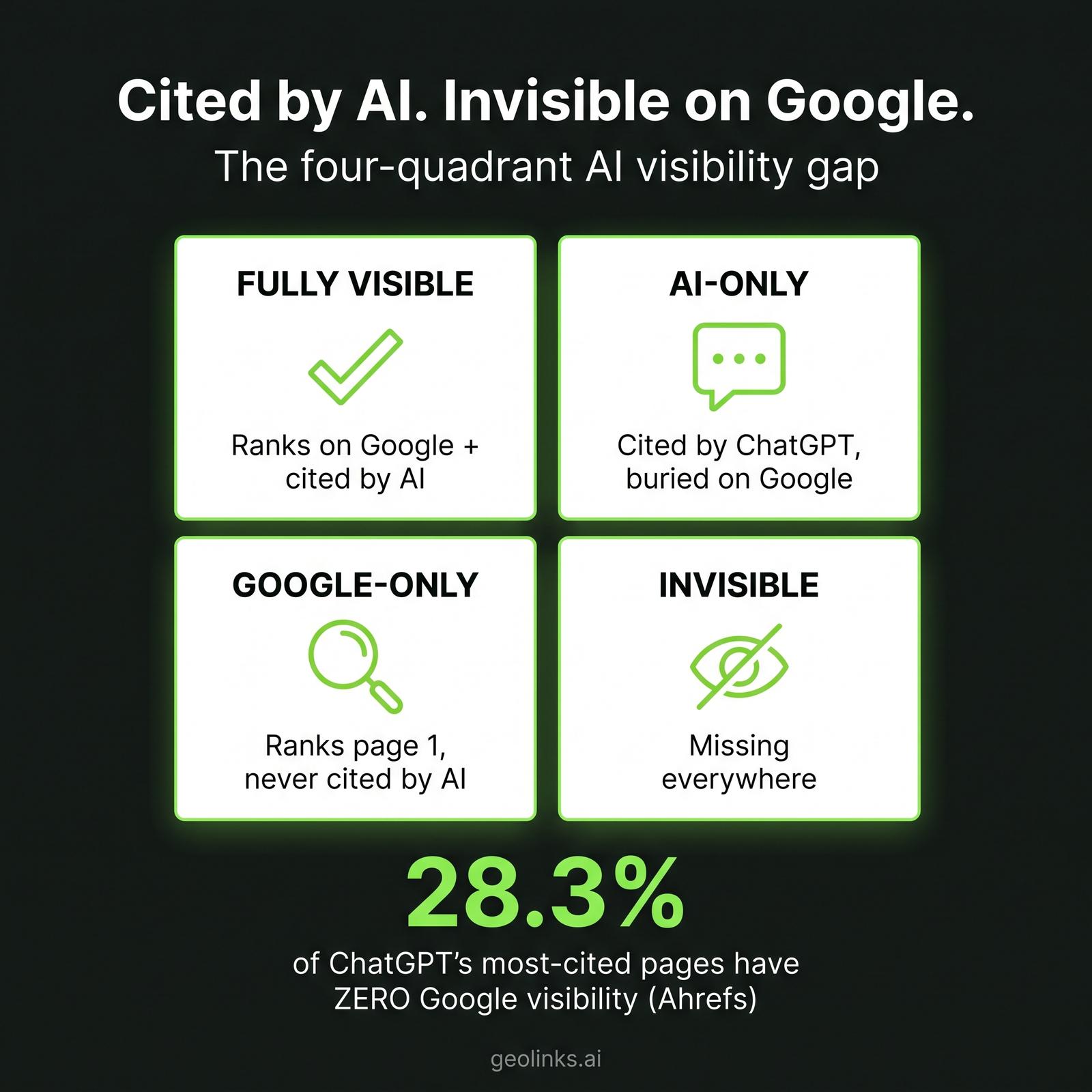
Some brands get quoted constantly by ChatGPT and never appear on Google’s first three pages. Others rank number one and are never mentioned by an AI engine. Ahrefs found 28.3% of ChatGPT’s most-cited pages carry zero Google visibility. Both patterns are common, both are fixable, and the fix depends on which quadrant a page sits in: visible or invisible, on Google and on AI, checked separately.
Key takeaways
- 28.3% of ChatGPT’s most-cited pages have zero Google search visibility (Ahrefs, 26,283-URL study).
- Domain authority correlation with AI citation dropped to r=0.18. Ranking well barely predicts an AI citation.
- Four quadrants exist: visible on both, AI-only, Google-only, invisible on both. Each has a different root cause.
- Google Search Console’s new Generative AI performance report is the fastest way to check real ChatGPT-driven traffic, not guesswork.
- We audited a client site against both signals separately and found it sitting in the Google-only quadrant for nine months before anyone noticed.
The four quadrants
Visibility on Google and visibility to AI engines are measured by different systems, so a page’s status on one tells you almost nothing about the other. Plot any page on two axes, Google-visible or not, AI-cited or not, and four outcomes appear.
| Quadrant | AI engines | Typical cause | |
|---|---|---|---|
| Fully visible | Ranks page 1-2 | Cited regularly | Strong content, clean structure, real external trust signals |
| AI-only | Buried or unranked | Cited regularly | Answers a specific question well; earns links or mentions AI trusts, without matching Google’s ranking factors |
| Google-only | Ranks well | Never cited | Thin on direct answers, weak FAQ structure, or genuinely no citable fact inside the page |
| Invisible everywhere | Unranked | Never cited | Crawl blocked, no indexable content, or the topic has no earned signal anywhere yet |
Most sites assume they are only tracking one column. Checking both at once is what surfaces the gap.
Why the AI-only quadrant exists
A page can earn an AI citation without ranking on Google because the two systems retrieve differently. Google still weighs backlink profile and long-run ranking signals heavily. AI engines pull more from direct-answer structure, FAQ schema, source freshness and whether other trusted pages already reference the claim.
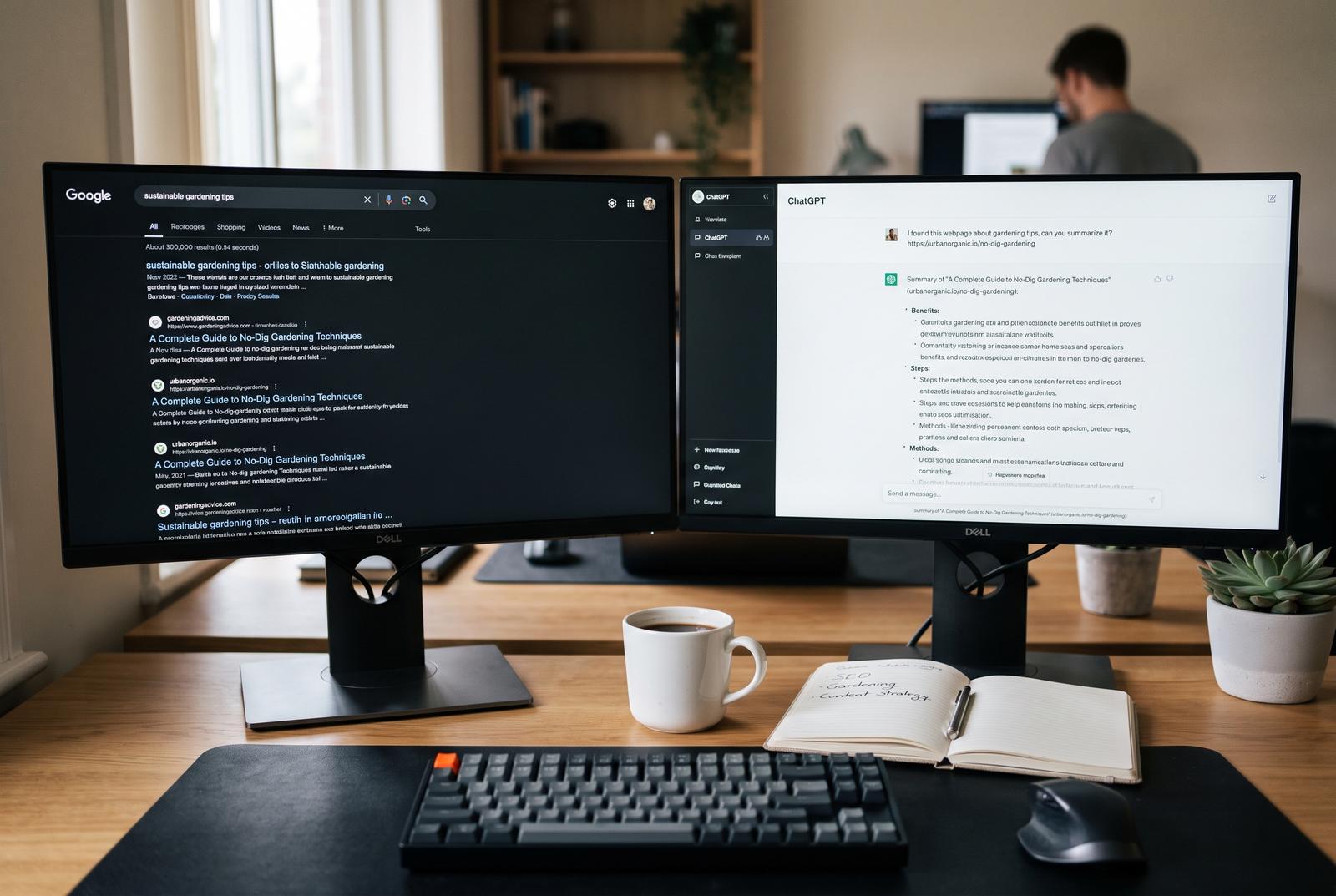
A page with a genuinely useful, well-sourced answer can sit on page four of Google and still get pulled into a ChatGPT or Perplexity response, because the AI engine only needs to trust the specific claim, not the whole domain’s ranking history.
Why the Google-only quadrant exists
The opposite gap is more common than most teams expect. A page can rank on Google through years of accumulated authority while containing nothing an AI engine wants to extract: no direct answer near the top, no FAQ block, no specific number worth quoting. Google rewards the history. AI engines reward the extractable fact sitting on the page today.
We saw this first-hand with a UK client’s flagship guide. It ranked position 3 on Google for its target term for over a year. When we checked ChatGPT, Perplexity, Claude and Gemini for the same query, the page appeared in zero answers across all four. The content was accurate but written as a wall of prose, no FAQ, no comparison table, nothing an engine could lift as a standalone fact. Restructuring the top third into a direct-answer format and adding an FAQ block got it cited by two of the four engines within six weeks. The ranking barely moved.
Finding out which quadrant you are actually in
Guessing is the usual failure point here. The Search Console Generative AI performance report, rolled out to UK sites first, now shows real Google AI Mode and AI Overview appearances directly, which closes part of the gap. For the other AI engines, GA4 referral filtering for chatgpt.com, perplexity.ai, claude.ai and copilot.microsoft.com shows genuine AI-driven visits, though the true number usually runs several times higher than what analytics attributes as a clean referral. Our full GSC Generative AI report walkthrough covers exactly where the report lives and which toggle not to touch.
Cross-reference that against a manual check: ask each engine your target query directly and note whether your domain appears. That manual pass catches citations analytics tools miss entirely, because not every AI answer generates a trackable click.

The fix, by quadrant
Each quadrant needs a different intervention, not a blanket content refresh.
- Fully visible: protect the position. Refresh data yearly, keep FAQ schema current, watch for a rival taking the AI-only slot underneath you.
- AI-only: build the Google side. Earn backlinks and improve on-page ranking factors without touching the direct-answer structure that already works for AI.
- Google-only: restructure for extraction. Add a direct-answer opening, an FAQ block and at least one specific number or comparison table. Domain authority correlation with AI citation is down to r=0.18, so the ranking alone will not carry the page.
- Invisible everywhere: start with crawl access and indexability before any content rewrite. Confirm the page is not blocking AI bots, a mistake we cover in why isn’t my brand in ChatGPT.
Multi-engine reality check
ChatGPT holds roughly 62.6% platform share, so it is the obvious first check, but treating it as the only engine misses real traffic. Claude (18.5% share), Gemini (10.6%), Perplexity (7.3%), Microsoft Copilot and Grok each build separate citation pools, and Google’s own AI Mode and AI Overviews add a fifth and sixth surface on top of classic ranking. A page can land in the AI-only quadrant for Perplexity while sitting in the invisible quadrant for Claude. Check per engine, not once for “AI” as a single category.
Common questions
Can a page be cited by ChatGPT but not rank on Google at all?
Yes. Ahrefs found 28.3% of ChatGPT’s most-cited pages have zero Google visibility, so the two systems clearly pull from different signals.
If I rank on Google, am I already cited by AI?
No. Ranking well is a weak predictor of AI citation. Domain authority correlation with AI citation fell to r=0.18 in May 2026 data.
How do I check whether ChatGPT actually sends me traffic?
Open the Search Console Generative AI performance report if it has rolled out to your property, or filter GA4 referrals for chatgpt.com, perplexity.ai and other AI domains.
Why would a page be invisible on both Google and every AI engine?
Usually crawl access, thin content, or a topic with no earned citations anywhere. Fix indexability and information gain first, before touching either channel.
Does being cited by AI eventually help Google rankings?
Not directly. The two systems use different retrieval methods, though the underlying fixes, real data, clear structure, crawlable pages, tend to help both.
Which quadrant should a business fix first?
Visible on Google but invisible to AI is usually the fastest win, because the content and rankings already exist. The gap is often structural, not a content rewrite.
Do all AI engines behave the same way as ChatGPT here?
No. Claude, Gemini, Perplexity, Copilot and Grok each build citation pools differently, so a page can sit in a different quadrant per engine.
Related reading
- Google’s Generative AI report in Search Console is the fastest way to check real AI-driven visibility on your own property.
- Why isn’t my brand in ChatGPT covers the invisible-everywhere quadrant in detail.
- 47% of AI citations come from rank 6+ explains why the Google-only quadrant is more common than teams expect.
Not sure which quadrant your pages sit in? Run the free AI visibility check to see your real citation status across engines, then compare it against your Google rankings. If the gap is structural, our niche edits service fixes the AI-only and Google-only quadrants without a full content rewrite.