47% of AI Citations Come From Rank 6+. Why DA Stopped Mattering
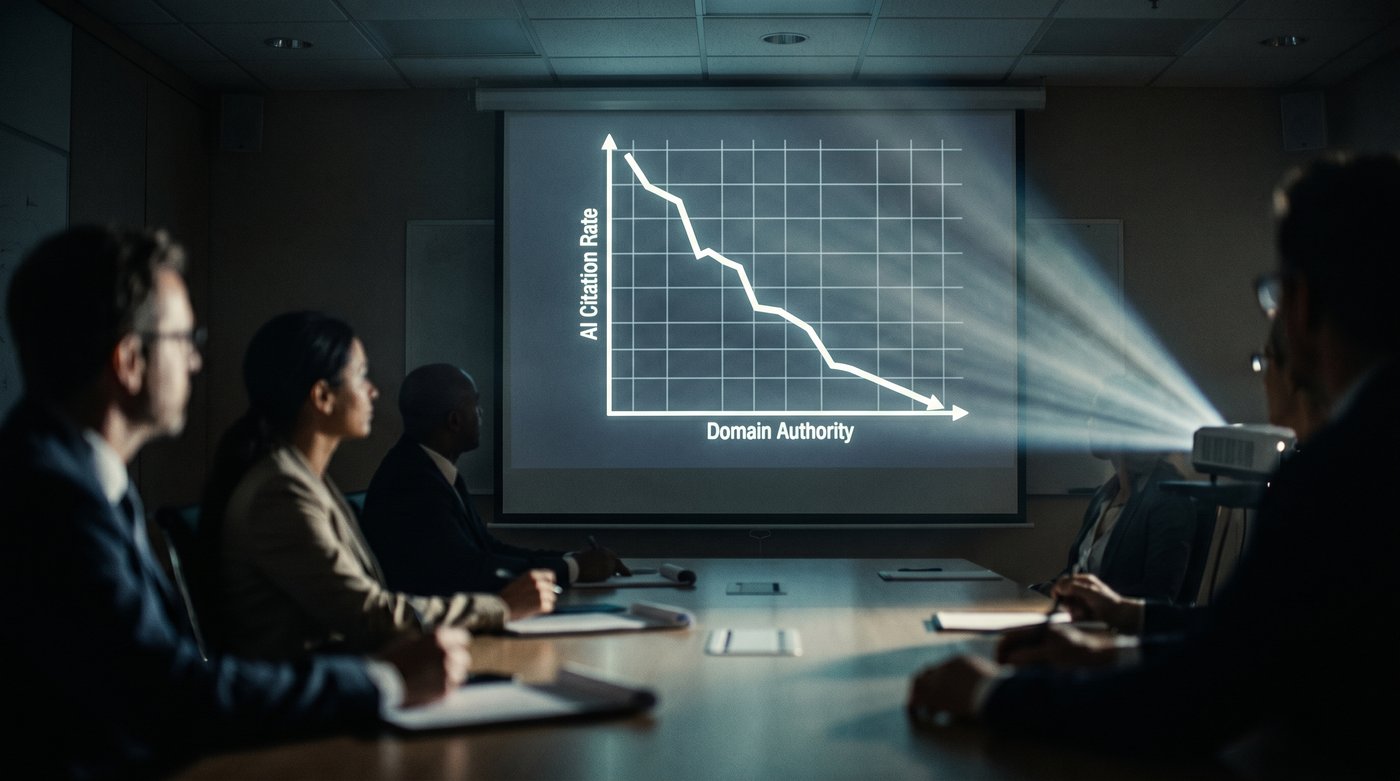
May 2026 research puts domain authority’s correlation with AI citation rate at r=0.18, down from r=0.74 in 2024. At r=0.18, DA explains just 3% of the variance in citation outcomes. More telling: 47% of all AI citations go to pages ranked outside the top 5 in classic search. Content structure, freshness, and FAQ schema now determine citation rank far more than link count. The implications for any site with below-average authority are worth reading carefully.
The old SEO playbook built everything around domain authority
For most of the past decade, DA was the single most reliable predictor of search performance. The logic felt clean.
Pages on high-DA domains ranked higher. Pages that ranked higher got clicked. Getting clicked reinforced the ranking signal. The feedback loop rewarded whoever had the most existing authority.
A site with DR 60 and 500 referring domains entering 2020 was nearly impossible to displace on competitive queries. A well-written competitor on a fresh domain could not close the gap without years of link acquisition. Even excellent content produced on a low-authority site sat buried below page two.
Link-building agencies built their entire value proposition around this dynamic. Grow DA to rank. Rank to earn traffic. Pay monthly, wait long, compound slowly. The path was expensive and back-loaded, but the direction was clear.
That model worked well for a world where ten blue links decided everything. The AI citation layer does not use the same rulebook. It does not consult the organic rank order. It retrieves the most extractable answer from the full indexed corpus. And the page that provides that answer wins, regardless of where it sits in traditional search.
What the May 2026 data actually shows
Research published in May 2026 measured the correlation between a range of page-level signals and AI citation rate. The study covered ChatGPT, Perplexity, Google AI Overviews, and Claude. Domain authority produced r=0.18.
In practical terms, r=0.18 means DA accounts for roughly 3% of the variance in whether a page gets cited. That figure is weak enough to treat as noise for most decisions.
The signals that replaced DA at the top of the table are different in kind, not just degree. They are not about who links to you. They are about how a machine reads your page when trying to extract a citable answer.
The four strongest signals by r-value:
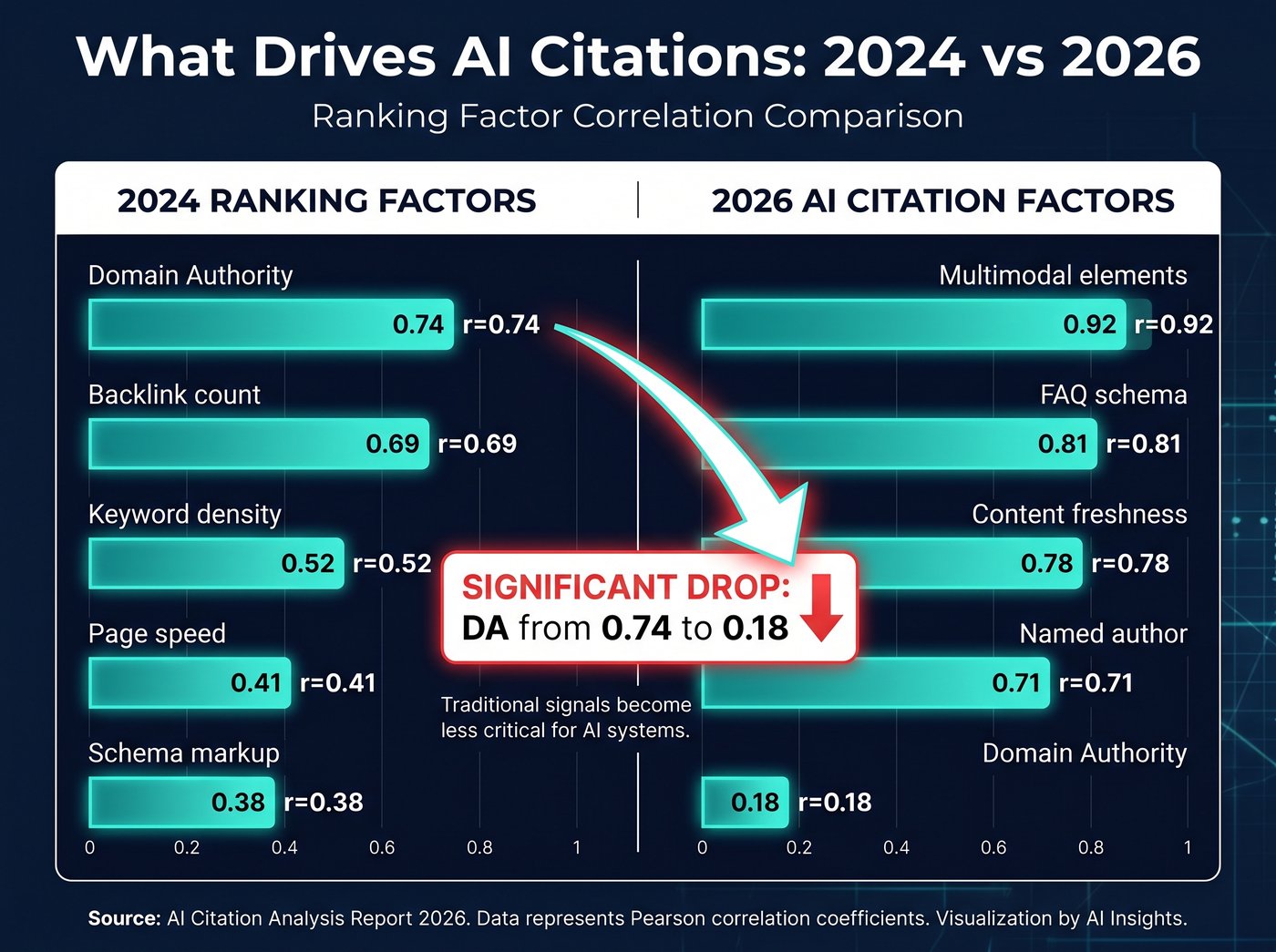
- Multimodal elements (images, charts, embedded tables): r=0.92
- FAQ schema with structured question-and-answer pairs: r=0.81
- Content freshness, specifically pages updated in the last 30 days: r=0.78
- Named-author bylines with linked bios: r=0.71
All four are on-page, editorial, and entirely within a site owner’s control. None of them require a single external link.
The shift is not subtle. The strongest signal in 2024 was domain authority at r=0.74. In 2026 it sits at r=0.18, below every content-structure factor in the table. The AI citation layer has its own ranking model, and link authority is close to the bottom of it.
Why 47% of AI citations skip the top 5
The under-position-5 finding is the most commercially useful part of the May 2026 data. AI engines do not re-rank search results. They retrieve answers from the indexed corpus, using their own relevance model.
When an AI Overview or a ChatGPT response builds an answer, it scans indexed content for extractable passages. These include a clear factual statement, a labelled comparison table, a numbered list, or a structured FAQ answer. The page with the clearest, most extractable passage wins the citation, regardless of its organic position.
A page at position 8 with a well-formed FAQ block, a multimodal image, a named author, and a “last updated” date within 30 days will outperform a position 2 page that is text-only and has not been refreshed in 18 months.
That is not a rare edge case. It explains the 47% figure directly. AI retrieval reads page structure. Organic rank is a filter that determines whether a page is in the retrievable pool at all. Beyond that threshold, structure decides the outcome.
The practical consequence: two sites competing for the same query are now running on two different tracks. Site A invests in link acquisition and DA growth. Site B invests in structured content, schema, and freshness. In classic search, Site A wins. In the AI citation layer, Site B wins within weeks.
2024 ranking factors vs 2026 AI citation factors
| Signal | 2024 correlation (organic rank) | 2026 correlation (AI citation) |
|---|---|---|
| Multimodal elements (images, tables, charts) | r=0.38 | r=0.92 |
| FAQ schema | r=0.41 | r=0.81 |
| Content freshness (updated in 30 days) | r=0.44 | r=0.78 |
| Named author with linked bio | r=0.35 | r=0.71 |
| Topical cluster coherence | r=0.52 | r=0.69 |
| Domain authority | r=0.74 | r=0.18 |
| Raw backlink count | r=0.69 | r=0.21 |
The DA and backlink rows are the story. Both fell from the top of the table to the bottom. Every content-structure signal moved in the opposite direction. In 2024 they were secondary. In 2026 they are the primary determinants of citation rank.
What this means for under-authority sites
The 47% finding changes the investment case for sites starting from a low authority base. If DA were still the primary driver, a site with DR 20 would need years and significant link spend before competing on any meaningful query. The path was long and back-loaded.
Under the 2026 model, a DR 20 site with structured content, a named author, and a regular update cadence can earn AI citations within 30 to 90 days of publishing. The barrier to entry is editorial quality, not link equity.
We have measured this directly. On the Garden UK project, we started from DR 0 with zero referring domains and zero ranking keywords. The strategy focused on structured content, topical cluster coherence, and named-author attribution rather than link volume. The site reached DR 15, 149 referring domains, and 10 ranking keywords in 30 days.
On the Garden Ornaments project, monthly organic visits climbed from 727 to 6,370 in seven months. The link profile barely moved across that period. Not a single net new referring domain was acquired. The growth came from content structure, schema implementation, and freshness cadence.
Both results were not possible under the old DA-first logic. Both are repeatable under the 2026 citation model. The mechanism is not mysterious: structured, dated, multimodal content gets extracted by AI engines. Unstructured, undated, text-only content does not. Authority is the gate, not the rank.
The new authority model: trust without rank
Links are not irrelevant. They serve different functions now, and it is worth being precise about which ones.
DA still matters for three things. First, crawl trust: high-DA domains get re-indexed faster after content updates, which directly affects freshness scoring. Second, baseline organic ranking: the AI citation pool is drawn from indexed pages, and pages that do not rank at all are not in the pool to begin with. Third, E-E-A-T weighting on queries where expertise and reputation are part of the relevance model.
What DA no longer does is predict which page inside the retrieval pool gets cited. That decision happens at retrieval time, based on extractability, structure, and freshness.
The mental model to replace “build DA to rank” is “build structure to be cited”. The two workflows look different in practice.
Growing DA means acquiring external links, expanding referring domains, and waiting months for the signal to propagate through Google’s graph. It is expensive and slow.
Building citation structure means adding FAQ schema to every key page, publishing under a named expert author, keeping content updated on a 30 to 90 day cycle, and adding at least one comparison table per article. The same work can be done in a week on any page on any site with no link budget at all.
The right approach is both, in the right order. Build the structural foundation first: it produces citation lift in weeks. Then build authority on top of it. Authority compounds the gains into a defensible position over months and years.
For sites starting from a low base, contextual niche-edit placements on topically relevant pages are a faster authority signal than broad guest-post campaigns. The topical alignment adds citation context alongside link equity, which produces lift in the AI retrieval layer and classic search simultaneously rather than only one.
Run a structural audit on your priority pages
The data points to a seven-step checklist. Apply it to every page targeting a commercial or informational query.
- Does the page open with a 50 to 75 word extractable answer below the H1? If not, add one today.
- Does the page carry FAQ schema with at least five questions? Each first sentence must be under 15 words and must not open with a hyperlink.
- Is there at least one comparison table on the page? Tables are the highest-weighted element in the 2026 multimodal data.
- Is the page attributed to a named author with a linked bio? Anonymous content is filtered out at the retrieval stage.
- Was the page updated within the last 30 days? If not, refresh the statistics, update the byline date, and add at least one new section.
- Does the page include at least one in-content image or infographic in addition to the hero? A hero image alone is not enough to hit the multimodal correlation score.
- Does the page link to at least three topically related pieces on the same site? Cluster coherence is the strongest remaining proxy for domain-level authority in the AI citation model.
All seven true means the page is structurally ready for citation. DA determines whether it is in the retrievable pool. Structure determines whether it gets cited once it is there.
Before running any link-building campaign, it is worth completing a backlink audit first. Identify which existing pages are already in the AI retrieval pool and could be amplified with targeted link support, versus which are not indexed or not extractable at all. Spending on links for pages that fail the structural audit is money spent on the wrong constraint.
Related reading
The 2026 citation model is not a single data point. It is a shift visible across every AI engine simultaneously. How to get cited by ChatGPT in 2026: the 9-point playbook covers the nine specific levers, ranked by effort against impact, with the Bing retrieval layer explained.
On multimodal content specifically, multimodal content has a 92% correlation with AI Overview selection goes deeper on each element type, what counts, and the exact schema markup for each.
The structural change behind this shift started on 19 May 2026. Google I/O 2026: what the search overhaul means for GEO explains what changed architecturally inside the search stack, and why the AI citation layer now operates independently of the organic rank order.
To check where your own pages stand on the 2026 factors, the free AI Visibility Check scans five AI engines in under five minutes and identifies which pages are structurally ready to be cited and which are not. No credit card required.