Why Isn't My Brand in ChatGPT? 7 Real Reasons

If buyers ask ChatGPT for a recommendation and your brand never appears, the cause is usually fixable in an afternoon. The single most common culprit is technical: your own website blocks the crawlers that feed AI answers. This guide lists seven real reasons a brand stays invisible across ChatGPT, Claude, Gemini and Perplexity, ordered by how often we find each one, with a one-hour check and fix for every reason.
Reason 1: You Are Blocking the Bot That Would Cite You
The most frequent reason a brand is absent from ChatGPT is that the site refuses the crawler. If the bot cannot read your pages, no engine can quote them. We find this on roughly one site in three when we audit, and it is almost always accidental.
Two settings cause it. The first is robots.txt with a Disallow line naming an AI bot, or a blanket User-agent: * rule. The second is a CDN toggle. Cloudflare ships a Block AI Bots control that is on by default for many plans, so the block exists even when robots.txt looks clean.
Each engine sends its own crawler, so allowing one does nothing for the others. The table below lists the user-agents that matter and what blocking each one costs you.
| Engine | Crawler user-agent | What it powers | Cost if blocked |
|---|---|---|---|
| ChatGPT | GPTBot, OAI-SearchBot | Training plus live browsing answers | Invisible in the largest AI audience |
| Claude | ClaudeBot, anthropic-ai | Claude answers and citations | No Claude citations |
| Perplexity | PerplexityBot | Live retrieval answers | Missing from the fastest citer |
| Gemini / AI Overviews | Google-Extended | Gemini and AI Overview sourcing | Out of Google’s AI surfaces |
The one-hour fix: open yoursite.com/robots.txt, remove any Disallow aimed at those agents, then check your CDN and switch off the AI-bot block. The bots overtook human visitors on many sites this year, so crawler access is the new front door. Get this wrong and the other six reasons do not matter.

Reason 2: No Third Party Vouches for You
AI engines rarely cite a brand on its own say-so. They corroborate. If your brand appears nowhere except your own website, the model has nothing to confirm you exist as a real, trusted option. Self-published claims carry almost no weight in a generated answer.
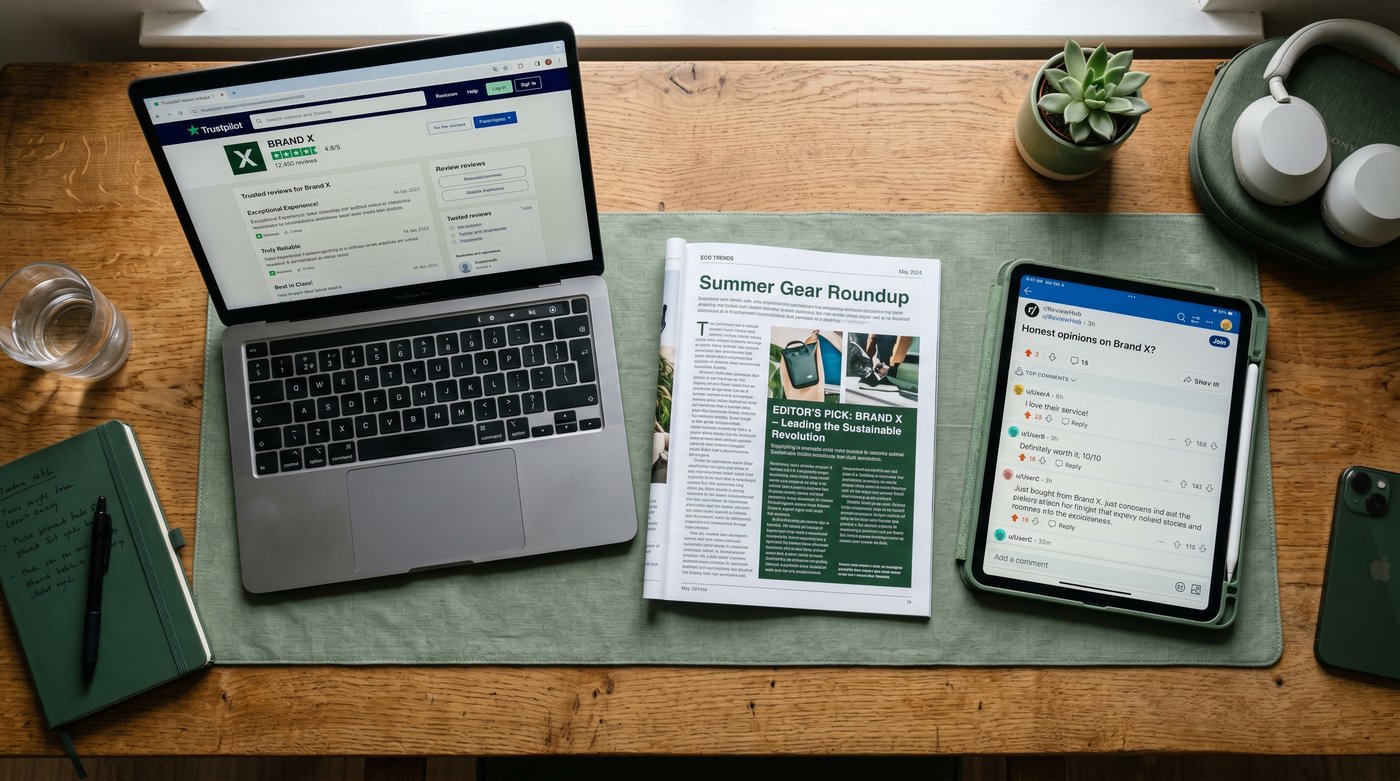
This is why a thin brand with a perfect website still loses to a scrappy competitor with reviews. The competitor is mentioned on Trustpilot, in a Reddit thread, on a roundup page, so the engine sees agreement across sources. Review presence alone can lift citation rates sharply, as our Trustpilot and G2 analysis shows.
The one-hour check: run your three most important buying prompts in each engine and read the sources cited. If they are all third-party pages and none mention you, corroboration is your gap. The fix is earned mentions on the sites those answers already pull from.
Reason 3: Your Entity Is Ambiguous
If an engine cannot work out exactly who you are, it will not risk citing you. Brands with inconsistent names, no clear category and no structured identity get filtered out. The model needs a confident entity match before it puts your name in an answer.
Three things blur an entity. Inconsistent naming across the web, for example “Acme”, “Acme Ltd” and “Acme Group” used interchangeably. Missing presence on the references engines lean on, such as Wikidata, Crunchbase or a relevant industry directory. And no Organization schema with sameAs links tying your profiles together.
The one-hour check: search your brand name in each engine and ask “what is [brand] and what do they sell”. A vague or wrong answer means your entity is unclear. Schema is one input here, though not a silver bullet, as our schema and AI citations data sets out.
Reason 4: Your Pages Answer Nothing Directly
AI engines lift sentences. If no sentence on your page cleanly answers the question being asked, there is nothing to quote, so you are skipped even when you rank. Marketing prose that circles a topic without stating an answer is invisible to extraction.
Look at how an engine builds a reply. It finds pages on the topic, then pulls the clearest direct statement it can find. A page that opens a section with the answer in plain words wins the citation. A page that opens with a hook and buries the answer in paragraph four does not.
The one-hour check: read your key pages and ask whether the first sentence under each heading answers a real question. The fix is the format, not more words. Lead with the answer, then explain. The 9-point ChatGPT citation playbook covers the extractable structure in detail.

Reason 5: You Optimised for One Engine
Brands that chase ChatGPT alone miss most of the AI audience. The engines retrieve differently and trust different sources, so a presence in one does not carry to the others. Treating “AI search” as a synonym for ChatGPT is a common and costly mistake.
The split is real. ChatGPT leans on Wikipedia and Reddit. Perplexity skews to Reddit and forum threads. Gemini and AI Overviews favour sites already strong in classic Google rankings. Claude weights established, editorial sources. A link strategy aimed only at ChatGPT’s preferred sources leaves the rest of the field open.
The one-hour check: run the same five prompts across all four engines and note where you appear and where you do not. A strong ChatGPT showing with zero Perplexity citations is the classic single-engine footprint. The case for spreading the work sits in why you should stop optimising only for ChatGPT.
Reason 6: Your Domain Is Too New or Too Thin
A young domain with little content and few links has not earned enough trust to be cited yet. Engines lean toward sources with a track record. This reason is real, but it is also the most overused excuse, often hiding one of the five above.
Age helps, but it is not a hard gate. A new domain can earn citations fast with the right foundations. Our own Garden UK project went from a Domain Rating of 0 to 15, grew referring domains from 27 to 149, and earned ten ranking keywords inside 30 days. It started showing in AI answers well before it looked like an old, authoritative site.
The one-hour check: be honest about your starting point, then rule out reasons 1 to 5 first. If the bot is allowed, the entity is clear, the content answers questions and third parties mention you, age stops being the blocker. The Garden UK case study shows the timeline from cold.
Reason 7: You Show Up for Your Name, Not Your Category
Many brands are cited fine for their own name yet vanish the moment the prompt is about the category. Branded recall is easy. Category authority is the prize, because category prompts are where buyers who do not yet know you make a shortlist. This gap is the most underserved of the seven.
The mechanism is simple. For a branded prompt the entity match is obvious, so the engine pulls your own pages. For a non-branded prompt it cites the sources it trusts most on that topic, which are usually third-party. If you only ever optimised your own site, you own the easy prompts and lose the valuable ones.
The one-hour check: compare a branded prompt with a category prompt in each engine. Present for the first and absent for the second is the signal. Closing it means earning citations on the trusted third-party pages those category answers already use. Our work took Garden Ornaments from 727 to 6,370 monthly organic visits in seven months, a 776% rise, by moving it into category answers, not just brand ones. The Garden Ornaments case study has the full figures.
Run the One-Hour Diagnosis
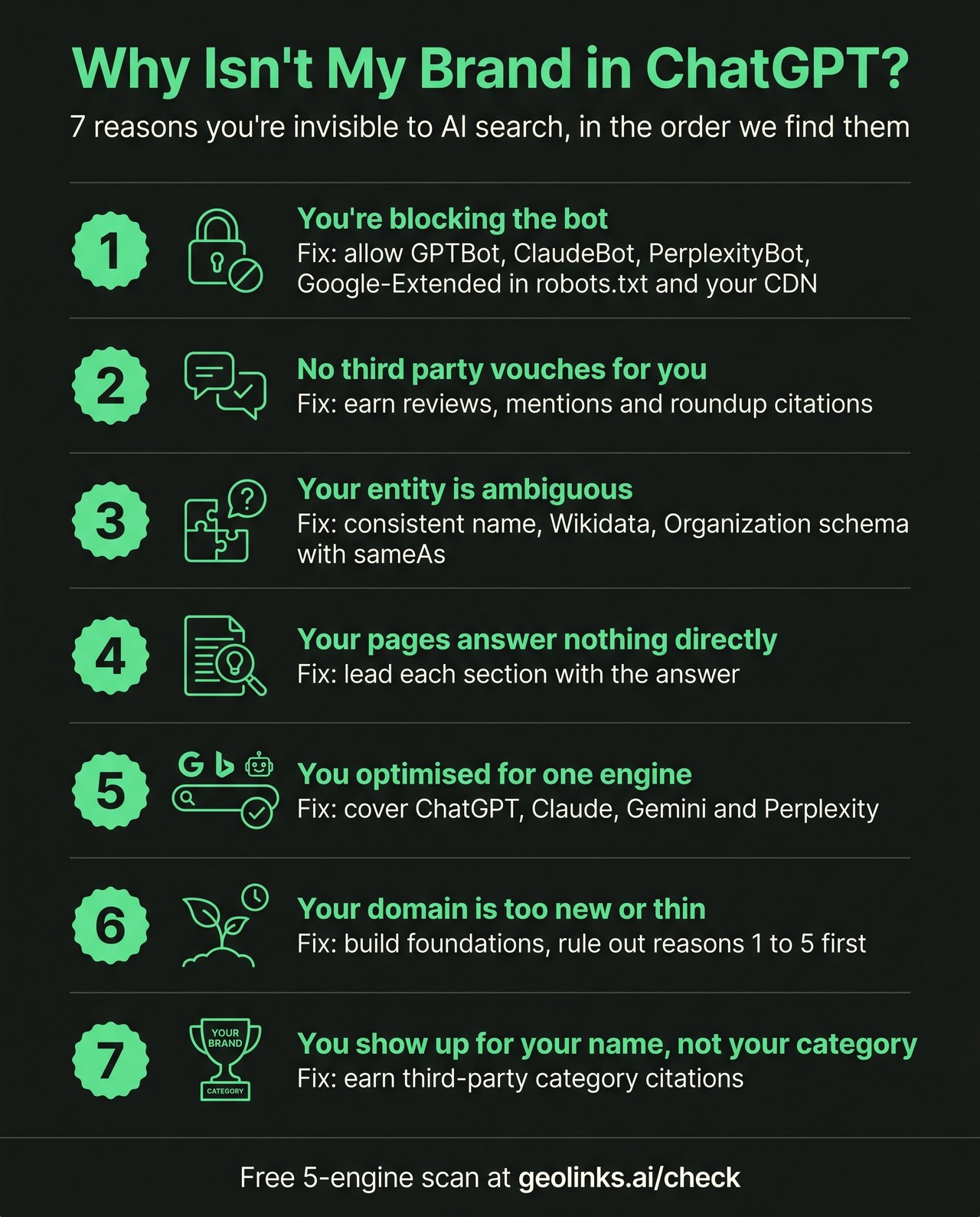
Work the list in order. Open your robots.txt and CDN settings first, because a blocked crawler makes everything below it pointless. Then run your priority prompts across ChatGPT, Claude, Gemini and Perplexity and note exactly where your brand is present and where it is not.
When we audited a UK retailer this spring, the entire problem was reason 1: a default Cloudflare setting was blocking every AI bot. We switched it off, and the first Perplexity citations appeared within the fortnight, before any new content or links. Not every case is that clean, but the technical check is always worth running before you spend a penny on content.
Measurement turns this from guesswork into a plan. The five numbers worth tracking, and how to baseline them, sit in our guide to measuring AI citations. Diagnose first, then fix in priority order.
Where to Start
The fastest way to find your reason is to scan all five engines at once. The free AI Visibility Check measures where your brand is cited across ChatGPT, Perplexity, Gemini, Claude and AI Overviews in under five minutes, and it flags a crawler block straight away. Run it first at /check/.
If the scan shows a gap that content alone will not close, our managed authority programmes handle the corroboration and category work behind reasons 2, 5 and 7. Pricing is published, and managed work begins with a three-month commitment. Most visibility problems start with reason 1, which you can fix yourself today.