Copilot Deep Citations: Your Headings Are the Citation Unit

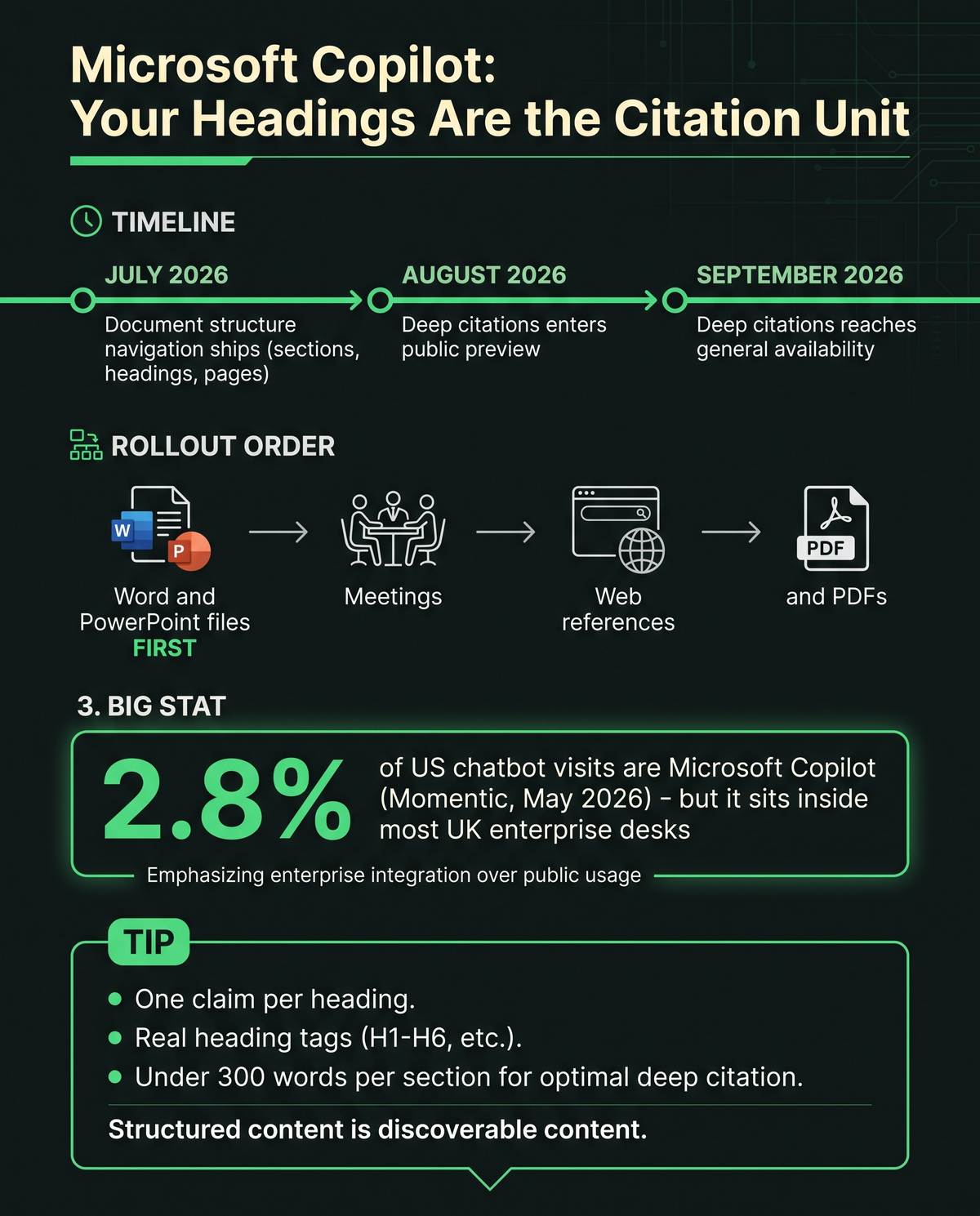
Microsoft 365 Copilot now links its answers to the exact section of a document, not just the document itself. A July 2026 update taught Copilot to navigate files by their sections, headings and pages before answering. An August 2026 feature called deep citations then jumps straight to that part of the source. For B2B content that lands in a buyer’s Microsoft 365 tenant, heading structure is no longer a formatting choice. It is the unit Copilot cites from.
Key takeaways
- A July 2026 Microsoft 365 update (Roadmap ID 559614) lets Copilot parse a document’s sections, headings and pages before generating an answer.
- Deep citations (Roadmap ID 523223) enters public preview in August 2026 and reaches general availability in September 2026, per Microsoft’s own roadmap.
- Rollout order matters: deep citations starts with Word and PowerPoint files, then adds meetings, web references and PDFs.
- Copilot grounds mainly in a tenant’s own Microsoft Graph data: Office files, email, SharePoint and Teams. Web references are a fallback, not the default.
- Microsoft Copilot holds only 2.8% of US chatbot visit share (Momentic, May 2026). It still sits inside most UK enterprise desks, through the Microsoft 365 seat.
- SharePoint AI citation analytics rolls out in August 2026 too. It lets a content owner see how often Copilot actually references their pages and files.
Two updates, not one
Two separate Microsoft 365 Copilot changes are behind the “headings are the citation unit” shift, and they shipped on different timelines. Keeping them apart matters for planning.
The first is document structure navigation, Roadmap ID 559614, announced in July 2026. It lets Copilot read a file’s internal organisation, its sections, headings and pages, before it starts building an answer. Copilot uses that map to jump to the most relevant part of a long file instead of skimming the whole thing, which produces sharper answers and a citation that points somewhere specific.
The second is deep citations itself, Roadmap ID 523223. It entered public preview in August 2026 and Microsoft’s roadmap targets general availability for September 2026. Deep citations is the visible layer: a clickable reference that lands the reader inside the exact section of the source, rather than at the top of a 40-page PDF. Rollout starts with Word and PowerPoint files, then extends to meeting transcripts, web references and PDFs, in that order. A B2B content team publishing static PDFs today should expect that citation layer later than teams working in Word or PowerPoint natively.
What Copilot actually cites from
Microsoft 365 Copilot is not a general web search engine wearing a chat interface. It grounds primarily in a tenant’s own Microsoft Graph data: Office files, email threads, SharePoint sites and Teams conversations that the asking user already has permission to see. Web references exist as a fallback, not the default source.
That single fact changes the GEO playbook for B2B content. A public blog post competes for a ChatGPT or Perplexity citation across the open web. A sales deck, a product PDF or a SharePoint intranet page competes for a Copilot citation only once it has actually landed inside a prospect’s or employee’s own tenant, through email, a shared drive, or a company intranet migration.

Heading-hierarchy rules for content that reaches Copilot
The practical rules follow directly from how the structure-navigation update works. Copilot reads the outline first, so the outline has to carry the meaning on its own.
| Rule | Why it matters for Copilot |
|---|---|
| One claim per H2 or H3 | Deep citations links to a section, so a section mixing three claims gets cited for the wrong one |
| Descriptive headings, not label headings | ”Setup time: under 15 minutes” beats “Getting Started” as a heading Copilot can match to a question |
| Keep sections under 300 words | Matches how every engine we track chunks content before citing it, Copilot included |
| Use real heading tags in Word and PDF exports | A visually bold paragraph with no heading style is invisible to the structure-navigation pass |
| Put the direct answer in the first sentence of the section | The July update reads the heading and the opening line together to decide relevance |
| Keep a consistent hierarchy (H1 then H2 then H3) | Skipped levels confuse the section map Copilot builds before citing |
What this changes for B2B content specifically
Most B2B content still gets written for a human skimming top to bottom: a product PDF, a comparison one-pager, a proposal document. Structure-aware Copilot changes what “good” looks like for exactly that content type, because the whole file now competes with its own sections for the citation.
A 20-page buyer’s guide with one long, unstructured narrative gives Copilot nothing clean to jump to. The same guide, rebuilt into ten single-claim H2 sections, each answering one question a buyer is likely to ask, gives Copilot ten separate citation targets instead of one vague one. That is a rewrite most content teams have not scheduled, because it was never necessary before deep citations existed.
We rebuild client pages this way already for ChatGPT and Perplexity citations, and the same discipline carries straight across. Our Garden UK case study moved Domain Rating from 0 to 15 and referring domains from 27 to 149, a 452% jump, in the same period we rebuilt its cornerstone pages into single-claim sections rather than long unbroken narratives. The heading-hierarchy rules above are the same rules, applied to files instead of web pages.

How the other engines compare
Copilot’s move to section-level citation is not unique. Every major engine now chunks a page or document before deciding what to cite, though each does it differently.
| Engine | Citation unit | What favours citation |
|---|---|---|
| Microsoft Copilot | Document section, via deep citations (Aug 2026 preview) | Clear heading hierarchy, real heading tags, one claim per section |
| ChatGPT | A 100-300 word chunk within a page | Title-query match and clean chunk structure, not domain authority |
| Perplexity | Whole retrieved passage, live index | Freshness and impression volume, cited within 48 hours of publication |
| Google AI Mode / AI Overviews | Passage tied to existing organic ranking | Pages that already rank well, plus multimodal content |
| Gemini | Blended Google index and generative passage selection | Similar pattern to AI Overviews, less independently studied |
| Claude | Whole page or document, more conservative citation | Entity clarity and corroborating sources, per available data |
| Grok | Real-time passage tied into X | Recency and social corroboration, per available data |
The source mix differs by engine too: Copilot leans on a tenant’s own files, ChatGPT and Perplexity lean on the open web, and Gemini blends both through Google’s index. Structuring content around clean, single-claim headings is the one habit that pays off no matter which engine ends up citing it.
What to fix this week
- Audit your highest-value B2B PDFs and decks for real heading tags, not bold paragraphs styled to look like headings.
- Split any section covering more than one claim into separate H2 or H3 sections, each answering one question.
- Rewrite vague headings (“Overview”, “Getting Started”) into specific, question-shaped headings a buyer would actually ask.
- Check the export: a Word doc with proper heading styles can lose that structure entirely in a flattened PDF export.
- Watch SharePoint AI citation analytics once it rolls out in August 2026, and treat low-citation pages as a structure problem first.
Frequently asked questions
What is Microsoft Copilot deep citations?
A feature that links a Copilot answer to the exact section of a source file, not just the file itself. Public preview is August 2026.
When does deep citations roll out to Microsoft 365 Copilot?
Public preview starts August 2026, with general availability targeted for September 2026, per Microsoft’s roadmap (ID 523223).
Does deep citations cover web pages or only internal files?
It starts with Word and PowerPoint files, then adds meetings, web references and PDFs, in that rollout order.
How does document structure change what Copilot cites?
A July 2026 update lets Copilot navigate a document’s sections, headings and pages before answering, then cite the specific part it used.
Can a business see how often Copilot cites its content?
Yes. SharePoint AI citation analytics, rolling out August 2026, shows content owners how often their pages and files get referenced.
Does Copilot mostly cite internal company files or the open web?
Mostly internal Microsoft Graph data: Office files, email, SharePoint and Teams within a tenant, with web references as a fallback.
Do these heading rules matter for ChatGPT, Claude, Gemini and Perplexity too?
Yes. Every engine we track chunks content before citing it, so clear, single-claim headings help across all of them, not just Copilot.
Related reading
- Why ChatGPT cites one page, not another covers the same chunk-and-structure logic for open-web citations.
- Query fan-out, explained is the sub-question mechanism deciding which section of a page even gets read.
- Which sources each AI engine actually cites maps Copilot’s tenant-first grounding against the open-web engines.
Not sure whether your B2B content is structured for a citation Copilot can actually jump to? See how our managed content programme rebuilds cornerstone pages and sales collateral into single-claim sections built for every engine, Copilot included.