Query Fan-Out: What It Is and How to Win It

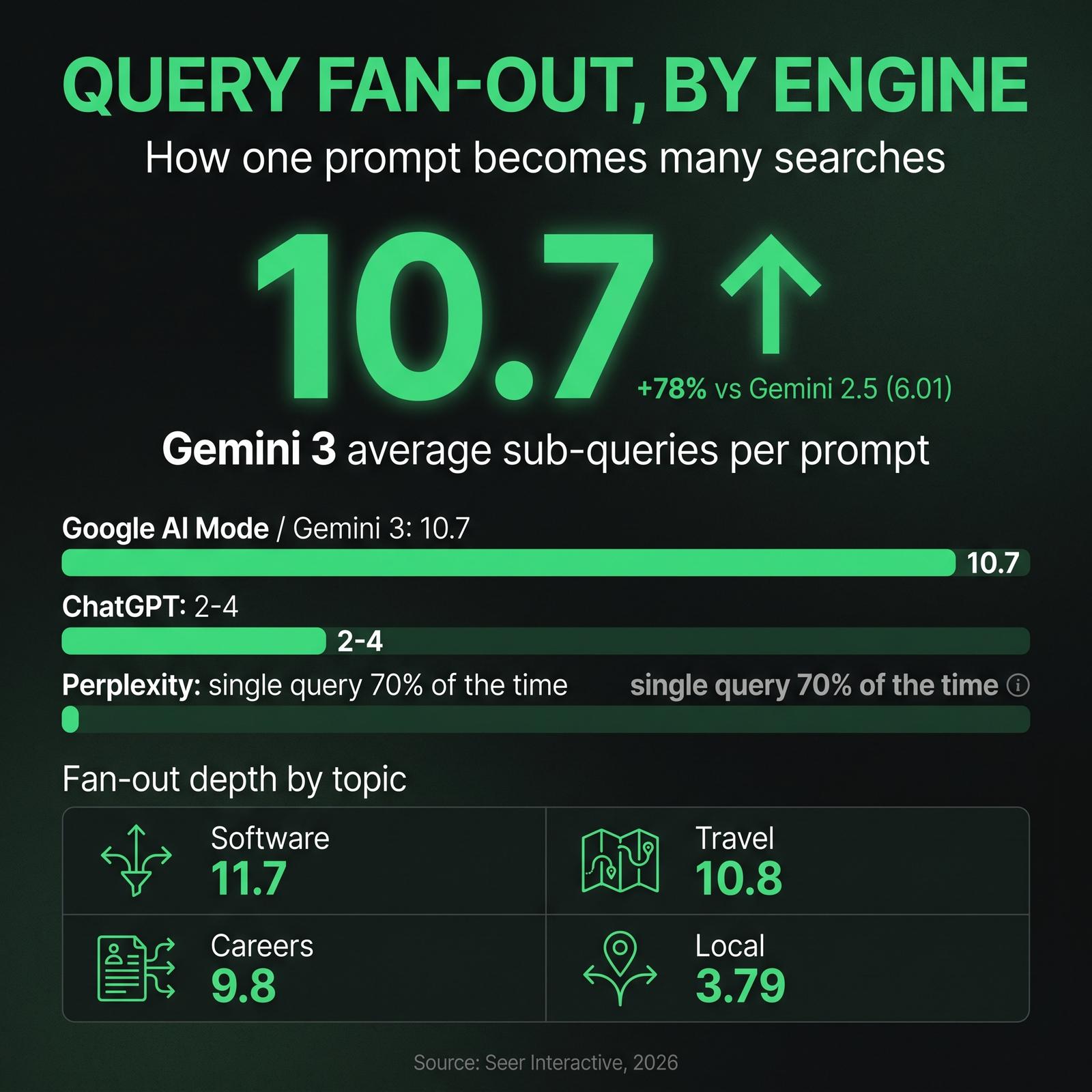
Gemini 3 does not answer your prompt with one search. Seer Interactive tracked 501 prompts and found it fans each one into 10.7 sub-queries on average, up 78% from Gemini 2.5’s 6.01. ChatGPT issues 2 to 4. Perplexity runs a single search 70% of the time and saves fan-out for genuinely complex questions. A page that answers only the headline question misses most of the sub-answers an AI engine actually assembles its response from.
Key takeaways
- Gemini 3 fans one prompt into 10.7 sub-queries on average, across a 501-prompt tracking set (Seer Interactive, 2026), up 78% on Gemini 2.5’s 6.01.
- ChatGPT issues 2 to 4 sub-queries per complex prompt. Perplexity answers roughly 70% of queries with a single search.
- Fan-out depth varies by topic: software prompts average 11.7 sub-queries, travel 10.8, careers 9.8, local searches a shallower 3.79 (Seer Interactive).
- Across 680 million analysed citations, only 11% of domains were cited by both ChatGPT and Perplexity, evidence that each engine samples a different candidate set.
- A page can rank first on Google and still enter zero of the sub-queries an AI engine generates for the same topic, because ranking and retrieval are separate mechanisms.
What query fan-out actually is
An AI search engine does not treat your prompt as a single lookup. It parses the entities, constraints and intent inside the question, then issues several parallel searches against its index before writing anything. Each of those searches, a sub-query, retrieves its own small set of candidate pages. The model reads across all of them and writes one answer, citing whichever pages survived retrieval for each sub-query.
Ask “best sneakers for walking” and Gemini 3 will not just search that phrase. It might separately search sneaker cushioning for walking, best walking sneakers for wide feet, walking sneaker durability, and seasonal walking shoe recommendations, then merge the results. Your page can be the single best resource on cushioning and still never surface, because it never entered the wide-feet or seasonal sub-query’s candidate set.
This is why a page can rank position one on classic Google Search and be invisible in AI Mode for the identical topic. Ranking measures relevance to one query. Fan-out retrieval measures relevance to a dozen sub-queries your page may never have addressed.
The per-engine gap
Fan-out depth is not consistent across engines, and treating them as one target wastes effort.
| Engine | Typical sub-queries per complex prompt | Behaviour |
|---|---|---|
| Google AI Mode / Gemini 3 | 10.7 average (up to 28 on long-tail prompts) | Fans out broadly by default on complex, multi-entity questions |
| ChatGPT | 2 to 4 | Narrower fan-out, leans more on a single strong retrieved passage |
| Perplexity | Single query roughly 70% of the time | Fans out only when the question is genuinely multi-part |
| Claude, Copilot, Grok | Not separately measured at this scale yet | Retrieval-based, narrower published data; treat as ChatGPT-adjacent until better data exists |
Google AI Mode is the engine where fan-out coverage matters most today, simply on volume of sub-queries generated. A page built for a 10-sub-query engine will also cover the 2 to 4 sub-queries ChatGPT generates. The reverse is not true.
Fan-out depth also shifts by topic, not just by engine. Seer’s data shows software prompts spawning 11.7 sub-queries on average, travel 10.8, careers 9.8, and local search a comparatively shallow 3.79. A GEO business or SaaS content programme should assume deeper fan-out than a local trades page chasing the same engine.

Why 11% overlap between ChatGPT and Perplexity citations matters here
Across 680 million citations analysed in early 2026, only 11% of cited domains appeared in both ChatGPT and Perplexity answers. That is not primarily a ranking-algorithm difference. It is a retrieval-set difference, and fan-out behaviour is a large part of why. ChatGPT’s narrower 2-to-4 sub-query fan-out samples a smaller, differently weighted set of pages than Perplexity’s mostly single-query approach or Gemini 3’s ten-plus sub-query sweep. A page optimised for one engine’s retrieval pattern is not automatically visible to another’s.
This is the retrieval mechanism sitting underneath most single-engine GEO advice. Content built to satisfy one engine’s fan-out habits genuinely does not transfer cleanly to the next.
How to structure a page to win more sub-queries
The fix is not longer content. It is broader coverage of the actual sub-questions a topic generates, each answered on its own terms.
- List every real sub-question before writing. For a competitive topic, expect 8 to 12 genuine variants: definition, comparison, cost, timeline, per-segment differences, common mistakes, alternatives. Treat this list as the outline, not an afterthought.
- Give each sub-question its own heading and a direct answer in the first two sentences. Retrieval systems chunk by heading boundaries. A sub-question buried mid-paragraph under an unrelated H2 is far less likely to be pulled as its own chunk.
- Answer the sub-question fully within that section, not by pointing elsewhere. A chunk that says “see below for pricing” gives the retrieval system nothing to cite.
- Cover the segment variants a fan-out engine is likely to generate. If the topic is “best CRM for small business”, expect sub-queries for specific team sizes, industries and budgets. Address the two or three most likely ones explicitly rather than leaving them implied.
- Corroborate with outbound links to sources the engine already trusts. Sub-query answers that stand alone, uncorroborated, retrieve less reliably than ones that cite verifiable data, consistent with what we found writing about why ChatGPT skips some brands entirely.
None of this requires guessing. Query the target engine directly with your seed prompt, read which sub-topics it surfaces unprompted, and build the outline from what it actually asks, not from what you assume it asks.

What we have seen work running citation placements
We do not run fan-out audits as a packaged product yet, this is a young enough mechanic that few agencies have. What we can show is the underlying pattern our link placements depend on: a page corroborated by other trusted sources retrieves more consistently across sub-queries than one standing alone, exactly the mechanism fan-out rewards. Our Garden Ornaments case study took organic visits from 727 to 6,370 a month between October 2025 and May 2026, a 776% lift built on the same broad-coverage, well-corroborated content structure this piece recommends, not a fan-out-specific rebuild.
Matt’s Pick: build for Gemini 3’s fan-out depth first
If you can only restructure one page this month, pick the one ranking well on Google but generating no AI Mode traffic. Map its likely sub-queries, give each one a heading and a direct answer, and add corroborating outbound links. That single change targets the engine generating the most sub-queries per prompt, and it will not hurt your ChatGPT or Perplexity visibility either. For the citation sources that make a corroborated page actually get pulled into a sub-query’s candidate set, read our guide to getting cited by ChatGPT. For the sources that differ engine to engine, our per-engine citation playbook breaks down where each one draws from. If you want a free read on where your own pages currently stand, run the AI Visibility Check before you decide which page to rebuild first. Ongoing fan-out coverage across a full content set is the kind of work our managed search programmes are built to run.
Frequently asked questions
What is query fan-out in AI search?
Query fan-out is when an AI engine splits one prompt into several sub-queries and retrieves sources for each before writing an answer.
How many sub-queries does Google AI Mode generate per prompt?
Seer Interactive measured an average of 10.7 sub-queries per prompt on Gemini 3, up 78% from Gemini 2.5’s 6.01.
Does ChatGPT use query fan-out the same way as Google?
No. ChatGPT typically issues 2 to 4 sub-queries per prompt, far fewer than Gemini 3’s 10.7 average.
Does Perplexity fan out every query?
No. Perplexity answers roughly 70% of queries with a single search and reserves fan-out for genuinely complex questions.
Can a page rank on Google and still miss every AI Mode sub-query?
Yes. A page can hold position one and never surface if it only answers the headline question, not the sub-queries around it.
How do I structure a page to win more sub-queries?
Give every likely sub-question its own heading and a direct answer in the first two sentences beneath it.
Does query fan-out vary by topic?
Yes. Seer found software prompts average 11.7 fan-outs, travel 10.8, careers 9.8, and local searches a shallower 3.79.
Related reading
- How to get cited by ChatGPT covers the corroboration signals that help a page survive retrieval once it enters a sub-query’s candidate set.
- The per-engine citation sources playbook breaks down where each engine draws its sources from, engine by engine.
- Why isn’t my brand in ChatGPT? covers the access and structure problems that keep a page out of any sub-query’s candidate set at all.
See the Garden Ornaments case study for the numbers behind our method, or check current pricing for the services referenced above.