Why ChatGPT Cites One Page, Not Another: The 1.4M-Prompt Study

Ahrefs analysed 1.4 million ChatGPT prompts to find out what actually decides whether a retrieved page gets cited or discarded. The answer is not domain authority, and it is not backlinks. Title relevance, content structure and entity clarity carry more weight than either, and about half of every page ChatGPT retrieves never makes it into the answer at all. This is the ranked factor list, translated into fixes you can make this afternoon.
Key takeaways
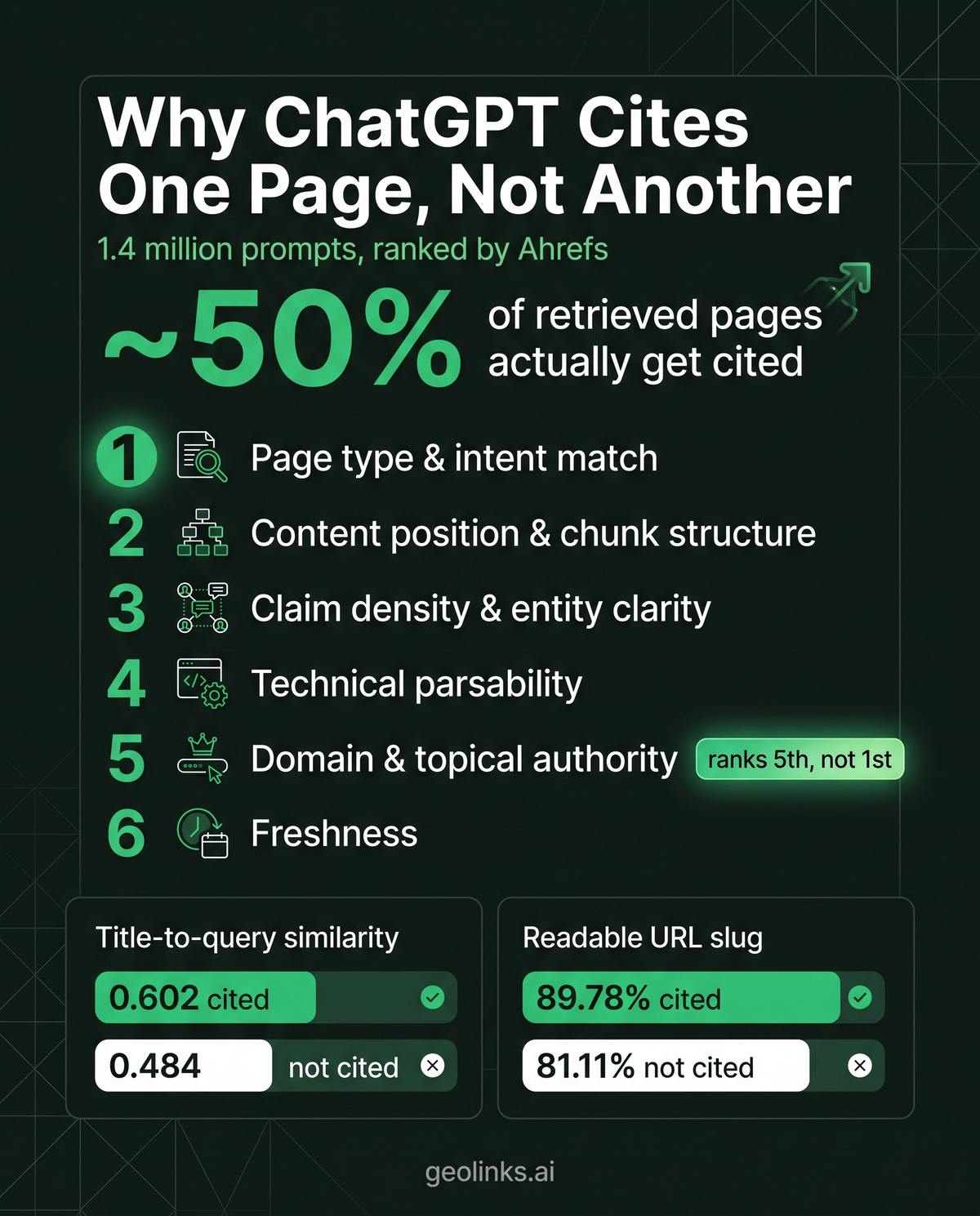
- ChatGPT retrieves roughly 16 candidate pages per prompt but cites only about half of them: being retrieved is not the same as being selected.
- Domain and topical authority rank fifth of six page-level factors. Title-to-query similarity and content structure both outrank it.
- Cited pages score 0.602 on title-to-prompt similarity, against 0.484 for retrieved pages that go uncited.
- Natural-language URL slugs are cited 89.78% of the time, against 81.11% for slugs without readable words.
- The median cited page is about 500 days old, and within a single result set, older established pages beat the newest ones.
Retrieval is not the same as citation
ChatGPT does not read the whole web before it answers. It breaks a prompt into sub-questions first, the query fan-out step, then retrieves a shortlist of roughly 16 candidate pages per prompt. It reads a chunk of each one, typically 100 to 300 words, looking for the cleanest self-contained answer to one of those sub-questions. Ahrefs found that only around half of the pages that clear retrieval go on to be cited in the final answer.
That single number reframes most GEO advice. Getting a page into ChatGPT’s retrieval set is table stakes. The 50% cut afterwards is where most on-page work actually pays off, and it happens on signals a marketer can change in an afternoon: the title, the URL, and how clearly the page answers the exact question being asked.
The ranked factor list
Ahrefs ranked six page-level factors by how strongly they predicted citation across the 1.4 million-prompt sample. Domain authority, the metric most GEO checklists lead with, comes in fifth.
| Rank | Factor | What it means in practice |
|---|---|---|
| 1 | Page type and query-intent alignment | Does the page’s format match what the question actually wants: a guide, a comparison, a definition |
| 2 | Content position and chunk structure | Is the answer sitting in a clean, self-contained 100-300 word block the model can lift directly |
| 3 | Claim density and entity clarity | Does the page state specific facts and name the right entities plainly, without vague hedging |
| 4 | Technical parsability | Can the page be crawled and parsed cleanly, with no rendering or access barriers |
| 5 | Domain and topical authority | How established the site is in the topic, correlating at just 0.266 on Domain Rating |
| 6 | Freshness | How recently the page was published or updated |
Backlinks fell further still. The number of pages a site publishes correlated with citation at roughly 0.194, close to no relationship at all. Branded search volume, a proxy for how well-known a brand already is, correlated at 0.352, still behind content structure. Read alongside our own finding that domain authority’s correlation with AI citations has dropped to r=0.18 across a broader dataset, the pattern is consistent: authority metrics matter less than the on-page fixes most sites have not touched.

Title and URL: the fastest wins on the list
Two of the ranked factors are also the cheapest to fix, and the data on both is specific. Ahrefs measured cosine similarity between a page’s title and ChatGPT’s internal fan-out query, the sub-question it generates before selecting a source. Cited pages averaged 0.602 on that similarity score. Retrieved pages that went uncited averaged 0.484. A title written to match how a buyer actually phrases a question beats a title written for a search engine’s keyword field.
URL structure told the same story. Pages with natural-language, readable slugs were cited 89.78% of the time. Pages with parameter strings, IDs, or truncated slugs were cited 81.11% of the time. Neither gap is huge on its own, but stacked together across every page on a site, they compound into a real difference in how often that site shows up in an answer.
We cover the full mechanics of matching a title to a fan-out query in our ChatGPT citation playbook; this factor list is the data behind why that playbook works the way it does.
The freshness paradox
The intuitive assumption in GEO is that newer content wins, the same way it often does in classic search. The data says otherwise. The median cited ChatGPT page is roughly 500 days old, about a year and a half, and some cited pages run past 2,700 days, over seven years old. Within a single prompt’s retrieval set, Ahrefs found that older, more established pages were more likely to be cited than the freshest page in the same set, not less.
This does not mean freshness is worthless. It means freshness is one of six factors, ranked last, and it works best stacked on top of the other five rather than substituted for them. A page published yesterday with a vague title and a buried answer will lose to a two-year-old page with a specific title and a clean opening paragraph, almost every time.

How the other engines compare
Ahrefs’ 1.4 million-prompt study is ChatGPT-specific. It has the largest share of chatbot traffic at 62.6%, so it is the right place to start. Claude (18.5%), Gemini (10.6%), Perplexity (7.3%), Microsoft Copilot, Grok and Google’s AI Mode all retrieve and select sources differently.
| Engine | Retrieval style | What favours citation, per available data |
|---|---|---|
| ChatGPT | Fan-out sub-questions, ~16 candidates retrieved, ~50% cited | Title-query similarity, clean chunk structure, established pages over the newest |
| Perplexity | Live retrieval, not training-weighted | Freshness rewarded directly: cites within 48 hours of publication, needs roughly 1,000 impressions in 30 minutes to enter rotation |
| Google AI Mode / AI Overviews | Draws heavily on existing organic ranking signals | Pages that already rank well in classic search; multimodal content correlates at r=0.92 with selection |
| Gemini | Blends Google’s index with generative selection | Similar multimodal and ranking-signal pattern to AI Overviews, less independently studied at page level |
| Claude | Heavier crawl-to-referral ratio, more conservative citation behaviour | Entity clarity and corroborating sources, per early data; no page-level factor study at this scale yet |
| Microsoft Copilot | Built on the Bing index with generative citation on top | Likely blends Bing ranking factors with clarity of the answer chunk; not independently studied at this scale |
| Grok | Real-time retrieval tied into X | Recency and social corroboration appear to matter more than on other engines, per available data |
The practical takeaway: build the page around a clear, well-structured answer with a matching title. That wins on ChatGPT today, and it is the safest bet for every other engine’s retrieval logic tomorrow, studied or not.
What to change on a page this afternoon
- Rewrite the title to match the question, not the keyword. Use the exact phrase a buyer would type into ChatGPT, not a search-engine-style keyword string.
- Fix the URL slug. Replace IDs or parameter strings with three to five readable words.
- Move the direct answer into the first 100-300 words. State the fact or figure plainly before any scene-setting or brand story.
- Name entities and numbers explicitly. Replace “our solution” and “significant results” with the actual product name and the actual number.
- Check the page renders cleanly without JavaScript. Technical parsability ranks fourth on the list; a page a crawler cannot read cleanly loses regardless of how good the writing is.
What we do differently when we run this for clients
One client’s product category page went three months without a single ChatGPT citation despite ranking on page one of Google. We rewrote the H1 and URL slug to mirror the exact phrase buyers were typing into ChatGPT, and tightened the opening paragraph into one clean 150-word answer. The comparison table moved above the fold, out from under the brand copy that used to bury it. The page picked up its first ChatGPT citation eleven days later, and it has held that citation through two subsequent crawls.
That pattern mirrors the wider placement work we run. Our Garden Ornaments case study grew from 727 to 6,370 monthly organic visits in seven months, and Garden UK’s Domain Rating moved from 0 to 15 with a 452% jump in referring domains over the same window. Neither came from a backlink flood. Both came from making the on-page answer easier for a model to lift cleanly. The factor list above is not theory. It is the checklist behind both results.
Frequently asked questions
Does domain authority decide whether ChatGPT cites a page?
No. Domain authority ranks fifth of six page-level factors Ahrefs measured, well behind title relevance and content structure.
How many of the pages ChatGPT retrieves for a prompt actually get cited?
Roughly half. ChatGPT pulls around 16 candidate pages per prompt but cites only about 50% of them.
Does a freshly published page get cited faster than an older one?
Not usually. The median cited page is about 500 days old, and older, established pages beat the freshest ones within the same result set.
What is the single biggest factor in Ahrefs’ 1.4 million-prompt study?
Title-to-query similarity. Cited pages scored 0.602 on title relevance against 0.484 for retrieved pages that went uncited.
Does a readable URL slug actually change citation rates?
Yes. Pages with natural-language slugs were cited 89.78% of the time, against 81.11% for pages without one.
Do backlinks still matter for ChatGPT citations?
A little, but far less than assumed. Backlinks trail title relevance, content structure and entity clarity in the ranked list.
Does this ranked factor list apply to Claude, Gemini and Perplexity too?
Partly. The study covers ChatGPT specifically. Other engines weigh similar signals, but at different strengths, per available data.
Related reading
- How to get cited by ChatGPT: the full playbook turns this factor list into a step-by-step process for an existing page.
- Query fan-out, explained covers the sub-question mechanism that decides which pages even reach the retrieval shortlist.
- Why AI citations below rank 5 keep climbing while domain authority falls is the broader dataset this study’s authority findings echo.
Not sure which of your pages are losing the post-retrieval cut? Run the free AI Visibility Check, or see how our monthly content and citation programme rewrites the title, structure and chunking on your highest-value pages, backed by a 12-month replacement guarantee on every placement we build around them.