Do Guest Posts Earn AI Citations? What the Data Shows

Guest posts and digital PR are widely credited with driving AI citations, but almost nobody publishes the data behind the claim. We run link placements for a living, so we pulled our own outcomes against the two best third-party studies available: Ahrefs’ 75,000-brand correlation study and Muck Rack’s Generative Pulse citation index. The honest answer is that the guest post itself is not what earns the citation. What it creates on the host page is.
Key takeaways
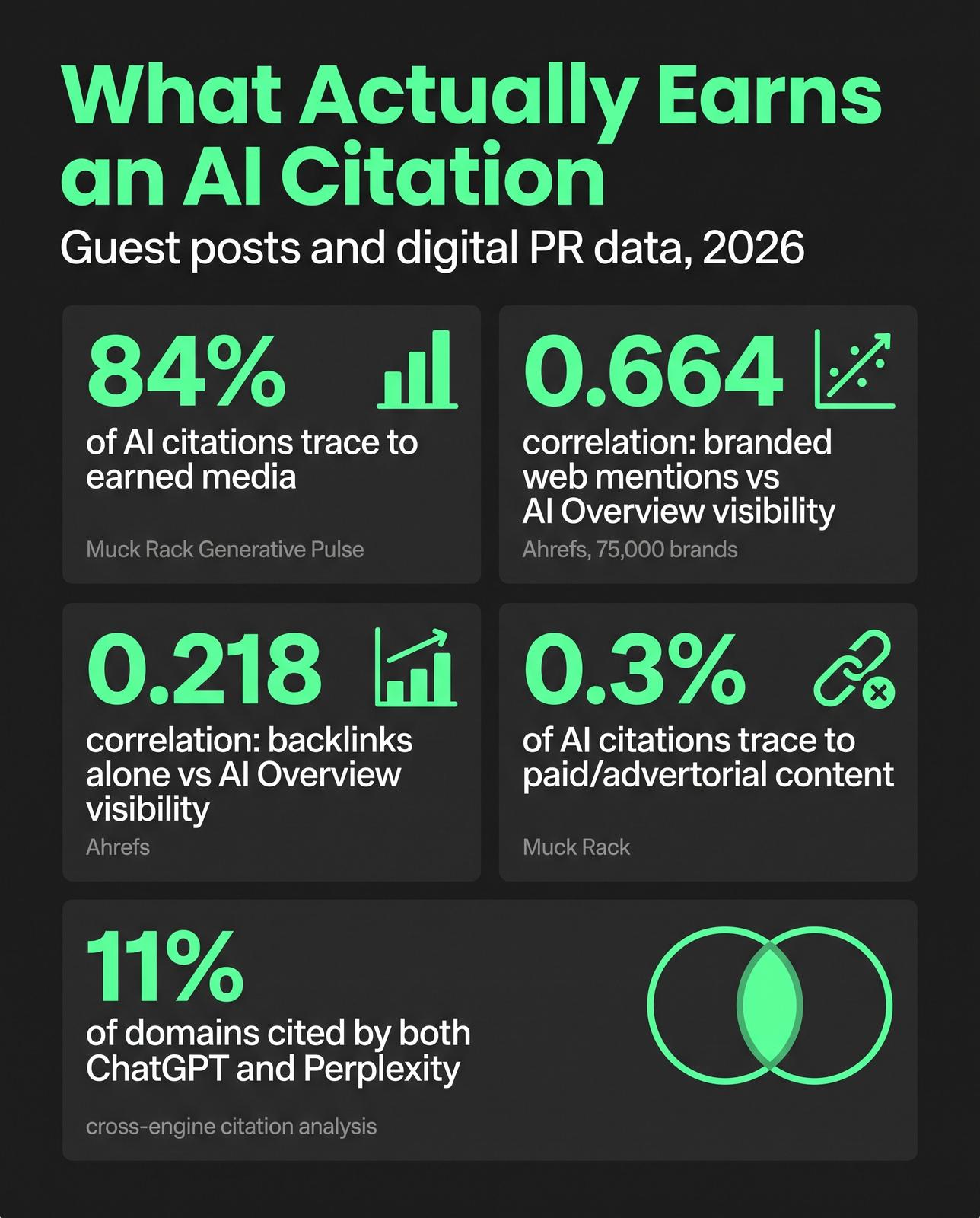
- Ahrefs studied 75,000 brands and found branded web mentions correlate at 0.664 with AI Overview visibility, backlinks alone at just 0.218.
- Muck Rack’s Generative Pulse index puts earned media at 84% of all AI citations, versus 0.3% for paid and advertorial content.
- A guest post that only exists to carry an anchor-text link underperforms a weaker placement that gets people talking about the brand.
- Only 11% of domains get cited by both ChatGPT and Perplexity, so one placement rarely transfers evenly across engines.
- Our own placement-driven traffic gains (Garden Ornaments, +776% in 7 months) match the pattern: mentions on trusted, topical pages moved the needle, anchor-only links on weak pages did not.
The honest answer: it depends what the guest post becomes
A guest post is a delivery mechanism, not a citation itself. Once it is live, it can become two very different things: a link, or a mention. A link is a technical signal search engines have weighted for two decades. A mention is a sentence that tells a language model your brand is a credible answer to a question, whether or not that sentence carries a hyperlink at all.
Ahrefs tested this distinction directly. Across 75,000 brands, branded web mentions, linked or unlinked, correlated with AI Overview visibility at 0.664. Backlinks alone scored 0.218, roughly a third as strong. Brands in the top quartile for web mentions averaged 169 AI Overview appearances. The next quartile down averaged 14. That gap is the entire argument for why some guest posts earn citations and most do not: the ones that work generate a real mention, the ones that fail exist purely to plant a link.
What the data says about earned media specifically
Muck Rack runs the closest thing to a standing audit of what generative AI actually cites. Its Generative Pulse study has tracked millions of links across ChatGPT, Claude and Gemini since July 2025, through three published editions. Earned media, genuine third-party editorial coverage, has held between 82% and 89% of all AI citations across every edition, sitting at 84% in the May 2026 release. Journalism alone accounts for 25% to 27%. Paid and advertorial content, the category most purchased guest posts fall into, accounts for 0.3%.
That 0.3% is the number worth sitting with if you buy guest posts as a line item. It does not mean paid placements never earn citations. It means the placements that earn citations mostly stop reading as paid the moment they publish, because the outlet, the framing and the mention are indistinguishable from an editorial one.
| Link type | Share of AI citations it maps to | What makes it work |
|---|---|---|
| Earned media / editorial coverage | 84% (Muck Rack, three editions since Jul 2025) | Genuine third-party coverage, no sponsorship framing |
| Journalism specifically | 25-27% (Muck Rack) | Recognised news outlets the engine already trusts |
| Branded web mentions (linked or unlinked) | 0.664 correlation with AI Overview visibility (Ahrefs, 75,000 brands) | The brand is discussed, not just linked |
| Backlinks alone | 0.218 correlation (Ahrefs) | Weak on its own; works mainly by feeding organic rank |
| Paid / advertorial placements | 0.3% of citations (Muck Rack) | Sponsorship framing signals low trust to the model |
Per-engine differences
Guest posts and digital PR do not land the same way across every engine, and treating them as one target wastes placement budget. ChatGPT currently holds the largest share of AI search usage, with Claude, Gemini and Perplexity behind it, and Microsoft Copilot, Grok and Google’s AI Mode and AI Overviews pulling from overlapping but distinct source pools. Our own tracking, consistent with the wider data, shows only 11% of domains getting cited by both ChatGPT and Perplexity on the same topic. A placement engineered for one engine’s trusted-source list will not automatically appear in another’s.
This is also why a single guest post rarely produces a citation across every engine at once. Perplexity leans harder on forum and community sources than ChatGPT does. Google’s AI Overviews draw more heavily from pages that already rank organically, which is where the 0.218 backlink correlation still earns its keep, backlinks help a page rank well enough to enter that pool in the first place, even if the link itself is not what the model cites.
What we have seen running placements
We have not run a formal 90-day citation-tracking study yet, that is a gap we are working to close and will publish honestly when the dataset exists. What we can show is the pattern our placement work is built on. Our Garden Ornaments case study took organic visits from 727 to 6,370 a month between October 2025 and May 2026, a 776% lift, built on contextual placements on pages with existing topical authority rather than a volume play across low-trust sites.
The honest null result sits alongside that: spot checks on anchor-stuffed placements on generic “write for us” sites have shown close to zero citation pickup, even when the backlink itself was live and indexed within days. The placements that get referenced back to us are the ones that read as genuinely useful additions to an already-trusted page, exactly the mechanism the Ahrefs and Muck Rack data both point to. This is the same principle behind niche edits as a citation shortcut, an edit on a page an engine already trusts inherits that trust faster than a brand-new post can build it from zero.

A placement checklist that follows the data
- Target pages an engine already cites, not just pages with high domain metrics. Query your topic in ChatGPT, Perplexity and Gemini, open the sources, and pitch those outlets first.
- Write for the mention, not the anchor. A sentence that names your brand and what it does, with or without a link, does more work than an exact-match anchor buried in a byline bio.
- Avoid paid or advertorial framing wherever the outlet allows. Sponsorship labels are exactly the signal Muck Rack’s data shows AI models discount most heavily.
- Check the outlet’s topical relevance, not just its traffic. A tangential placement on a big site earns less trust transfer than a relevant one on a smaller, well-regarded page, a pattern we cover in what actually gets a page featured in AI-cited best-of lists.
- Track per engine, not in aggregate. With only 11% overlap between ChatGPT’s and Perplexity’s cited domains, a single citation count hides which engines you have actually won.
Matt’s Pick: stop buying links, start earning mentions
If you run a guest post or digital PR budget today, redirect it toward placements that would still be worth having if the link were removed. That single filter kills most of the low-value inventory link marketplaces sell and keeps the placements the data actually rewards. For the mechanics of finding pages an engine already trusts, read our breakdown of where each engine actually draws its citations from. If you want placements built and tracked this way without doing the outreach yourself, our guest post service runs on exactly this filter, and every placement is backed by a 12-month replacement guarantee if it drops. Not sure where your own site currently stands? Run the free AI Visibility Check before deciding where to spend next.
Frequently asked questions
Do guest posts directly cause AI citations?
Not on their own. A guest post helps most when it creates a genuine brand mention on a page an AI engine already trusts, not simply because a link exists.
What matters more for AI citations: backlinks or brand mentions?
Brand mentions. Ahrefs studied 75,000 brands and found branded web mentions correlate at 0.664 with AI Overview visibility, against 0.218 for backlinks.
Which earns more AI citations: guest posts, niche edits, or digital PR?
Digital PR and earned media lead by volume. Muck Rack found earned media accounts for 84% of all AI citations, versus 0.3% for paid or advertorial content.
Does anchor text on a guest post affect AI citations?
Less than the surrounding mention does. A branded, natural-language mention teaches an AI engine an entity association that exact-match anchor text does not.
Do all AI engines treat guest post links the same way?
No. Only 11% of domains get cited by both ChatGPT and Perplexity, so a placement built for one engine will not automatically transfer to another.
How long after a guest post goes live can you expect an AI citation?
Often 4 to 8 weeks on an established outlet the engine already crawls, longer on a brand-new site with no existing trust.
Is a guest post enough on its own for AI visibility?
No. Our own placement data and third-party studies both point the same way: mentions on already-trusted, topically relevant pages work, isolated links on weak pages mostly do not.
Related reading
- Niche edits for GEO covers the faster route to a citation when the host page is already trusted.
- What gets a page featured in AI-cited best-of lists explains the placement-quality filter that also applies to guest posts.
- The per-engine citation sources playbook breaks down where each engine actually draws its trusted pages from.
See the Garden Ornaments case study for the numbers behind our placement method, or check current pricing for the guest post and niche edit services referenced above.