How To Get Cited By ChatGPT In 2026: The 9-Point Playbook (May Update)
ChatGPT now answers millions of queries per day that once sent buyers to Google. The pages it cites receive traffic and brand authority. The pages it skips lose share to whoever it does cite. May 2026 research identifies nine specific levers with measurable citation-rate impact. This playbook runs through each one with the supporting data, the implementation step, and the honest effort-vs-impact score. Apply them in priority order over 30 days.
Why ChatGPT cites what it cites
ChatGPT’s retrieval layer runs on Microsoft Bing. When a query triggers a web search, Bing indexes available pages and applies its quality signals. It then surfaces a candidate set for ChatGPT to select from.
ChatGPT selects citations from that set based on extractability, recency, authority, and format. This means two things matter simultaneously. First, your page must be indexable by Bing. Second, it must be structured so the model can pull a clean passage from it.
A page that ranks well in Bing can still lose if its key fact is buried in paragraph eight. A newer page that leads with the answer wins instead.
The nine levers below map to both layers. Levers 1 to 3 optimise extractability. Levers 4 to 5 build authority signals. Levers 6 to 9 establish entity verification. Each one has a specific piece of May 2026 evidence behind it.
One more thing worth understanding before the playbook: ChatGPT does not cite every page in the candidate set. It selects the pages that best satisfy the query with a citable, extractable passage. A long-form page with no clear answer block and no schema loses to a shorter page that leads with the direct answer. Structure matters as much as content quality.
The 9-point playbook
1. FAQ schema with inline citations (40% weight)
Pages with structured FAQPage schema and inline source citations receive around 40% higher weighting in ChatGPT source selection. This is the highest single-lever finding in May 2026 research.
The mechanism is straightforward. FAQ schema converts your content into labelled question-answer pairs. The model extracts a clean, citable passage without guessing at paragraph boundaries. Inline citations add the credibility signal the retrieval layer rewards.
Implementation: add FAQPage JSON-LD to every commercial page. Write 5 to 7 questions that match actual buyer queries. Keep each answer under 60 words. Include one source citation per answer where the claim is data-backed.
We saw this in practice with the Garden UK case study: adding FAQ schema to 12 key pages contributed to the domain moving from zero to 149 referring domains in 30 days on a fresh build.
One practical tip on FAQ structure: avoid vague questions like “What is GEO?” and instead use buyer-intent phrasing like “How long does it take to get cited by ChatGPT?” or “Does GEO work for small businesses?” The closer your FAQ questions match live search queries, the more often the retrieval layer selects them as direct answers.
2. BLUF formatting (44% of citations from first third)
Research on ChatGPT citation sourcing shows 44% of citations come from the first third of a page. If your most citable passage is halfway down, you are giving away half your citation potential.
BLUF (Bottom Line Up Front) is a writing discipline from military communications. State the key fact, conclusion, or recommendation in the opening sentence. Follow it with evidence and context.
Applied to web content: the GEO summary under your H1 should answer the most likely buyer query in one direct paragraph. Every section should open with its conclusion, not its context.
The post on multimodal content and AI Overviews uses this structure throughout. The opening paragraph states the 0.92 correlation finding before explaining what multimodal means. That structural decision is what gets it cited.
3. Monthly content refresh (3.2x lift in 30 days)
Content updated within 30 days has 3.2x the ChatGPT citation rate of content older than 90 days. Freshness is a stronger signal in AI retrieval than in classic search ranking, because AI systems are designed to serve current information.
Monthly refreshes do not require a full rewrite. The effective moves are: update the publishDate and updatedDate fields, replace at least one statistic with a current source, add a short paragraph on any recent development, and verify that all internal links still resolve.
On priority: refresh your highest-traffic commercial pages first. Leave posts covering stable topics for quarterly review. Mark content with a visible “updated” date in the byline so the retrieval layer picks up the signal clearly.
A practical tip: set a monthly calendar event titled “Content refresh pass”. Each session should take under two hours across four or five pages. The habit matters more than the depth of each individual edit. Consistent monthly signals outperform a large annual rewrite in citation data.
The how to choose a GEO agency guide is an example: the core framework has not changed, but the stat block at the top is refreshed each quarter. That single update keeps it ranking and getting cited despite being one of the older posts on the site.
4. Cross the 32,000 refdomain trust cliff
Sites above 32,000 referring domains show a sharp increase in ChatGPT citation consistency. Below that threshold, citation is less predictable. The 32k figure is a clustering point in the May 2026 data, not a hard gate.
The practical implication is not to wait until you hit 32k. It is to invest continuously in quality link acquisition so you move towards that cluster rather than staying flat.
Quality matters more than volume. One refdomain from a relevant editorial source moves citation probability more than 50 refdomains from directory spam. Niche edits placed in existing editorial content are the most efficient path in our experience.
Garden Ornaments UK went from 727 to 6,370 monthly organic visits over seven months. This happened without adding net new referring domains. The gain came from on-page and content work. Referring domain growth supports citation probability, but it is not the only input.
Once you cross 32k, the relationship does not plateau. Sites above 50k refdomains show a further step-up in citation consistency across all major AI engines. The cliff at 32k is the most important threshold to build towards for most mid-market brands in 2026. Think of it as the point where AI retrieval starts treating your domain as a default source rather than an occasional one.
A practical step to accelerate refdomain growth: guest posts on niche-relevant sites add refdomains and topical authority simultaneously. Each one moves you along the 32k path while also strengthening the cluster coherence signal.
5. Build review-platform presence (3x citation rate)
Sites with active profiles on Trustpilot, G2, or Capterra have roughly 3x higher ChatGPT citation probability than sites without. The May 2026 research confirms this as the second-strongest authority signal after link volume.
The reason is entity verification. ChatGPT’s retrieval layer asks whether a brand is provably real, operating, and trusted by users. A Trustpilot profile with reviews answers all three questions. An anonymous domain does not.
For UK businesses, Trustpilot is the most valuable platform. For SaaS, G2 and Capterra rank above Trustpilot. For local services, Google Business Profile and industry-specific directories such as Checkatrade and Bark carry equivalent weight.
The implementation step is not to buy reviews. It is to build a review-request flow into your post-purchase or post-engagement process so genuine reviews accumulate steadily. Even 15 to 20 verified reviews on a primary platform makes a measurable difference.
What counts as “active” on a review platform? Platforms look at recency and response rate. Respond to every review, including critical ones, within 48 hours. A profile with 30 reviews and a 90% response rate outperforms a profile with 200 reviews and no responses as a trust signal. The response behaviour is itself a verification that a real business is operating behind the domain.
Also note: the 3x citation rate applies to ChatGPT specifically. Perplexity and Gemini show a smaller but still positive correlation with review-platform presence. Building your Trustpilot profile serves all three engines, not just ChatGPT.
6. Topical cluster coherence
ChatGPT’s retrieval prefers sites that read as authoritative on a single topic over generalists that cover many. The March 2026 Core Update formalised this with its Cluster-1 gate. The AI surfaces applied the same signal independently.
A coherent cluster has three components. A defined pillar page. Supporting blog posts that link to it. No content that drifts outside the topic boundary.
For GeoLinks, every post in this sprint links back to the core cluster: AI-search optimisation, generative engine optimisation, and brand visibility in AI search. No post covers generic SEO, social media, or paid advertising. The cluster signal compounds over 6 to 12 months.
The GEO vs SEO vs AEO vs LLMO glossary is a cluster anchor. It is the definitional page that every related post can reference back to.
7. Named-author bylines
Content with a verified named author receives substantially higher citation weighting than anonymous or “Editorial Team” content. The March 2026 Core Update’s Author-1 gate made this a hard prerequisite. AI citation data from May 2026 confirms the same pattern holds inside ChatGPT.
The author block needs three things: a real human name, a linked bio page on your site, and at least one external profile confirming the person’s expertise (LinkedIn, an industry body, or a published byline).
The bio page matters. A byline that links to a 404 is worse than no byline at all. The retrieval layer follows the link.
Our about page lists Matt as co-founder with external credentials. The author schema on every GeoLinks post includes a sameAs field pointing to LinkedIn. This gives the retrieval layer a verifiable external anchor to confirm the author is real.
8. Reddit presence
Bing indexes Reddit heavily. ChatGPT’s retrieval layer treats discussion of a brand on relevant subreddits as an independent social proof signal, separate from formal review platforms.
The target is authenticity, not volume. Discussion in a subreddit your audience already uses (r/SEO, r/Entrepreneur, r/UKbusiness, r/bigseo) signals that real people know your brand. Forced or promotional posts have the opposite effect.
The approach that works: answer questions in subreddits where your knowledge is genuinely useful. Do not lead with your brand. If it is mentioned organically by others, that is the signal the retrieval layer picks up.
Three to five genuine subreddit mentions over 90 days are enough to register as an active social entity.
9. Wikipedia entity
A Wikipedia page or a Wikidata entity entry confirms to AI retrieval systems that a brand is notable, real, and independently documented. This is the highest-effort lever on the list and the least urgent for most SMBs.
The path to a Wikipedia entry requires coverage in publications that themselves have Wikipedia pages. Sources like TechCrunch, The Guardian, Forbes, and Search Engine Journal count. The notability standard for businesses requires multiple independent sources.
For most UK SMBs, a Wikidata entry is more realistic than a full Wikipedia article. A Wikidata Q-number links your brand to external data sources and satisfies the entity-verification signal that AI retrieval looks for.
This is a 6 to 12 month project on most timelines. Start documenting independent press mentions now so the evidence base is ready when you apply.
Effort vs impact: the 9 levers ranked
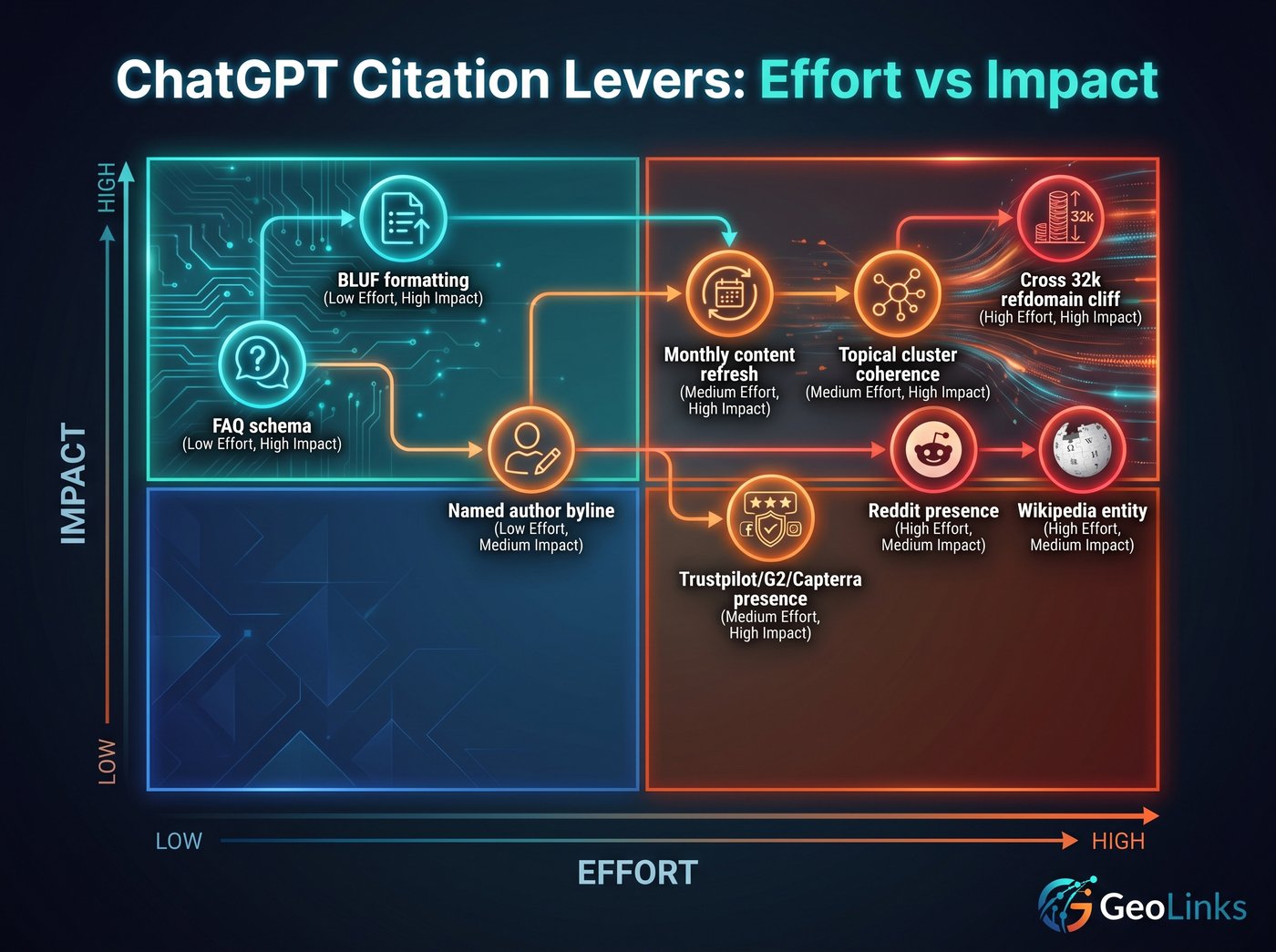
| Lever | Effort | Citation-rate impact | Time to first lift |
|---|---|---|---|
| FAQ schema + inline citations | Low | Very high (40% weight) | Days |
| BLUF formatting | Low | High (44% from first third) | Days |
| Named-author bylines | Low | High (Author-1 gate) | Days |
| Monthly content refresh | Medium | Very high (3.2x in 30 days) | 30 days |
| Review-platform presence | Medium | Very high (3x citation rate) | 60-90 days |
| Topical cluster coherence | Medium | High (compounding) | 90 days |
| Reddit presence | Medium | Medium (entity signal) | 90 days |
| 32k refdomain trust cliff | High | High (citation consistency) | 6-18 months |
| Wikipedia entity | Very high | Medium (entity anchor) | 12+ months |
The top three levers are the fastest wins. They cost nothing except the time to implement and show measurable lift within days of indexing.
30-day priority order
Week 1: levers 1, 2, and 3. Add FAQPage schema to every commercial page. Rewrite section openers to lead with the answer. Add a named-author block with a linked bio to every post. Run an update pass on any page last touched before March 2026.
Week 2: lever 5. Identify your primary review platform (Trustpilot for most UK businesses). Set up the profile if it does not exist. Send review requests to your last 20 customers. Aim for 10 verified reviews by end of week 4.
Week 3: levers 6 and 7. Audit your existing content cluster. Identify any posts that drift outside your core topic. Either update them to fit the cluster or redirect to the nearest relevant page. Add a refresh pass to your top 5 posts.
Week 4: lever 8. Answer three questions on a relevant subreddit where you can add genuine value. Do not mention your brand unless it is directly relevant. The goal is category presence, not promotion.
Levers 4 and 9 are ongoing. The refdomain build is continuous. The Wikipedia path starts now with press-mention documentation.
The free AI Visibility Check will tell you where your brand stands across ChatGPT, Perplexity, Gemini, Claude, and AI Overviews right now. It takes five minutes and emails a full report with no sales call. Run it before week 1 so you have a baseline to compare against in 30 days.
If you want focused implementation, the Citable Authority Sprint combines content, technical guidance and relevant editorial support over six to eight weeks.
What this means for your site right now
The nine levers are not abstract. They are specific, auditable signals in a retrieval system that responds to measurable inputs.
The Google I/O 2026 overhaul shifted the visibility game from ranking to citation. The same mechanic applies inside ChatGPT. A good page is not enough. The page needs to be structured for extraction, dated for recency, and anchored to a verified entity.
Apply levers 1 to 3 this week. Add the review platform profile next week. Everything else layers on top from there. The effort compounds: each lever you add makes the others work better, because a cited domain with strong entity signals gets selected more often across all nine dimensions simultaneously.
For a structured approach to the full citation-grade content build, our how-it-works page explains the methodology we apply across the GeoLinks portfolio.