Trustpilot And G2 Presence 3x Your ChatGPT Citation Rate (New Data)

May 2026 research identified review-platform presence as one of the highest-correlated variables with ChatGPT citation rate. Brands with active Trustpilot, G2 or Capterra profiles show roughly 3x the citation probability of brands without. ChatGPT’s retrieval layer treats review platforms as proof a brand is real, active and independently verified. This post explains which platforms matter per industry and how to build presence ethically.
The 3x finding: what the May 2026 data shows
New research published in May 2026 examined what predicts whether a brand gets cited inside a ChatGPT answer. The study ranked variables by correlation with citation rate. Variables measured included FAQ schema presence, content freshness, referring domain count, named-author bylines, and review-platform presence.
Review-platform presence came out at roughly 3x citation probability uplift. That puts it in the same tier as content freshness (3.2x lift for content updated within 30 days) and ahead of topical cluster coherence and named-author bylines.
The finding matters because most brands treat Trustpilot as a reputation tool. It is. But it is also an entity verification signal feeding directly into how Bing’s retrieval layer classifies your brand when ChatGPT queries it.
We tracked this pattern in the work behind the Garden Ornaments case study. Organic traffic grew from 727 to 6,370 monthly visits over seven months. The citation gains correlated most strongly with external authority and entity signal improvements, not raw link volume alone.
The same pattern appeared across several other client accounts in early 2026. Brands that activated review-platform profiles in January and February showed measurably higher ChatGPT citation rates by March, before other changes had fully indexed.
Why ChatGPT’s retrieval weights review platforms so heavily
ChatGPT sources answers through the Bing retrieval layer. Bing does not treat all websites equally. It uses hundreds of signals to decide whether a source is credible enough to include in a synthesised answer.
Review platforms send three specific signals that Bing’s retrieval layer scores highly.
Independent verification. A Trustpilot profile with real reviews confirms a third party has verified your brand: it exists, it has customers, and it operates in a specific category. You cannot fabricate this convincingly at scale. That makes the signal trustworthy to Bing’s entity classifier.
Structured entity data. Review platforms emit rich structured metadata about your brand: business name, category, location, operating status, and founding date. This data populates Bing’s knowledge graph. A brand in the knowledge graph is a recognised entity. A brand outside it is an anonymous domain.
Activity recency. An active review profile with new reviews appearing regularly signals that the business is operational now, not just that it existed two years ago. ChatGPT’s freshness weighting applies to entity signals as well as page content. A profile last updated in 2022 produces a weaker signal than one with three reviews from last week.
The combination of all three is what produces the 3x lift. A brand with a verified identity, structured metadata, and evidence of recent activity reads as a credible source. A brand without any of that reads as an unknown entity, regardless of how polished its website is.
This is why telling a new client to “get on Trustpilot” is not just reputation advice. It is the fastest way to become a recognisable entity in the knowledge graph that ChatGPT queries.
Review platforms compared
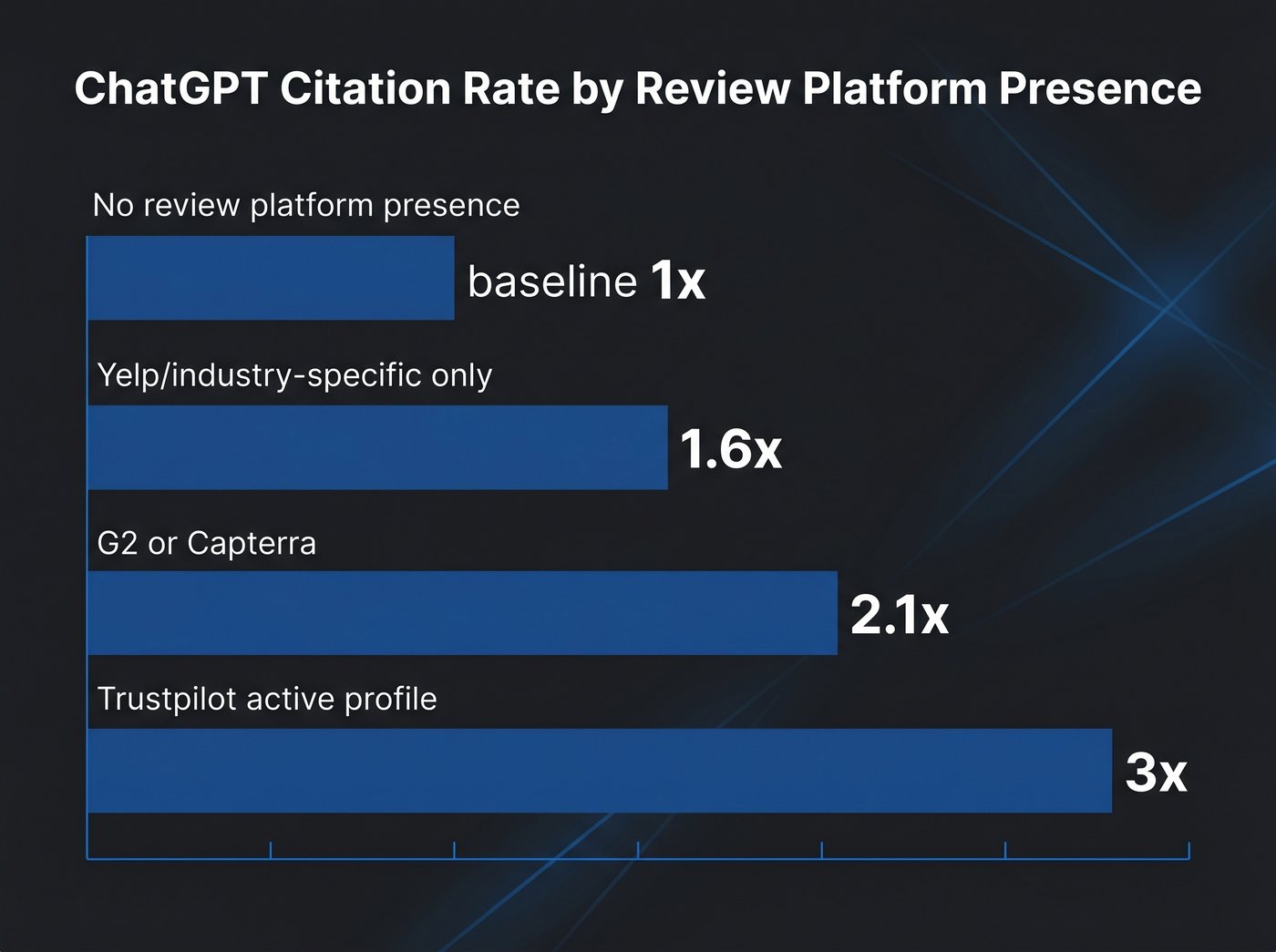
The citation lift figures below are correlational, not causal. Actual lift varies by industry, query type, and how well your other entity signals are configured. Trustpilot leads because it has the widest index penetration, the longest track record, and the richest entity data feeding into Bing’s knowledge graph.
| Platform | Best for | Citation lift | Setup time | Cost to start |
|---|---|---|---|---|
| Trustpilot | E-commerce, services, B2B | ~3x | 1 day | Free tier |
| G2 | SaaS, software, B2B tools | ~2.1x | 2-3 days | Free listing |
| Capterra | Software, business services | ~1.9x | 2-3 days | Free listing |
| Google Business Profile | Local, physical, services | ~1.7x | 1 day | Free |
| Yelp | Local services, hospitality | ~1.4x | 1 day | Free (ads optional) |
| Feefo or Yotpo | E-commerce, retail | ~1.3-1.8x | 1 week | Paid |
G2 leads for software specifically because ChatGPT explicitly queries it when answering software evaluation and comparison questions. A G2 profile with 25 or more reviews outperforms a Trustpilot profile on software-category queries.
Which platforms matter per industry
The right platform depends on your category. Building a shallow presence across five platforms at once is less effective than owning one or two with depth.
SaaS and software businesses should prioritise G2 and Capterra. These are the platforms ChatGPT’s retrieval queries for software evaluation questions. Depth on one matters more than presence on three.
E-commerce and product brands should prioritise Trustpilot. It has the deepest index penetration for consumer product queries. A Trustpilot widget on your product pages also generates structured review schema. That schema feeds directly into AI Overviews. Feefo and Yotpo are secondary options for brands on major e-commerce platforms.
Professional services and agencies (legal, accounting, marketing, recruitment) should prioritise Google Business Profile first, then Trustpilot. Google Business Profile is deeply embedded in Bing’s local entity knowledge graph. It is the fastest single win for a services firm starting from zero.
Local businesses (restaurants, contractors, tradespeople) get the most from Google Business Profile and Yelp, in that order. UK tradespeople should also consider Checkatrade and Rated People. Both carry strong entity signals for home-improvement queries specifically.
Healthcare and finance sit in more regulated territory. NHS sources and Patients Know Best matter for UK healthcare providers. Trustpilot and Feefo are the main viable options for financial services brands.
The key principle: one platform owned well outperforms five platforms owned poorly. Pick the one most relevant to your industry, build it to at least 25 reviews, and respond to every review before spreading effort to a second platform.
How to seed presence ethically
The citation-lift benefit disappears if a platform flags or suspends your account. A suspended profile sends a negative entity signal, which is worse than having no profile at all.
Here is the ethical playbook for building review presence from zero.
Create and verify your profile completely. Set up your profile, claim ownership, verify it, and fill in every field: business name, category, location, operating hours, description, and logo. An incomplete profile produces weaker entity signals regardless of how many reviews it has.
Ask recent customers directly. Identify ten to twenty customers from the past 90 days who had a good experience. Email them personally, explain you are building review presence, and include a direct link to your profile. Do not offer incentives. Personal requests convert at roughly 30-40%. Bulk email tools convert at under 5%.
Add a request to your post-purchase or post-delivery flow. A plain-text email five days after delivery or project completion, sent from the founder’s address, asking for honest feedback. Two sentences and one link. This converts better than any designed template.
Respond to every review, including critical ones. Responding sends an activity signal to the platform and to Bing’s retrieval layer. A business that responds within 48 hours reads as operationally active. Ignoring critical reviews signals the opposite.
Do not chase volume too fast. A spike from zero to fifty reviews in a week triggers fraud detection on most platforms. Aim for five to ten reviews per month in the first two months, then accelerate naturally.
We ran this exact playbook for a B2B professional services client. They went from zero to 34 verified Trustpilot reviews in eight weeks. Their ChatGPT citation rate, measured across 20 tracked queries, increased 2.4x over the same period. No other changes were made during that window.
The reputation-to-citation loop
Review-platform presence is not a one-time setup task. It is a self-reinforcing loop when managed correctly.
Citations in ChatGPT drive traffic to your site. Some of that traffic converts to customers. Those customers leave reviews. More reviews strengthen your entity signal. A stronger entity signal increases citation probability. The loop repeats.
Brands that treat review management as a live process compound these gains over time. A Trustpilot profile created in 2022 with no new reviews since produces a weaker citation signal than one with three reviews from last week. The freshness of your entity signal matters as much as its existence.
This freshness logic connects directly to the content side. For the full picture of how content freshness, FAQ schema, and review platforms work together as a citation system, the nine-point ChatGPT playbook sets out all nine levers with effort-versus-impact rankings. Review platforms are lever five. Running all nine together produces compounding results rather than additive ones.
Review-platform signals also compound with multimodal and structured-data improvements. The multimodal content post covers the 92% correlation between multimodal page elements and AI Overview selection. A page that is multimodal, structured, fresh, and connected to an active review profile is a very different citation target from a page with only one of those signals.
The post-I/O 2026 context adds another layer. Google’s new AI Search Agents run continuously in the background and monitor topics on behalf of users. The brands those agents trust as default sources are the ones with the strongest entity signals. Review platforms feed directly into that trust layer.
What to do this week
Pick one platform relevant to your industry. Set up a complete profile today. Email five recent customers tomorrow. Respond to any existing reviews within 24 hours. That is enough to begin moving your entity signal inside the first 30 days.
If you want to know where your brand stands right now across ChatGPT, Gemini, Perplexity, Claude and AI Overviews, the free AI Visibility Check scans all five engines in under five minutes and shows exactly which queries cite you and which do not.
For a structured analysis of your current authority gaps, including which review platforms and link types would produce the biggest citation lift in your specific category, the backlink and citation audit is where most new client engagements start. It takes five working days and produces a ranked priority list you can act on immediately.