78% of UK Local Businesses Are Invisible to AI Search

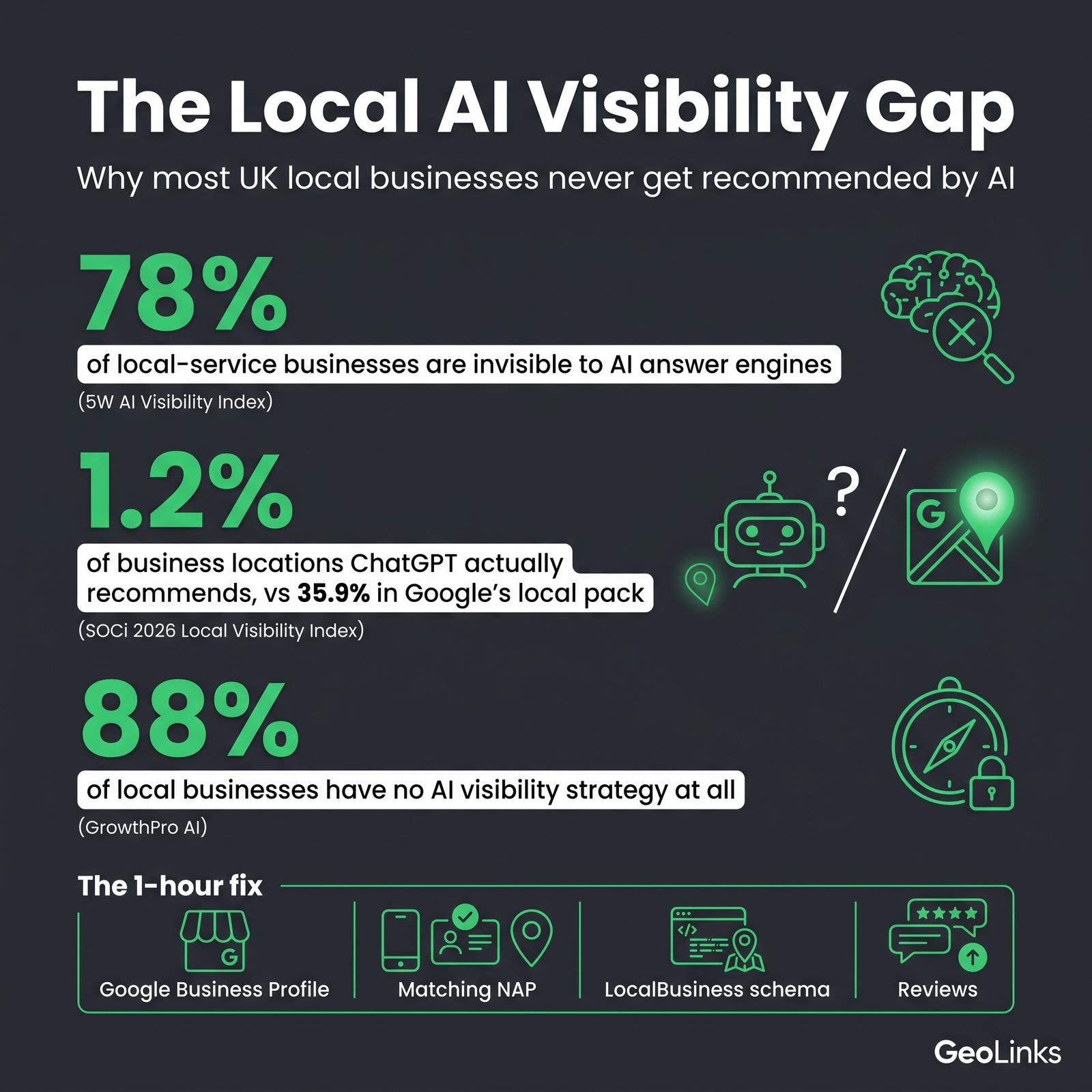
78% of local-service businesses are invisible to AI answer engines. AI recommends only 1.2% of the business locations it evaluates, against 35.9% that still appear in Google’s local pack. 88% of local businesses have no plan for any of this. The gap is not a ranking problem. It is an entity-data problem, and most of it is fixable in an hour.
Key takeaways
- 78% of local-service brands are invisible to AI answer engines (5W AI Visibility Index, May 2026).
- ChatGPT recommends just 1.2% of the ~350,000 business locations SOCi analysed, versus 35.9% appearing in Google’s local pack.
- 88% of local businesses have no active AI visibility strategy (GrowthPro AI, May 2026).
- Google Business Profile data is the heaviest single signal AI engines pull from for “near me” recommendations.
- Our own Garden UK portfolio site went from Domain Rating 0 to 15 and 27 to 149 referring domains in 30 days, with zero AI-specific budget beyond entity clean-up.

Why local businesses are getting left behind
Local businesses spent a decade optimising for the Google local pack: reviews, categories, proximity, a few hundred words of copy. That work still matters for Google. It does almost nothing for AI answer engines on its own.
The 5W AI Visibility Index found 78% of local-service brands invisible to AI answer engines altogether, for queries like “best plumber near me” or “electrician open now.” The businesses that do appear are not always the same ones ranking well on Google. SOCi’s 2026 Local Visibility Index, covering more than 350,000 business locations across five industries, found that fewer than half of retail brands performing well in Google’s local results also showed up in AI recommendations. Ranking and recommending are now two separate contests, and most local businesses have only entered one of them.
The gap between Google local search and AI recommendations
The scale of the gap is the part most local business owners have not seen in one place.
| Metric | Traditional Google local pack | AI answer engines |
|---|---|---|
| Businesses appearing for their category | 35.9% | 1.2% |
| Businesses with no visibility strategy | Not tracked this way | 88% |
| Sample size | Same ~350,000 locations | Same ~350,000 locations |
Source: SOCi 2026 Local Visibility Index (ChatGPT recommendation rate); GrowthPro AI, May 2026 (no-strategy figure).
Being recommended by AI is roughly thirty times harder than appearing in a Google local pack, on this data. That is not a small optimisation gap. It is a different game with different rules, and most local businesses are still only playing the old one. Our free AI Visibility Check shows exactly where a business sits in that gap before spending on a fix.
What each AI engine wants from a local business
Coverage is not uniform. Treat “AI search” as one channel and the fix list below will only work for part of it.
ChatGPT holds the largest AI answer-engine share and, for local queries, pulls heavily from Google Business Profile data alongside review volume and recency. Claude tends to lean on cited third-party sources such as directory listings and trade-body pages rather than a business’s own site copy. Gemini draws directly from Google’s own local index, so a strong Google Business Profile carries even more weight there than on ChatGPT. Perplexity favours businesses with a visible presence across multiple citation sources, not just one strong listing. Microsoft Copilot inherits Bing’s local index, which still weights website content more heavily than the Google-anchored engines. Grok pulls from X activity and mentions, so a business’s own posting and reply activity feeds it directly. Google’s AI Mode and AI Overviews sit closest to the local pack itself, since both draw on the same underlying data.
The practical read: no single fix reaches every engine. A Google Business Profile fix helps ChatGPT and Gemini most. Clean, consistent listings across directories help Claude and Perplexity. None of it helps Copilot or Grok on its own.
The 1-hour fix list
None of these require a rebuild. They require an hour and attention to detail.
| Fix | What it does | Time |
|---|---|---|
| Claim and complete Google Business Profile | Feeds the heaviest single AI local-recommendation signal | 15 min |
| Match name, address and phone everywhere | Removes the entity-verification friction that makes AI engines withhold a recommendation | 15 min |
| Add LocalBusiness schema to your site | Gives AI engines a ground-truth layer that is cheaper to parse than page copy | 15 min |
| Request and reply to reviews | AI platforms treat reviews as a confidence threshold, not a ranking gradient | 15 min |
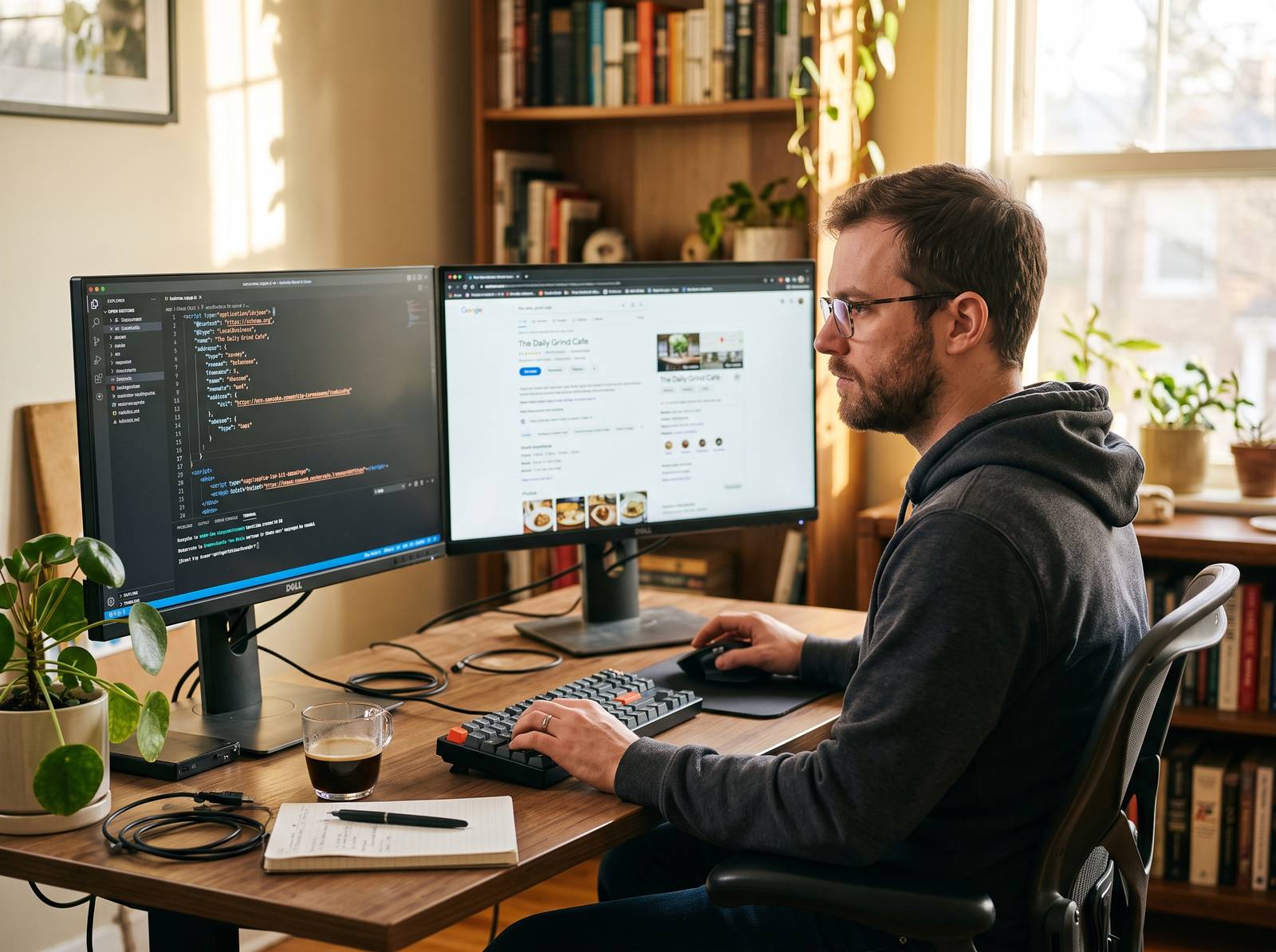
Even minor NAP mismatches, “St.” on the website against “Street” on a directory, create the kind of verification friction that makes an AI engine withhold a recommendation rather than guess. Schema markup matters for the same reason: it is structured, unambiguous and far cheaper for a model to parse than a paragraph of marketing copy. Neither fix touches your website’s design or your Google ranking. Both go directly at the entity-consistency problem that keeps 78% of local businesses out of AI answers.
What changed on our own portfolio
We do not just advise entity clean-up work. It is most of what we run on our own smaller sites. Garden UK, one of our own portfolio properties, started this year from a fresh domain with a Domain Rating of 0. We ran the same kind of entity and citation clean-up covered above rather than a broad content push. Within 30 days, Domain Rating moved from 0 to 15, referring domains went from 27 to 149, and the site had 10 ranking keywords from a standing start. That is not a local-service business specifically, but the mechanism is identical: consistent entity data plus real, verifiable citations, checked before a single word of new content gets written. Read the full Garden UK case study for the detail.
Matt’s Pick: start with the listing, not the content
If you run a local business and only do one thing this week, complete your Google Business Profile properly: full categories, real opening hours, recent photos, and a reply to every review from the last 90 days. It is the single heaviest signal feeding ChatGPT and Gemini local recommendations, and it costs nothing but time.
Once the listing is clean, our niche edits service places contextual mentions on pages AI engines already cite, closing the citation-diversity gap Claude and Perplexity weight most heavily. Small, budget-conscious operators can start with the approach in our sub-£1k GEO method rather than a full rebuild.
Frequently asked questions
How many UK local businesses are invisible to AI search?
78% of local-service brands are invisible to AI answer engines, per the 5W AI Visibility Index.
What percentage of local businesses does AI actually recommend?
ChatGPT recommends only 1.2% of the business locations it evaluates, per SOCi’s 2026 Local Visibility Index.
Do most local businesses have a plan for AI search visibility?
No. 88% have no active strategy for AI search, per GrowthPro AI’s May 2026 data.
Does a Google Business Profile help AI recommend a business?
Yes. GBP data is the single heaviest signal AI engines pull from for local recommendations.
How many reviews does a local business need before AI cites it?
Around 150 reviews per location is where AI platforms start naming businesses by name.
Does LocalBusiness schema markup help AI citations?
Yes. Pages with LocalBusiness schema get cited by ChatGPT, Perplexity and Gemini more often than pages without it.
Which AI engines matter most for local business visibility?
ChatGPT holds the largest share, but Claude, Gemini, Perplexity, Copilot, Grok and Google AI Mode all generate local recommendations too.
Related reading
- How to get cited by ChatGPT in 2026 covers the on-page fixes behind the schema and citation work here.
- Does schema markup help AI citations? The data goes deeper on where structured data does and does not move the needle.
- The UK GEO playbook covers the wider UK entity-signal picture this local fix list sits inside.
Run the free AI Visibility Check to see where your business stands, or see our current pricing for the services behind this fix list.