Best AI Visibility Tools 2026: A Tracker Won't Get You Cited

Every AI visibility tool shows you the same uncomfortable chart: brands your competitors get cited for, and a blank row where your name should be. That chart is genuinely useful. What it is not is a fix. We tested and compared the main trackers on the market, what each one shows, what none of them can do, and the one moment paying for a tracker is actually worth it.
Key takeaways
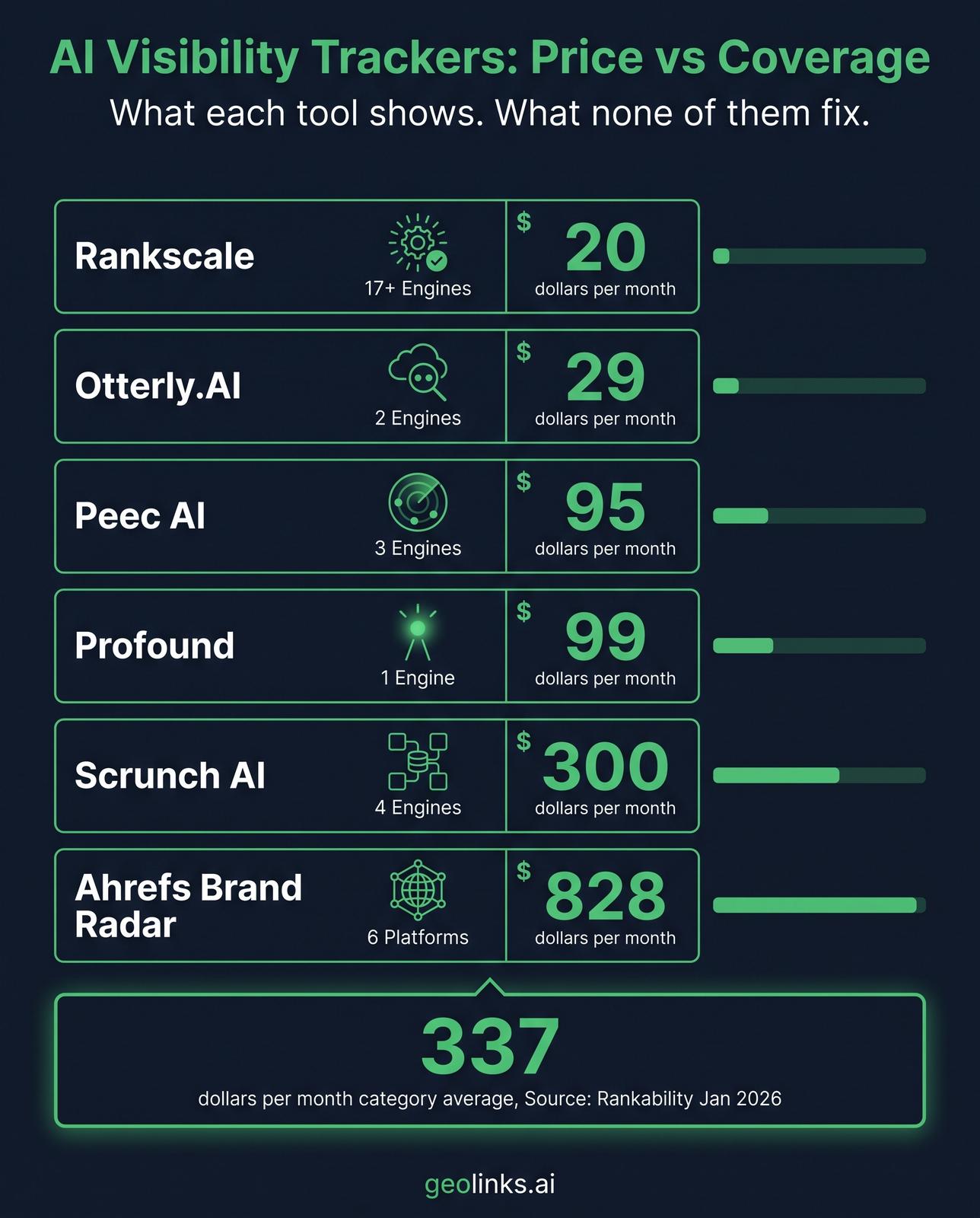
- Rankscale is the cheapest broad-coverage tracker at roughly 17 to 20 US dollars a month, spanning 17 or more AI engines.
- Ahrefs Brand Radar costs around 828 US dollars a month for full six-platform coverage, on top of a base Ahrefs subscription.
- The category average entry price is about 337 US dollars a month, per Rankability’s own January 2026 survey.
- Every tracker we tested measures citations. None of them writes the content, fixes the entity signals, or earns the links that create a new one.
- Google Search Console’s Generative AI report is a genuine free starting point for UK sites, not a rival product.

The trackers, compared
We looked at pricing, engine coverage and what each platform actually surfaces, based on published pricing pages and third-party reviews current as of July 2026.
| Tool | Entry price | Engines covered (entry tier) | Standout feature |
|---|---|---|---|
| Rankscale | ~$17-20/mo | 17+ (incl. Mistral, Grok, DeepSeek) | Widest coverage, cheapest entry, credit-based |
| Otterly.AI | $29/mo (15 prompts) | ChatGPT, Perplexity; Gemini billed separately | Self-serve, no sales call, transparent tiers |
| Peec AI | $95/mo (50 prompts) | 3 of 7 engines; Claude is Enterprise-only | Citation intelligence, response position analysis |
| Profound | $99/mo (ChatGPT only) | 1 engine on Starter, up to 10 on Enterprise | Sales-led, no self-serve signup |
| Scrunch AI | $250-300/mo (125 prompts) | 4 engines; 9 on Enterprise | Only tool with hallucination detection |
| Ahrefs Brand Radar | $129/mo base + $699/mo bundle | 6 platforms, 239M-prompt database | Cross-references AI mentions with branded search |
Rankability, the content-and-tools platform that publishes most of the “best AI visibility tool” roundups you will find on this exact search, charges from $199 a month itself and is worth naming for the same reason: it sells content optimisation bundled with tracking, not a standalone measurement product.
What none of them can do
A tracker’s job stops at the chart. It cannot rewrite a page so an engine has a reason to quote it. It cannot fix a missing entity signal, get a niche edit placed on a page ChatGPT already cites, or build the third-party mentions that close the gap between being talked about and being cited. We see this constantly in early calls: a prospect arrives with a Rankscale or Peec dashboard, points at the blank row next to their name, and asks what to do about it. The dashboard does not answer that question. That is the same reason a lot of GEO work stalls without ever producing a citation: measurement gets bought, the fix does not.
The free baseline before you pay for any of them
Google shipped a Generative AI performance report inside Search Console for UK sites first, under CMA pressure, back in June 2026. It shows AI Overview and AI Mode impressions and which pages get cited, at zero cost, for any site that already has GSC set up. It will not match Ahrefs’ 239 million prompt database or Rankscale’s 17-engine sweep. For a small UK business deciding whether the category is worth a monthly line item at all, it is the right first stop, not the paid tools.

When a tracker is genuinely worth paying for
Three situations justify the spend, in our experience running these dashboards for client work:
- You already know your fix list and need to prove it worked. A before-and-after citation count on a tool you did not build yourself is more credible to a client or a board than our own reporting alone.
- You manage more than one brand or client and need one dashboard, not seven browser tabs. Rankscale and Peec both handle multi-brand views; the entry tiers of most others do not.
- A specific engine matters commercially and you need daily, not monthly, movement. Perplexity citations can appear within 48 hours of publishing, and only a paid daily tracker will catch that speed.
Outside those three cases, the free Search Console report plus a proper citation measurement template covers most small businesses for nothing.
Matt’s Pick
If you want a single paid tracker and nothing else, Rankscale is the honest answer: cheapest entry, broadest engine coverage, and no sales call required to start. It will not fix a single thing it finds. For that, you need the entity, content and link work that actually earns a citation, which is a different budget line entirely.
Frequently asked questions
What is the cheapest AI visibility tracking tool?
Rankscale, from roughly 17 to 20 US dollars a month for 120 credits, covering 17 or more AI engines including Mistral and Grok.
Is Ahrefs Brand Radar worth the price?
Only if you already pay for Ahrefs. Full six-platform coverage costs around 828 US dollars a month on top of a base plan.
Which tool tracks the most AI engines?
Rankscale, with 17 or more engines. Most rivals cap entry tiers at three or four, with Claude often gated to the top plan.
Does a visibility tracker help you get cited by ChatGPT?
No. A tracker measures citations that already exist. Earning new ones needs content, entity, and link work a dashboard cannot do.
Can I check AI visibility for free?
Yes. Google Search Console’s Generative AI report is free for UK sites and shows AI Overview impressions and cited pages.
What does the average AI visibility tool cost?
Around 337 US dollars a month, per Rankability’s January 2026 market survey of the category.
Should a small UK business buy a tracker or an agency?
A tracker if you already know what to fix. An agency if the tracker’s report is the first time you have seen the gap.
Related reading
- Google’s Generative AI report in Search Console: the UK-only guide covers the free baseline in full.
- Mentioned by AI, never cited: the 30% overlap problem explains the gap a tracker only measures.
- GEO that doesn’t work, and the fix is the pattern behind most unused tracking dashboards.
- Why isn’t my brand in ChatGPT? 7 reasons is where the actual fix work starts.
See where you stand with a free AI citation check, or talk to us about ongoing monthly GEO work that closes the gap a tracker only shows you.