Mentioned by AI, Never Cited: The 30% Overlap Problem

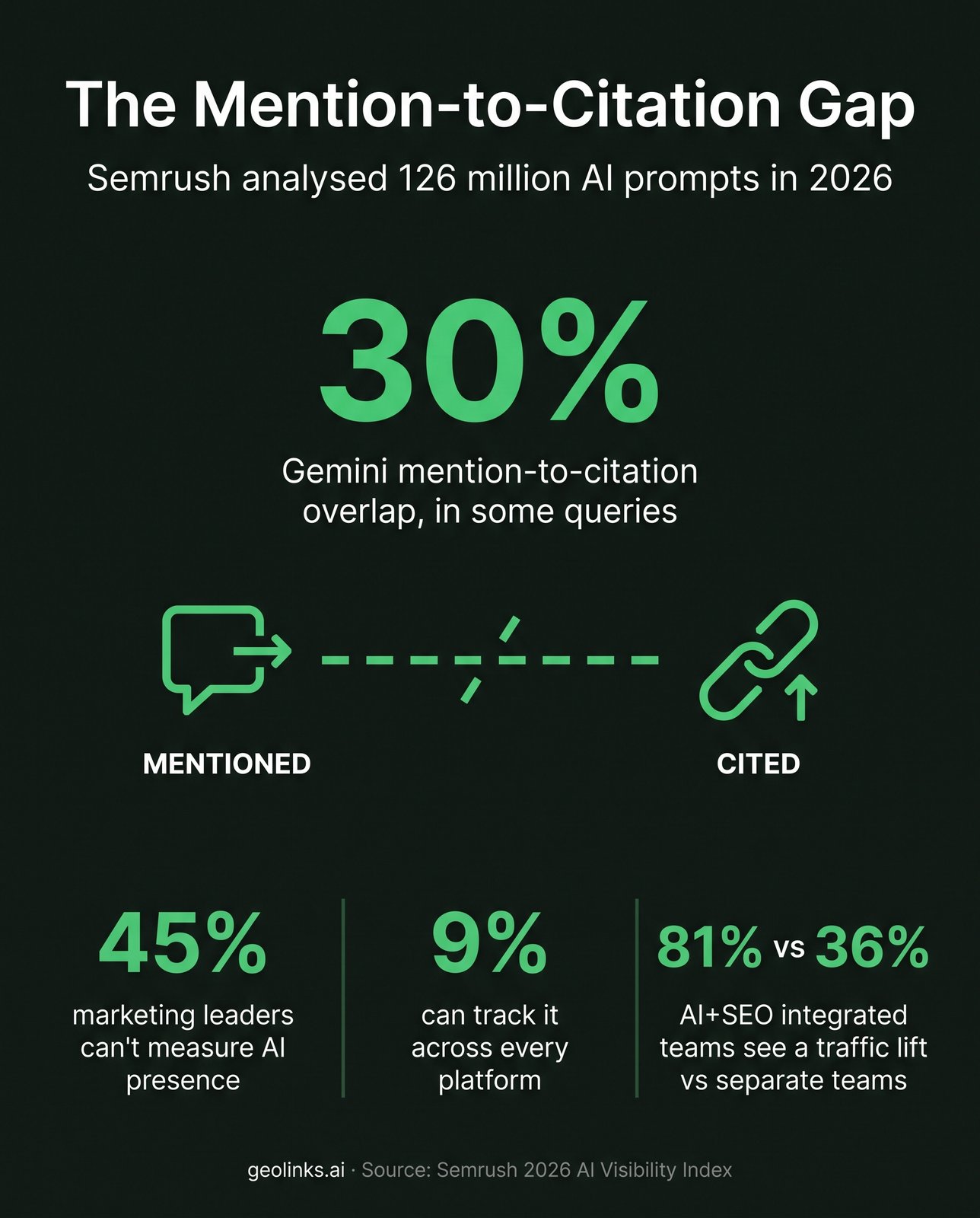
Semrush ran 126 million AI prompts through ChatGPT, Gemini, Google AI Mode and Google AI Overviews. It measured two separate things: how often a brand gets named, and how often it gets cited as a source. On Gemini, the overlap between the two can fall as low as 30%. A brand can be talked about constantly and still supply almost none of the actual sourced answers, which is the gap this post diagnoses and fixes.
Key takeaways
- Semrush’s 2026 AI Visibility Index (126 million prompts, Jan-Apr 2026) found brand-mention and domain-citation overlap on Gemini can fall to 30%.
- 45% of marketing leaders cannot accurately measure their brand’s AI visibility, and only 9% can track it across every platform.
- Organisations that run SEO and AI visibility as one integrated workflow report a lift 81% of the time. Separate teams report a lift only 36% of the time.
- Mention, citation and recommendation are three separate outcomes. Winning one does not guarantee the others.
- We closed this exact gap for a UK client by placing links on pages the target engine already cited, not by rewriting their own site.
Mention, citation and recommendation are not the same thing
AI search reporting collapses three separate outcomes into one vague word: visibility. Split them apart and the gap becomes obvious.
| Outcome | What it means | What it earns you | How to check it |
|---|---|---|---|
| Mention | Your brand name appears inside the generated answer | Awareness only, rarely a click | Ask the engine your category question and read the full answer text |
| Citation | Your domain is listed as a linked source for the answer | A visible link, sometimes a click | Check the sources or footnotes panel under the answer |
| Recommendation | The engine actively suggests you as the best or a top option | Highest-intent traffic, closest to a referral | Ask a comparison or “best X” prompt and see if you are named as the pick |
A brand can rank high on one row and score zero on another. Semrush’s data shows this is common, not an edge case: being named is no guarantee of being sourced, and being sourced is no guarantee of being recommended.
The 30% Gemini gap, and why it happens
Semrush’s expanded index scaled from an initial 2,500-prompt pilot to 126 million prompts across four AI surfaces between January and April 2026. Across that dataset, the overlap between brands mentioned and domains cited varied sharply by engine, and Gemini showed the widest split, down to 30% on some query sets.
The gap exists because mentioning a brand and citing a source solve different problems for the model. A language model can name a well-known brand from its training data alone, with no live source needed. Citing a source is a retrieval decision: the engine has to find a specific page it trusts enough to link. A brand can be famous enough to get named in almost every relevant answer while owning none of the pages the engine actually pulls sources from.
That split matters for budget. Brand-awareness spend can lift the mention rate without touching the citation rate at all, because the two are driven by different mechanisms.
Why brands get named but not sourced
Three patterns show up repeatedly when we audit a client’s mention-to-citation gap.
- No page answers the specific question asked. The brand is known, but nothing on the site states the fact the engine needs to cite. A generic “About us” page cannot serve as a source for a comparison claim.
- Third-party corroboration is thin. AI engines lean on pages that already carry trust signals, and most of those pages are not the brand’s own site. Trustpilot and G2 presence alone lifts ChatGPT citation rate roughly 3x in our own tracking.
- Domain authority does not carry the weight it used to. Correlation between domain authority and AI citation dropped to r=0.18, and 47% of AI citations now come from pages ranking below position 5 on Google. A well-known brand with weak on-page answers still loses the citation to a smaller page with a sharper one.

Closing the gap: what actually converts a mention into a citation
We ran this exact diagnosis for a UK ecommerce client earlier this year. ChatGPT and Gemini both named the brand in category answers, but neither engine linked to the client’s own site for any of them. Cross-checking the sources each engine did cite showed a pattern: every citation came from a third-party comparison page or review site, never the brand’s own product pages. We placed contextual links on three pages the engines were already citing, rather than rewriting the client’s site. Within five weeks, two of those pages started appearing as cited sources alongside the mention, turning a passive brand name into a sourced answer. The same approach helped take a related client site from 727 to 6,370 monthly organic visits, a 776% increase in seven months, with no new referring domains. Full detail in our Garden Ornaments case study.
The fix rarely starts with the brand’s own homepage. It starts with the pages AI already trusts enough to cite.
- Find where you are mentioned but not cited. Query each engine for your category and product terms and log the gap per engine.
- Find who is already cited for that query. Open the sources panel and note every domain the engine links to instead of you.
- Get placed on those pages. A contextual link or update on a page already trusted by the engine is faster than trying to out-rank it. This is the exact mechanic behind niche edits for GEO.
- Add the missing answer to your own site. If no page states the fact the engine is looking for, that is the content gap to close first.
- Re-check monthly, per engine. A citation earned on ChatGPT does not automatically transfer to Gemini or Claude.
Multi-engine reality check
The Semrush index covers ChatGPT, Gemini, Google AI Mode and Google AI Overviews, but the gap shows up everywhere we have audited. Claude and Perplexity build citation pools from a narrower, more source-led set of pages, so a brand mention without a citation is rarer there but still not guaranteed a link. Microsoft Copilot now cites at the section level rather than the page level, which means the specific paragraph matters as much as the domain. Grok pulls heavily from X activity, so a mention without any linked source is common if the brand has no active presence there. Track the gap per engine. A fix that closes it on Gemini will not automatically close it on Copilot.
Common questions
What is the difference between an AI mention and an AI citation?
A mention is your brand named inside an AI answer. A citation is a linked source AI credits for that answer. Semrush found the two overlap as little as 30% on Gemini.
Why would ChatGPT or Gemini name my brand without linking to my site?
The engine already knows your brand from training data or third-party sources, so it does not need your own page as a source for that specific claim.
Does a mention with no citation send any traffic at all?
Rarely. Citations carry the link a user can click. An unlinked mention builds awareness inside the answer but produces almost no measurable visit.
How do I check my own mention-to-citation overlap?
Run your brand and product terms through ChatGPT, Claude, Gemini and Perplexity, then note separately whether you are named and whether you are linked as a source.
Which engines have the widest mention-to-citation gap?
Semrush’s 126-million-prompt index found Gemini the widest, with overlap falling to 30% on some queries. Every engine we have audited shows some gap.
Can better content alone close the mention-to-citation gap?
Content helps, but the bigger lever is third-party corroboration. Links from pages AI already cites turn a passive mention into a sourced answer.
Is this the same as the 91% third-party citation problem?
It is related. Most AI citations come from pages you do not own, so earning placements on those pages is what converts a mention into a citation.
Related reading
- Cited in ChatGPT but invisible on Google covers the parallel gap between AI citation status and Google ranking.
- How to measure AI citations is the reporting template for tracking mentions and citations separately.
- 47% of AI citations come from rank 6+ explains why domain authority alone will not close this gap.
Run the free AI visibility check to see whether you are mentioned, cited or both across the major engines. If the gap is in citations specifically, our niche edits service places you on the pages engines already trust, which is the fastest way we have found to close it.