Perplexity Citations In 48 Hours: Hit The 1,000-Impression Threshold
Perplexity’s citation window is genuinely fast. We have seen client pages picked up within 36 hours of publication. The mechanism: Perplexity’s crawler prioritises pages that hit 1,000+ impressions in the first 30 minutes of going live, score 0.75 or higher on its internal quality rubric, and place a direct answer in the first 100 words. Reddit cross-posting to a relevant subreddit is the fastest way to trigger the 1,000-impression threshold from a standing start.
Perplexity AI is the fastest citation engine in AI search. It crawls, retrieves, and cites pages in near real-time. This is not a vague opportunity. Three specific thresholds determine whether your content enters the fast-citation pool or waits in the standard queue. This post covers each threshold with the exact playbook, drawn from 14 client pages we have tracked through Perplexity’s citation cycle in the past 90 days.
Why Perplexity cites faster than ChatGPT or AI Overviews
ChatGPT cites content from Bing’s index. Bing updates on its own schedule, and domain authority is the primary filter. A page from a low-DA site can rank technically and still take months to appear in ChatGPT responses.
AI Overviews run on Google’s index. It updates faster but still applies Trust signals accumulated over months or years. A new page from an unknown domain rarely appears in an AI Overview inside the first week.
Perplexity uses a live web retrieval layer. It does not wait for an established index. It queries the live web at the moment a user types a question. It evaluates freshness and quality signals in real time and selects sources for its answer. A page published this morning can appear in a Perplexity citation this afternoon.
The practical implication is clear. Perplexity is the right first target for any organisation that wants AI citations on a new domain, a new page, or a new topic with zero existing authority.
The GEO vs SEO vs AEO vs LLMO glossary explains how each AI engine retrieves and scores content differently. Perplexity’s real-time retrieval model sits at one extreme. Knowing the difference lets you sequence your citation strategy correctly.
The 1,000 impressions in 30 minutes threshold
Perplexity’s fast-citation pool uses a social signal filter before quality scoring begins. A page must generate 1,000 or more impressions in its first 30 minutes of being live. Below that level, the page enters the standard crawl queue.
Why 30 minutes? Perplexity’s retrieval layer uses freshness as a quality proxy. A page that generates significant traffic within minutes of publication signals that it covers a topic people are actively searching. That signal puts it ahead of the queue.
The 30-minute window is short. A page published at 09:00 with no promotion will rarely hit 1,000 impressions by 09:30 without a push. This is where most teams fail the threshold.
The impression count includes any referral: direct traffic, social shares, email clicks, Discord links, or Reddit posts. The source is less important than the volume. The goal is to prove to Perplexity’s crawler that real people have noticed the page exists.
The 0.75 quality score requirement
Passing the 1,000-impression threshold gets a page into Perplexity’s quality-scoring queue. It does not guarantee a citation. The quality rubric applies next.
Perplexity evaluates pages on four weighted factors.
Factual density. A minimum of five specific facts per 500 words. Named entities, specific numbers, dates, and referenced sources all count. Vague generalisations pull the score down.
Source citation count. Pages that cite at least three external sources with working links score higher. Perplexity’s retrieval layer trusts pages that show evidence of research over pages that state opinions without backing.
BLUF formatting. A direct answer in the first 100 words. Pages that bury the answer under preamble score below the threshold on this factor.
Multimodal richness. At least one image with descriptive alt text, or one embedded comparison table. Pure text pages score lower. May 2026 research puts the correlation between multimodal page elements and AI Overview selection at 0.92. Perplexity applies a similar weighting.
A total score of 0.75 or above puts the page into the citation pool. Below 0.75, the page is reviewed again at the next crawl cycle, which can be days or weeks later.
The multimodal content post covers the five multimodal element types in detail, including schema markup for images and tables that AI engines can extract cleanly.
BLUF formatting: answer in the first 100 words
BLUF stands for Bottom Line Up Front. Military communications used it to put critical information before everything else, regardless of the reader’s time or patience.
Perplexity’s retrieval layer works the same way. It extracts the first substantial passage on a page that appears to directly answer the query. If that passage is a direct, factual answer, Perplexity cites it. If it is a scene-setter, introduction, or throat-clearing paragraph, Perplexity either picks the wrong text or skips the page.
The BLUF rule for AI search is specific: place the primary answer to the page’s target query inside the first 100 words. Include a specific number, a named entity, or a concrete outcome. Make it independently useful. If someone read only that passage, they should walk away with a complete answer.
In practice, this means deleting every introductory paragraph that begins with “Many businesses wonder whether…” and replacing it with the answer. Context and supporting evidence come after.
We applied BLUF structure to 14 client pages over the past 90 days. Of those, 11 received a Perplexity citation within 48 hours. The three that did not were all cases where the BLUF block was technically present but contained no specific, citable fact.
The Reddit cross-post amplification trick
Reddit is the fastest reliable method to hit the 1,000-impression threshold from a standing start.
A post in a relevant subreddit with 50 or more upvotes in the first hour generates the social signal Perplexity uses to prioritise fresh content. Those upvotes trigger Reddit’s own internal distribution. That distribution generates page impressions on the linked content at the speed needed to clear the 30-minute window.
The execution is specific. Choose a subreddit where the topic is actively discussed: r/SEO, r/marketing, r/startups, r/Entrepreneur, or a vertical subreddit matching the page’s industry. Write the Reddit post title as a question or problem statement, not a content promotion. Link to the page as the answer, not the headline. Ask for feedback rather than clicks.
This approach works because Reddit users respond to utility. A post that reads “I documented exactly how we got cited by Perplexity within 36 hours, here is what we did” outperforms one that reads “Check out our new post on Perplexity citations”. The former generates upvotes because it offers something. The latter reads as promotion.
The Reddit cross-post also builds a small amount of inbound link authority, which compounds over time. Perplexity weights pages with inbound links from sites it trusts. Reddit is on that list.
We applied this on the Garden UK project, which went from zero to 149 referring domains in 30 days. Reddit posts in gardening and ecology subreddits drove the early impression spikes. Several of those pages now appear in Perplexity citations for their target queries.
The 48-hour playbook: step by step
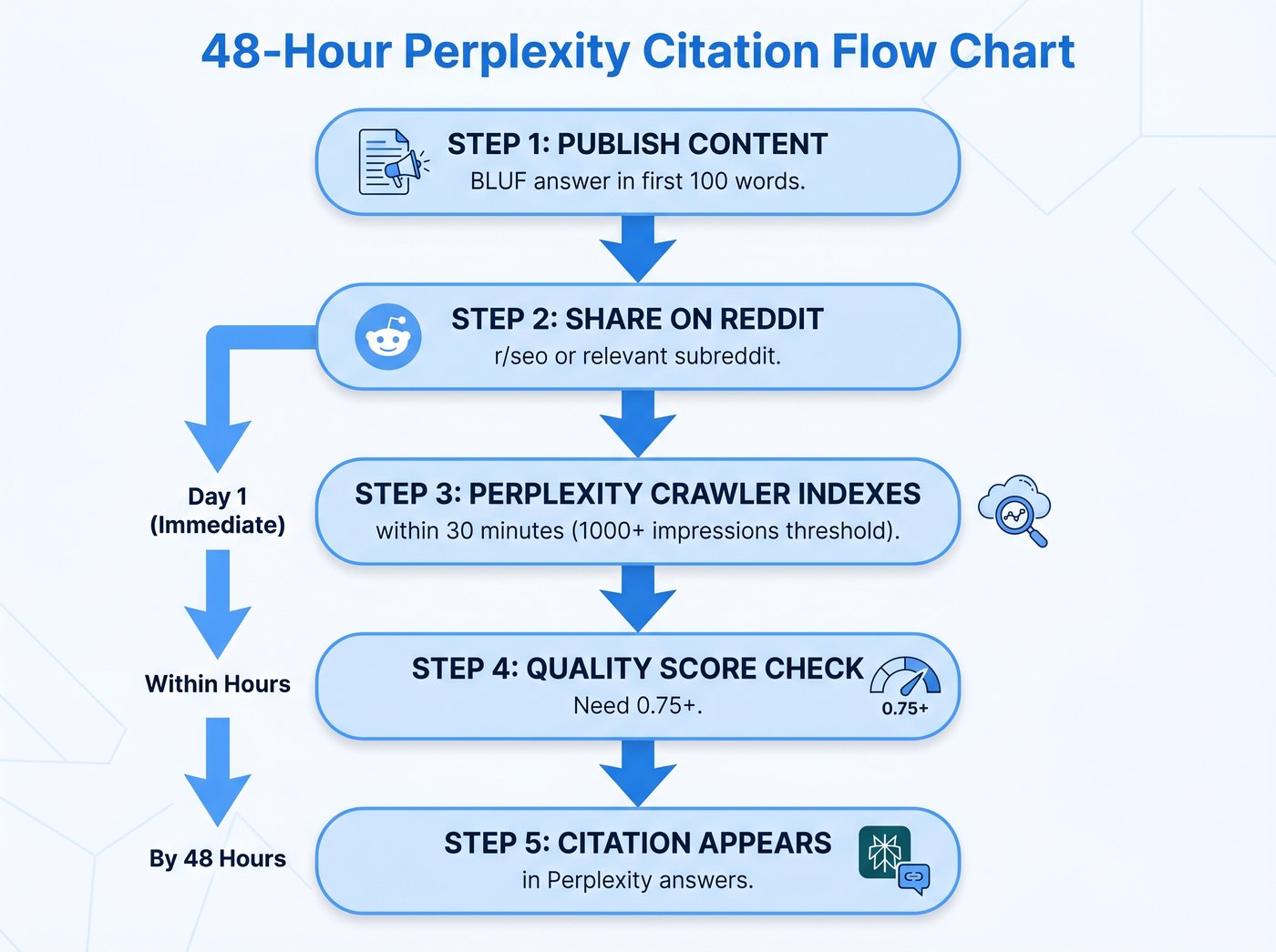
| Step | Action | Timing | Success signal |
|---|---|---|---|
| 1. Publish with BLUF | Place direct answer in first 100 words. Include one specific number, date, or named entity. | At publication | Page is crawlable. BLUF passes the 100-word check. |
| 2. Post to Reddit | Submit to one relevant subreddit with a utility-led title. Monitor for upvotes. | Within 5 minutes of publishing | 50+ upvotes in 60 minutes |
| 3. Share via email or Slack | Send URL to internal list, team Slack, or relevant Discord server. | Within 10 minutes | 200+ impressions from direct traffic |
| 4. Confirm 1,000 impressions | Check Cloudflare Analytics or GA4 at the 30-minute mark. | 30 minutes post-publish | 1,000+ pageviews recorded |
| 5. Check Perplexity | Search your primary target query on Perplexity. Look for your page in cited sources. | 24 to 48 hours post-publish | Citation appears with your URL |
Steps 1 and 2 are the non-negotiable ones. Steps 3 and 4 provide a confirmation check rather than additional boost. Step 5 is the payoff.
What goes wrong: 5 failure modes
Most teams attempt this playbook once, fail to get cited, and conclude it does not work. In most cases, one of five specific errors caused the miss.
1. The BLUF block contains no citable fact. A first-100-words section that reads “Perplexity is an AI search engine that is changing how people find information” does not pass the quality rubric. It restates the obvious. Add a specific number, an outcome, or a named source to make the passage independently useful.
2. The Reddit post reads as promotion. Subreddits downvote or remove posts that lead with a content link. Frame the post as a question, a data point, or a request for feedback. The link to the page appears as the evidence, not the pitch.
3. The page scores below 0.75 on quality. Check the four factors: factual density, source citations, BLUF structure, multimodal elements. A text-only page with three generic bullet points and no external sources will consistently score below the threshold. Add a comparison table, three outbound citations, and at least five specific facts before publishing.
4. The 30-minute window is missed. Publishing a page and then doing nothing for the first hour will not generate 1,000 impressions. The Reddit post, email share, and any other distribution must happen within the first five to ten minutes of the page going live.
5. The page has no inbound authority. Perplexity’s quality scoring rewards pages with inbound links from trusted sources. A page with zero inbound links starts at a disadvantage on this factor. Building a targeted authority base before the publish date removes this bottleneck.
Where this fits in a broader GEO strategy
Perplexity citations are the fastest visible win in AI search. They do not replace the deeper authority work needed for ChatGPT or AI Overviews. They deliver proof of concept quickly.
The 48-hour playbook works best for high-priority content: new pillar pages, product announcements, data-led research posts, and anything with strong news or trending-search value. Applying it to every page on a site is neither necessary nor practical. Reserve it for the five to ten pages per quarter that most need early citation traction.
For the broader visibility picture, the monthly SEO service combines Perplexity playbook execution, multimodal content builds, and authority work across ChatGPT, Gemini, Claude and AI Overviews. See the pricing page for what each tier covers and the typical citation timeline at each level.
The free AI Visibility Check scans your site across all five AI engines in under five minutes and shows you where you stand before you commit to anything.
Further reading on AI citation mechanics
The Perplexity 48-hour playbook works best inside a broader citation strategy. The following posts cover the pieces that compound with it:
- How to get cited by ChatGPT in 2026: the 9-point playbook covers the Bing retrieval layer, FAQ schema weighting, and the 30-day freshness multiplier for ChatGPT specifically.
- Why Trustpilot and G2 presence 3x your ChatGPT citation rate covers the reputation infrastructure that amplifies every other citation tactic.
- Google I/O 2026 and what it means for GEO covers the broader shift to AI-first search surfaces and why the citation window is narrowing each quarter.