Is GEO Just SEO With a Fancy Name? An Honest Answer
Ask the question out loud and people in the industry get defensive. So here is the plain answer from a company that sells GEO for a living: yes, mostly. Generative engine optimisation is roughly 80% fundamental SEO done well and about 20% genuinely new work. The honest version of this business says so. The version that hides the 80% is what one expert calls snake oil. This piece proves the split using our own client data.
Key takeaways:
- GEO is roughly 80% fundamental SEO and 20% genuinely new work.
- It becomes snake oil only when the 80% is hidden and the 20% is sold as a secret.
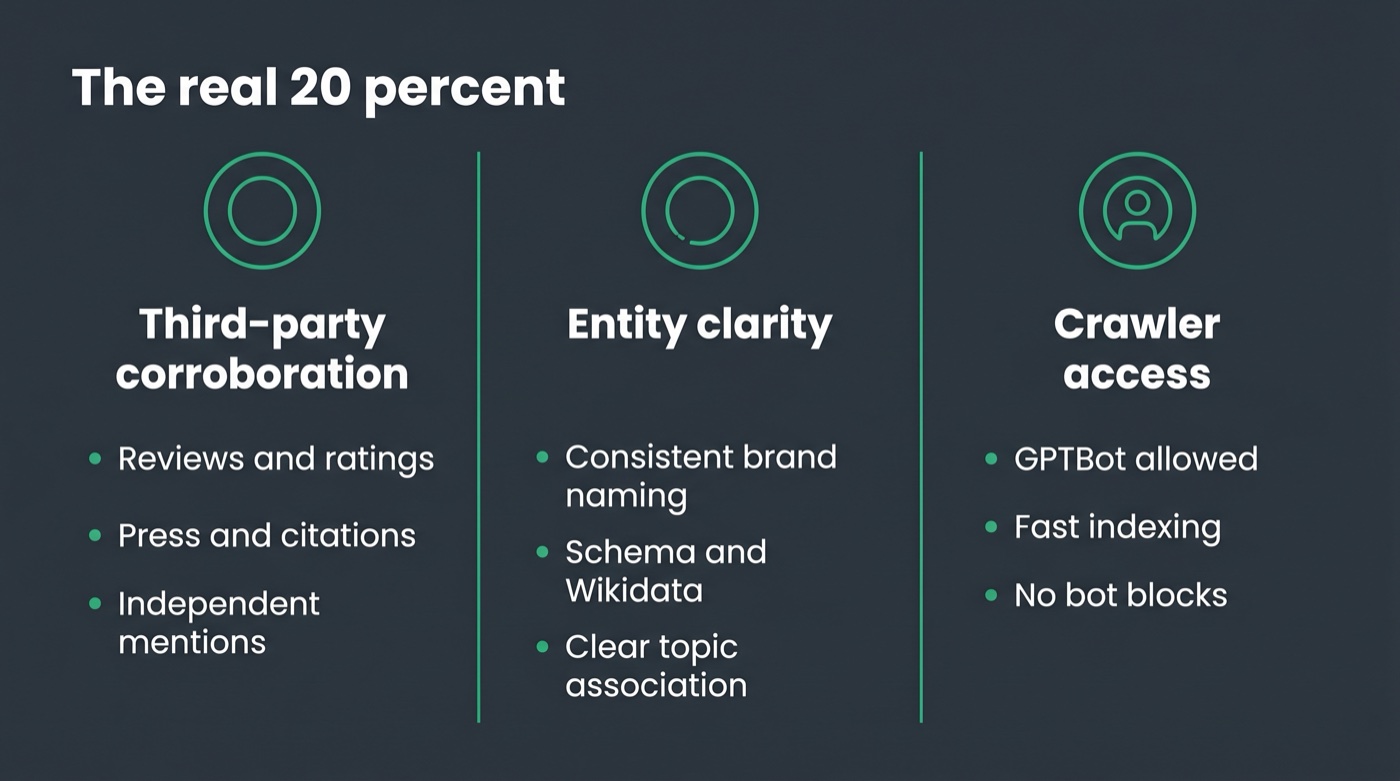
- The real 20% is third-party corroboration, entity clarity, and AI-crawler access.
- Around 91% of AI citations come from third-party sources, not your own pages.
- In our May 2026 audit, 8 of 15 UK GEO agencies could not explain how AEO differs from GEO.
The short answer, from people who sell it
GEO is mostly SEO. We say that to every prospect before they pay us. The honest reckoning in the industry has a clear quote behind it, from someone with no reason to talk his own category down.
“If a GEO service does not openly tell you that success in AI visibility is 80 percent good fundamental SEO, they are selling you snake oil.”
That is Jeremy Moser, co-founder and CEO of the SEO agency uSERP, speaking to Digiday in 2026. He is not alone. Lily Ray of Amsive argues GEO is following the same hype cycle as past trends like AMP and featured snippets, and that good SEO practice already rewards publishers in AI search. Michael King of iPullRank agrees much of GEO is repackaged SEO, while noting that the retrieval-architecture side is real new territory.
So the disagreement is not really about whether GEO is mostly SEO. Everyone credible agrees it is. The disagreement is about the 20% that differs, and whether your agency can name it.
What snake oil actually looks like
Snake oil is not the discipline. It is the packaging. The tell is always the same: someone sells you a secret method that supposedly bypasses content quality, links, and technical health. There is no such method.
Refuse any of the following:
- A “proprietary AI ranking algorithm” that nobody can describe.
- A promise of guaranteed first-position ChatGPT citations by a fixed date.
- An llms.txt file sold as the main lever, when no major AI crawler confirms using it.
- A flat refusal to discuss SEO fundamentals, as if they no longer matter.
- Pricing that hides the 80% so the 20% looks like the whole product.
The theatre exists because the category is new and buyers cannot yet judge it. That is exactly why an honest split is a competitive advantage. We would rather lose a sale than sell the mystery.
The 80%: what GEO borrows wholesale from SEO
Most of what earns an AI citation is the same work that earns a Google ranking. AI assistants retrieve from the open web. They favour pages that are fast, well-structured, genuinely useful, and backed by real authority. That is SEO.
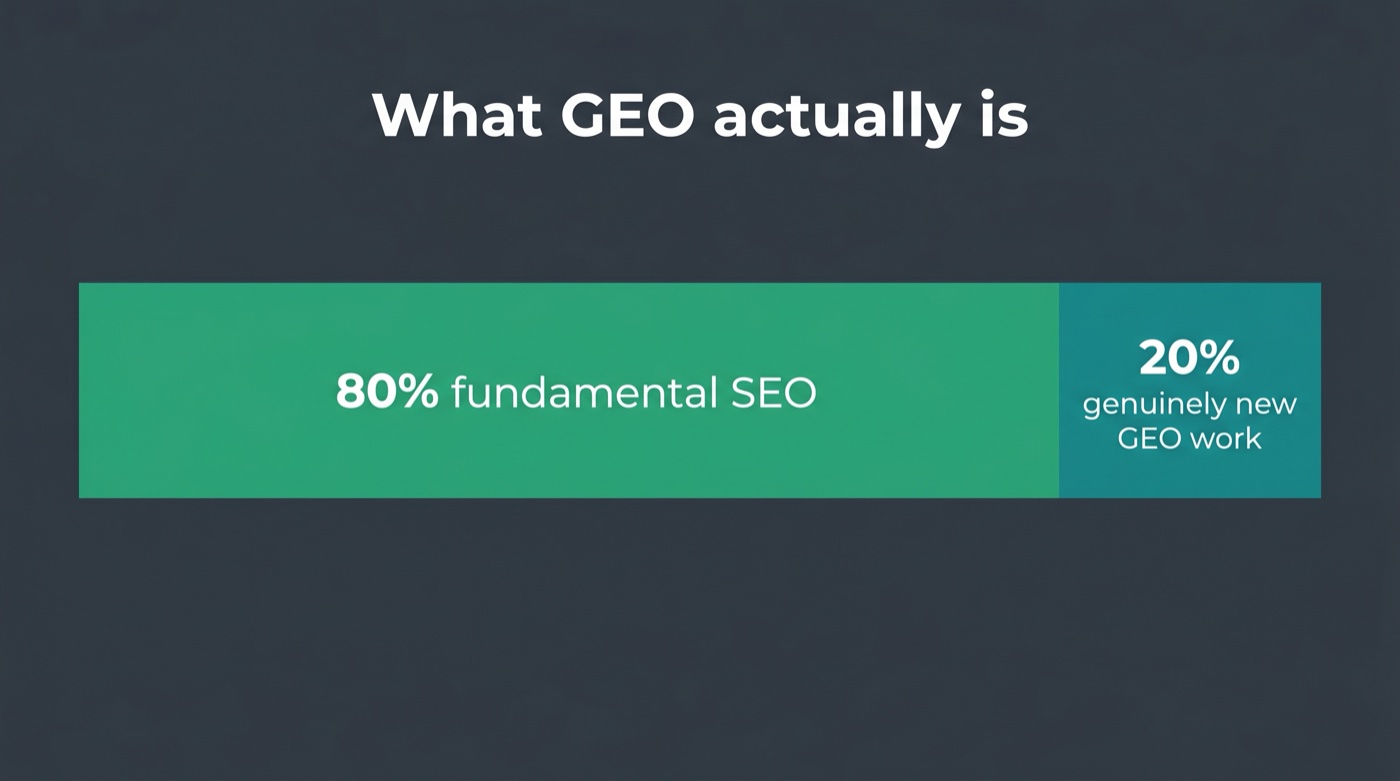
Here is the borrowed 80%, item by item.
| Borrowed from SEO | Why it still matters for AI citation |
|---|---|
| Technical health, speed, indexation | Models retrieve from indexed, crawlable pages. A leaking foundation breaks everything above it. |
| Genuine content depth and usefulness | AI assistants cite pages that answer the question well. Thin content is skipped. |
| Backlinks and brand mentions | Authority signals still decide which sources a model trusts. The input is unchanged. |
| Clean schema markup | Structured data helps both rankings and chunk-level extraction into answers. |
| Topical clusters and internal links | Coherent topic coverage reads as expertise to crawlers and to models alike. |
None of this is new. If your SEO is strong, you have already done about four fifths of the GEO job without calling it GEO.
The real 20%: what genuinely differs
This is the part worth paying for, and the part snake-oil sellers cannot describe. Three workstreams sit outside classic SEO. Get these wrong and strong SEO still leaves you uncited.
Third-party corroboration
Around 91% of AI citations come from third-party sources rather than the brand’s own pages. The link in an answer may point at your homepage, but the decision to trust you is made off your site. That changes the work. You are not just optimising your pages. You are building the external evidence that you are real: reviews on Trustpilot, G2 or Capterra, press mentions, niche-relevant placements, and consistent listings.
Entity clarity
Language models need to recognise your brand as a distinct entity before retrieval ever runs. That means consistent naming everywhere, schema.org markup, Wikidata where editorially appropriate, and a clear brand-to-topic association. SEO touches this. GEO depends on it.
Crawler access
The fastest own goal in GEO is blocking the AI bots. Many sites quietly disallow GPTBot and OAI-SearchBot, often through a default Cloudflare AI-bot block. If the crawler cannot reach the page, no amount of content quality earns a citation. Checking and fixing crawler access is a five-minute job that classic SEO audits often skip.
We sell GEO. Here is what we measured.
Talk is cheap in this category, so here are numbers from our own client work, not from a study we read.
On a B2B professional services account we built review-platform presence from zero to 34 verified Trustpilot reviews in eight weeks. Across 20 tracked queries, the ChatGPT citation rate rose 2.4x over the same window. No other changes were made during that period. That result came almost entirely from the third-party corroboration workstream, the new 20%, not from touching the website.
On content speed, we applied a clear answer-first structure to 14 client pages over 90 days. Of those, 11 earned a Perplexity citation within 48 hours of publication. The three that did not had the structure but no specific, citable fact, which is an SEO content failure, not a GEO one.
And when ChatGPT changed how it dropped brand links in May 2026, referral traffic to monitored sites roughly doubled, and B2B SaaS referrals tripled. The brands that gained were the ones with clear entity signals and third-party corroboration already in place. They had done the 20%.
The pattern is consistent. The 80% gets you eligible. The 20% gets you cited.
How to tell an honest offer from snake oil
The market is not short of vendors. It is short of clarity. When we scored the field, the gap was stark.
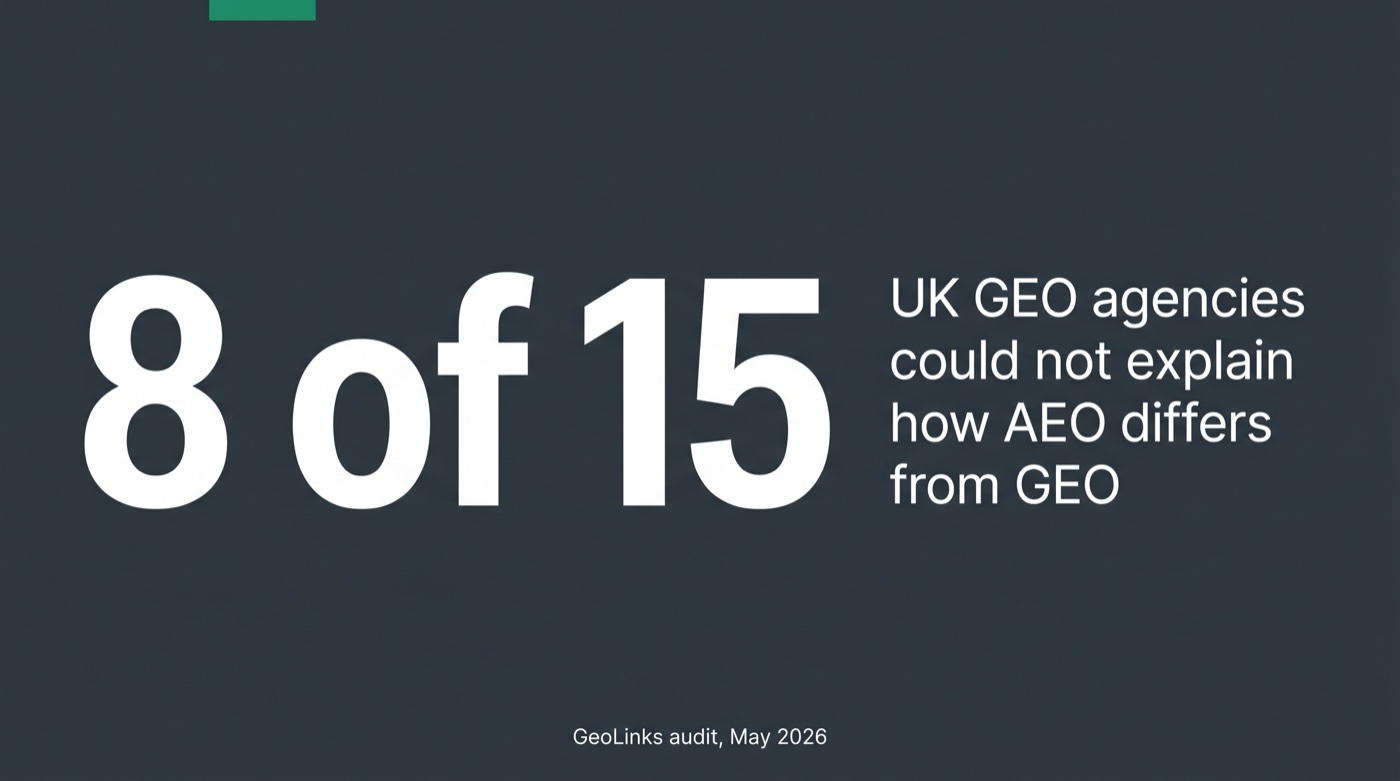
In our May 2026 audit of fifteen UK GEO agencies, 8 of 15 could not explain how AEO differs from GEO on their own service pages. Eleven of the fifteen hid pricing entirely. If a vendor cannot define the terms or show a price, the honest 80/20 conversation is not going to happen.
Use these three questions on any agency you shortlist:
- What share of GEO success is fundamental SEO? The honest answer is around 80%. A vendor who claims it is all new, AI-specific magic is the one to walk away from.
- Name the new 20%. A credible answer covers third-party corroboration, entity clarity, and crawler access. Vagueness here is the snake-oil signal.
- Show me a measured client result. Specifics beat slogans: starting position, the intervention, time elapsed, and the number that moved.
For the full scoring method, our buyer’s framework for choosing a GEO agency sets out seven weighted criteria and the red flags that should end a sales call early.
Frequently asked questions
Is GEO just SEO?
Mostly, yes. Roughly 80% of GEO is fundamental SEO done well. The remaining 20% is genuinely new work: third-party corroboration at scale, entity clarity for language models, and AI-crawler access. An agency that hides the 80% is overcharging for repackaged SEO.
Is GEO a scam or snake oil?
GEO is snake oil only when it is sold as magic. uSERP’s Jeremy Moser put it plainly: a GEO service that will not tell you success is 80% good fundamental SEO is selling you snake oil. The discipline is real. The mystique around it usually is not.
What part of GEO is genuinely different from SEO?
Three things differ. First, third-party corroboration, because around 91% of AI citations come from sites other than your own. Second, entity clarity, so models recognise your brand as a distinct thing. Third, crawler access for GPTBot and OAI-SearchBot. The rest is SEO.
Do I need a separate GEO agency if I already do SEO?
Not a separate retainer, no. If your SEO is strong you have already done about 80% of the work. You need the extra 20%: review-platform presence, entity cleanup, and AI-crawler checks. A credible agency folds that into one offer rather than billing it twice.
How much of a GEO budget should go to new work versus SEO fundamentals?
About a fifth. If a quote claims most of the budget funds novel AI-specific tactics, be sceptical. In our client work the new GEO-specific tasks rarely exceed 20% of the hours. The rest is content quality, links, schema, and technical health.
How can I tell if a GEO agency is selling snake oil?
Ask what percentage of success comes from fundamental SEO. An honest answer is around 80%. Then ask them to name the new 20%. If they cannot, or if they describe a secret method that bypasses content and links, you are looking at theatre, not strategy.
Related reading
- GEO vs SEO vs AEO vs LLMO: Plain-English Glossary defines each discipline and shows how they stack, so you can see exactly where SEO ends and GEO begins.
- How to Choose a UK GEO Agency: The Buyer’s Framework gives the seven-criterion scoring rubric and the twelve red flags that flag snake oil early.
- Best UK GEO Agencies 2026: The Honest Ranking scores fifteen UK agencies on a published rubric, with the audit data behind the 8-of-15 finding.
- Trustpilot and G2 Presence 3x Your ChatGPT Citation Rate covers the third-party corroboration workstream in detail.
- How GeoLinks Works lays out the four-step model: citable content, vetted links, live QA, and a before-and-after visibility check.
About the author
This piece is written by Matt Ward, founder of GeoLinks. Twenty-plus years building, ranking and selling on his own UK e-commerce sites including Greenhouse Stores (trading since 2012) and Garden Ornaments. Every line of SEO done in-house, every Google core update navigated since 2012, and now every GEO campaign measured against real citation data.
- Email for corrections: hello@geolinks.ai
We sell GEO, and we have just told you four fifths of it is SEO. If a vendor will not do the same, you have your answer. See the model on the how it works page, or run a free AI visibility check to see where you are cited today.