Google's June 2026 Spam Update: Safe Link Building for AI Citations

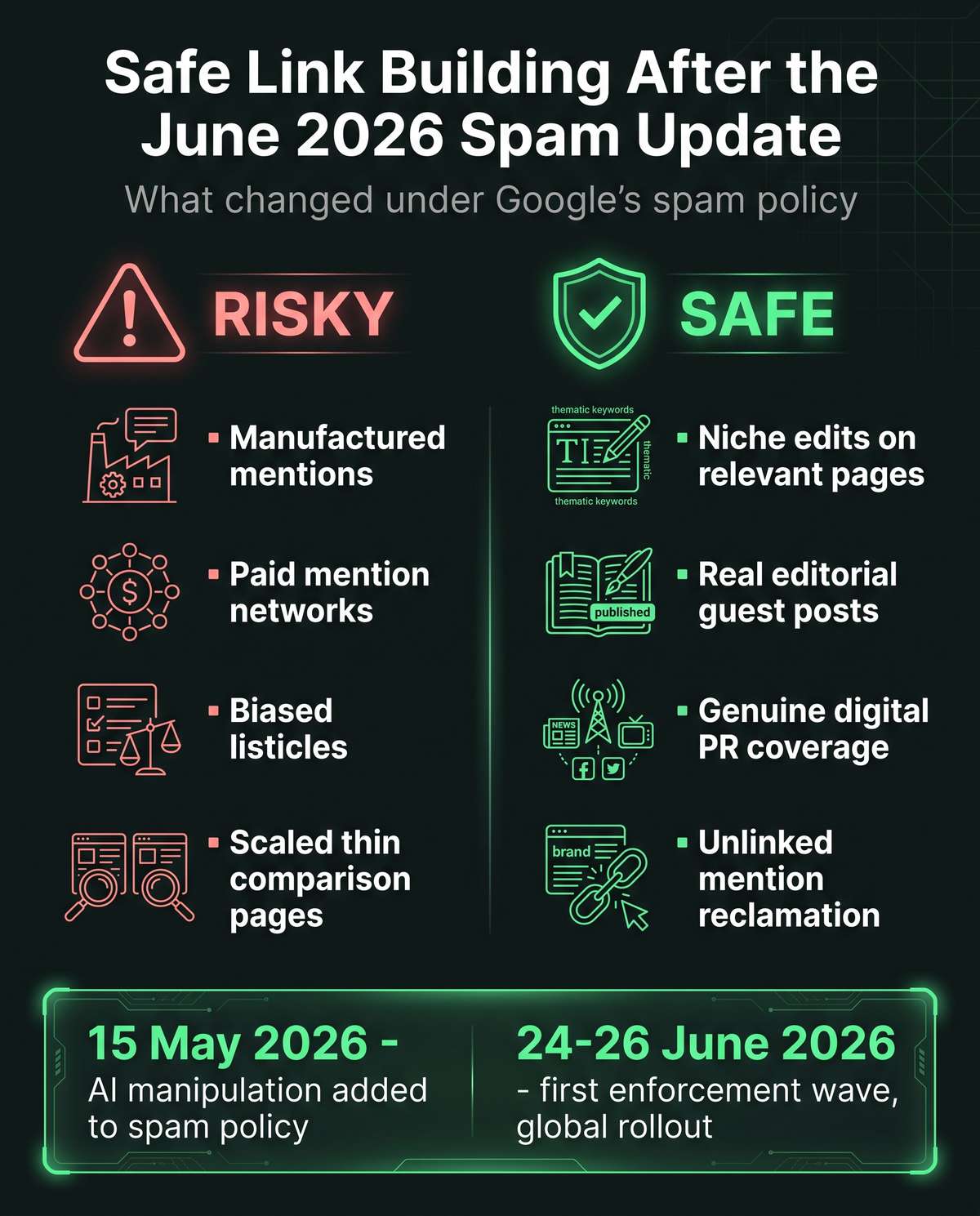
Google added AI-answer manipulation to its spam policies on 15 May 2026, then enforced the broadened rules in the June 24-26 update. Manufactured brand mentions and manipulated AI citations now carry the same demotion risk as bought links. Real placements on real, editorially relevant pages are unaffected. This explains what changed, what still works, and the audit to run before your next link invoice.
Key takeaways
- Google’s spam policy now explicitly covers “attempting to manipulate generative AI responses in Google Search”, added 15 May 2026.
- The June 24-26 spam update was the first enforcement wave under that broadened wording, rolled out globally across all languages.
- Google told Search Engine Roundtable the update does not specifically target link spam or the site reputation abuse policy: it enforces existing rules, including the new AI clause.
- Named at risk: biased listicles, paid mention networks, and scaled comparison pages built purely to harvest AI citations.
- Real placements on relevant, editorially controlled pages remain the safe route, and are the same mechanism behind our 12-month link guarantee.
What actually changed, and when
Two separate events created the update everyone is now reacting to, and conflating them is the most common mistake we see.
On 15 May 2026, Google quietly revised its Search spam policies page. The definition of spam now reads: “Spam refers to techniques used to deceive users or manipulate our Search systems into featuring content prominently, such as attempting to manipulate Search systems into ranking content highly or attempting to manipulate generative AI responses in Google Search.” That single clause brought AI Overviews and AI Mode under the same enforcement framework as classic web ranking.
The June 2026 spam update, which ran from 24 to 26 June and applied globally across every language, was the first visible enforcement wave. Coverage at the time called it more widespread than a typical spam update, though Google did not publish an impact percentage.

Manufactured mentions, not link building, is the target
The detail buyers keep missing: Google explicitly told Search Engine Roundtable the June update does not specifically target link spam or the site reputation abuse policy. It is a normal enforcement pass against existing spam policies, one of which now happens to cover AI manipulation.
That distinction matters because it separates two things the market has been treating as identical since the update landed.
| Tactic | Risk under the new policy | Why |
|---|---|---|
| Bought or planted mention on an irrelevant page, built purely to be pulled into an AI answer | High | Matches the spam definition directly: manipulating generative AI responses |
| Scaled “best of” listicle network with no editorial standard, sold as citation building | High | Google names biased listicles and “recommendation poisoning” as covered tactics |
| Niche edit on a page LLMs already cite, genuinely relevant to the surrounding content | Low | Earned placement on an editorially controlled page, not a manufactured mention |
| Guest post or digital PR placement that would exist with or without the AI-citation goal | Low | Real coverage on a real site is exactly what spam updates are built to reward |
| Unlinked brand-mention reclamation on a page already covering your category | Low | Adds a citation to content that already exists and already ranks |
The line is not “does this earn an AI citation”. It is “would this placement exist on its own editorial merits if AI citations did not exist at all”. Manufactured mentions fail that test. Real placements pass it.
What gets flagged, concretely
Google names two patterns directly: biased listicles and what it calls “recommendation poisoning”, tactics built to force a brand into AI Overviews or AI Mode. Reporting since the update adds thin “best of” pages, paid mention networks, and scaled comparison content with no genuine editorial process. Penalties run from ranking demotion to removal from Search, and Google is treating manipulated AI citations under the same framework as inauthentic backlinks: a bought or planted mention now carries the risk a bought link always did.
None of that touches AI-authored content on its own. The May clarification does not make AI writing spam. It brings Google’s generative surfaces under the policy logic already applied to the rest of the web.
The audit we run before every placement now
We audited our own live link placements against the new wording the week the June update finished rolling out. Every placement we checked was on a page with genuine organic traffic and topical relevance to the client’s category, so nothing needed pulling. The audit itself is worth running on anyone’s book, including your own.
- Pull the exact URL for every placement, not the domain. A safe domain can still carry an unsafe page.
- Check the page ranks or gets organic traffic for something real, not just for the anchor text pointing at you.
- Read the surrounding content. If your mention sits in a paragraph that reads as a manufactured slot rather than genuine coverage, flag it.
- Confirm the page existed, or would exist, without the AI-citation goal. That is the test Google’s own language implies.
- Re-run the check quarterly. Pages that were editorially sound at placement time can be repurposed into a mention farm later without you knowing.
This is the exact audit behind our 12-month link guarantee: we replace any placement that drops or degrades, which only works if every placement was earned on real editorial merit in the first place.

Why earned links were never the problem
We have made this case before: 47% of AI citations now come from pages ranking below position 5 on Google, and domain authority correlation with AI citation has dropped to r=0.18. Those numbers already told the market that raw authority buying was a weak strategy. The June update adds a second reason: manufactured mentions built to force an AI citation are now a policy risk on top of being a weak tactic.
The alternative was never complicated. Niche edits placed on pages an AI engine already cites work because the page was trusted before your link arrived, not because of the link itself. We took Garden Ornaments from 727 to 6,370 monthly organic visits, a 776% increase in seven months, with no net-new referring domains at all: the lift came from earning better placements on pages already doing the work, not from adding volume.
The same logic applies to the mention-versus-citation gap we covered after Semrush’s 30% Gemini finding: closing that gap with manufactured mentions is now the riskiest way to try. Closing it with genuine placements on pages engines already trust is the only version that survives an enforcement pass.
Multi-engine reality check
The 15 May policy clause and the June enforcement wave are Google-specific: they cover Google Search, AI Overviews and AI Mode, not the wider AI-search field. ChatGPT and Perplexity set their own citation standards and neither has published an equivalent manipulation clause, though both already down-weight pages with obvious mention-farm patterns in practice. Claude and Gemini lean harder on third-party corroboration than raw mention volume, which already limited the upside of manufactured mentions before this update. Microsoft Copilot cites at section level now, so a manufactured mention buried in a page with no real editorial structure was already a poor fit. Grok pulls heavily from X activity, where manufactured mentions are easiest to spot and quickest to discount. Treat Google’s policy as the clearest public statement of a standard every engine already applies informally.
Frequently asked questions
What did Google’s June 2026 spam update actually target?
It enforced existing spam policies, now including the AI-manipulation clause added on 15 May 2026. Manufactured mentions built to influence AI answers carry demotion risk.
Does the June 2026 update target link building directly?
No. Google told Search Engine Roundtable the update does not specifically target link spam or the site reputation abuse policy. It enforces the AI-manipulation clause instead.
Is a niche edit on a real, relevant page still safe after this update?
Yes. A contextual link on a genuinely relevant, editorially controlled page is earned placement, not manufactured manipulation. The policy targets fabricated mentions, not real ones.
What tactics does the new policy put at risk?
Biased listicles built to harvest citations, paid mention networks, scaled comparison pages with no editorial standard, and any citation bought or planted purely to influence AI answers.
Does Google’s AI-manipulation policy affect ChatGPT, Claude, Gemini or Perplexity too?
Not directly. The policy is Google’s own Search and AI Overviews rulebook. Other engines set separate standards, though manufactured-mention risk applies wherever citations are gamed.
How do I know if my current link building is safe?
Check every placement for genuine topical relevance, real page traffic, and an editorial process. Paid mention networks and templated “best of” pages are the clearest risk.
What should I do before paying my next link invoice?
Ask for the exact page URL, confirm it carries real organic traffic, and check the surrounding content is genuinely relevant to your brand rather than a manufactured mention slot.
Related reading
- 47% of AI citations come from rank 6+ explains why raw authority buying was already a weak strategy before this update.
- Niche edits as GEO citations is the earned-placement mechanic that stays safe under the new policy.
- Is GEO just SEO? covers where the two disciplines overlap and where they diverge, including on link risk.
Run a free backlink audit to check every placement on your book against the pattern in this piece before your next invoice, or read the 12-month guarantee that only works because every placement we build passes the same test.