ChatGPT's Branded Link Update: Brand Traffic Doubled
On 7 May 2026 ChatGPT quietly changed how it answers. It started dropping brand homepage links into responses far more often. Referral traffic to monitored sites roughly doubled within days and held. Most brands never noticed the cause, only the spike. This post explains what OpenAI changed, who gained, who stayed flat, and how to make your homepage the link ChatGPT now drops.
What OpenAI changed on 7 May 2026
OpenAI shipped a change that the analytics firm Profound named the “Branded Link Update”. ChatGPT began embedding brand homepage URLs inline, around five times more often than before.
Nothing was announced. There was no blog post and no changelog entry. The shift showed up first in referral logs, as a sudden rise in visits with a ChatGPT source.
Before the change, ChatGPT answers were mostly closed. The model gave you the answer and rarely sent you anywhere. After the change, answers routinely name a brand and link straight to its homepage.
That single behaviour turned ChatGPT from a dead end into a referral channel. The phrase doing the rounds among analysts captures it well. AI mentions are no longer a perception metric. They are a traffic source.
The numbers: referral traffic roughly doubled
The scale of the change is easy to understate, so here are the measured figures from Profound’s monitored set of brand sites.
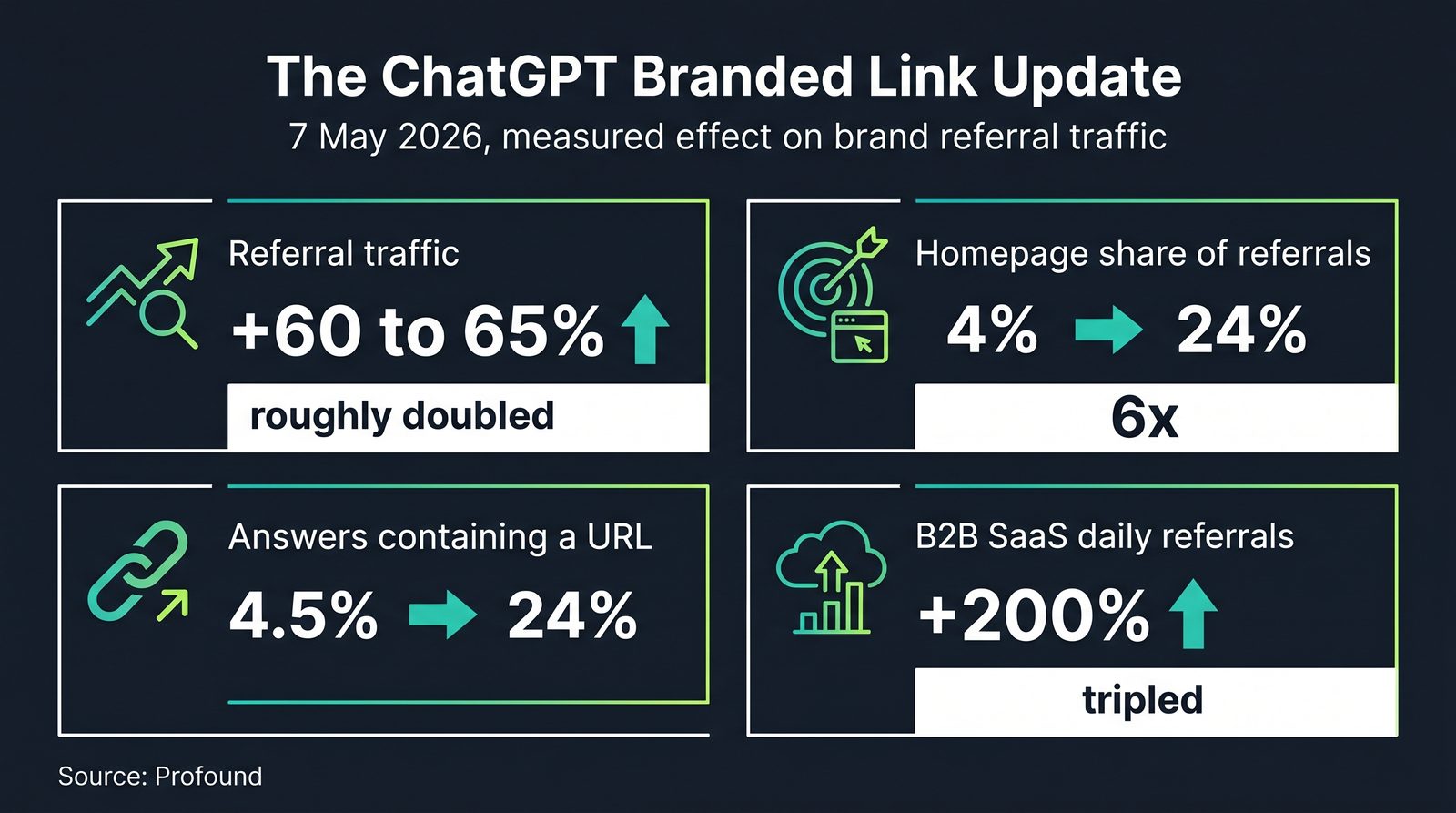
Referral traffic from OpenAI rose roughly 60 to 65% and stayed there. This was a step change, not a spike that decayed.
Homepage share of OpenAI referrals jumped from about 4% to 24%. That is a six-fold rise in how often the homepage was the landing page. The share of ChatGPT responses that contain a URL at all moved from around 4.5% to over 20%.
| Metric | Before 7 May | After 7 May | Change |
|---|---|---|---|
| OpenAI referral traffic | baseline | +60 to 65% | roughly doubled |
| Homepage share of referrals | ~4% | ~24% | 6x |
| Answers containing a URL | ~4.5% | 20 to 24% | ~5x |
| B2B SaaS daily referrals | baseline | +200% | tripled |
These figures matter because ChatGPT now sits at about 62.6% of all measurable AI referral traffic. A change to how it links is a change to the largest single AI traffic source on the web.
Why your homepage suddenly matters most
The most important detail is where the traffic landed. It went to homepages, not deep pages. That tells you what ChatGPT’s retrieval was trying to do.
ChatGPT did not pick a random page. It picked the page that best represents the whole brand. The homepage is the clearest statement of who a company is, what it sells, and who it serves.
So the update rewards a specific kind of homepage. One that names the brand plainly, states the category in obvious terms, and makes the offer legible to a machine in the first screen.
Many homepages fail this test. They lead with a vague slogan, hide the category behind a hero animation, and bury the actual offer below three scrolls. A person decodes that. A retrieval system reads it as noise and links a competitor instead.
The lesson is direct. The homepage is now your most valuable AI-search asset. It is the page ChatGPT reaches for when it decides to name a brand.
Who won and who stayed flat
The update did not lift everyone equally. The gap between winners and the flat tells you exactly how ChatGPT chooses what to link.

B2B SaaS won biggest, with daily referrals up around 200%. These queries are research-led. People ask ChatGPT to compare tools, explain categories, and recommend providers. The answer needs a brand to point at, so it links one.
Financial services rose about 60%. Same pattern, slightly more regulated language, but still advice-shaped queries that resolve to a named provider.
E-commerce stayed roughly flat. Product queries often resolve inside the answer itself. ChatGPT describes the product, lists the specifications, and the user rarely needs to leave. The link adds less, so it appears less.
The dividing line is whether your category prompts a “who should I use” question. If buyers ask ChatGPT for a recommendation, the branded link is a large opportunity. If they ask for a fact, the answer keeps it.
Why ChatGPT picks one brand link over another
When ChatGPT decides to name a brand, it still has to choose which one. That choice runs on the same trust signals that govern every AI citation.
ChatGPT sources answers through a retrieval layer that scores credibility. It looks for a clear entity, meaning your name, category and location agree everywhere they appear. It looks for independent corroboration, meaning other sites mention you without being asked. It looks for recent activity, meaning the web shows you are operating now.
Around 91% of AI citations come from third-party sources, not from the brand’s own pages. So the link points at your homepage, but the decision to trust you is made off your site.
This is why a polished homepage alone does not win the link. The homepage has to be backed by a brand the wider web already recognises. The corroboration earns the trust. The homepage receives the click.
How to become the link ChatGPT drops
We have spent the past year making client brands legible to AI retrieval. The branded link update rewards exactly that work. Two of our campaigns show the pattern, with numbers from our own records.
For Garden Ornaments, monthly organic visits grew from 727 to 6,370 over seven months, a rise of 776%. The gains tracked entity and external-authority work, the same signals the homepage link follows. Through May, OpenAI referrals in that account concentrated heavily on the homepage, in line with the wider update.
For Garden UK, a fresh domain reached Domain Rating 15 from zero and grew referring domains from 27 to 149, up 452%. It earned 10 ranking keywords inside 30 days. A clear identity plus fast corroboration is what let a new brand register at all.
The method is repeatable. Make the homepage state the brand and category plainly. Keep that identity consistent across listings and profiles. Then earn the third-party mentions that tell ChatGPT you are real. The nine-point ChatGPT playbook sets out each lever in order, and the review-platform data covers one of the fastest corroboration wins.
A one-week plan to claim your branded link
You can position for this inside a week. Work top down.
Day one, rewrite the top of your homepage. State the brand name, the category, and who you serve in the first screen, in plain words a machine can lift.
Day two, confirm ChatGPT can read it. Check that your key facts render in plain HTML and that no security rule blocks OAI-SearchBot. A blocked crawler cannot link you, a point covered in our piece on why bots now outnumber humans.
Day three, align your identity. Brand name, category and location should match across your site, your listings, and your review profiles.
Day four, audit corroboration. Ask ChatGPT your category’s “who should I use” questions and note which brands it links. That list is your gap.
Day five, brief the mentions that close the gap. Earned links and listings on the sources ChatGPT already trusts are what move you into the answer.
What to do this week
Start with the homepage, because it is the page the link lands on. If it does not say who you are in the first screen, fix that before anything else. Then check crawler access and identity consistency. Those three steps position you for the link inside 30 days.
To see whether ChatGPT and the other engines name you today, the free AI Visibility Check scans ChatGPT, Gemini, Perplexity, Claude and Google AI Overviews and shows which queries cite you.
When you are ready to improve the evidence and corroboration around your brand, the Authority Blueprint identifies the strongest commercial starting point.