AI Citations +35%. Organic CTR -61%. Why GEO Is No Longer Optional
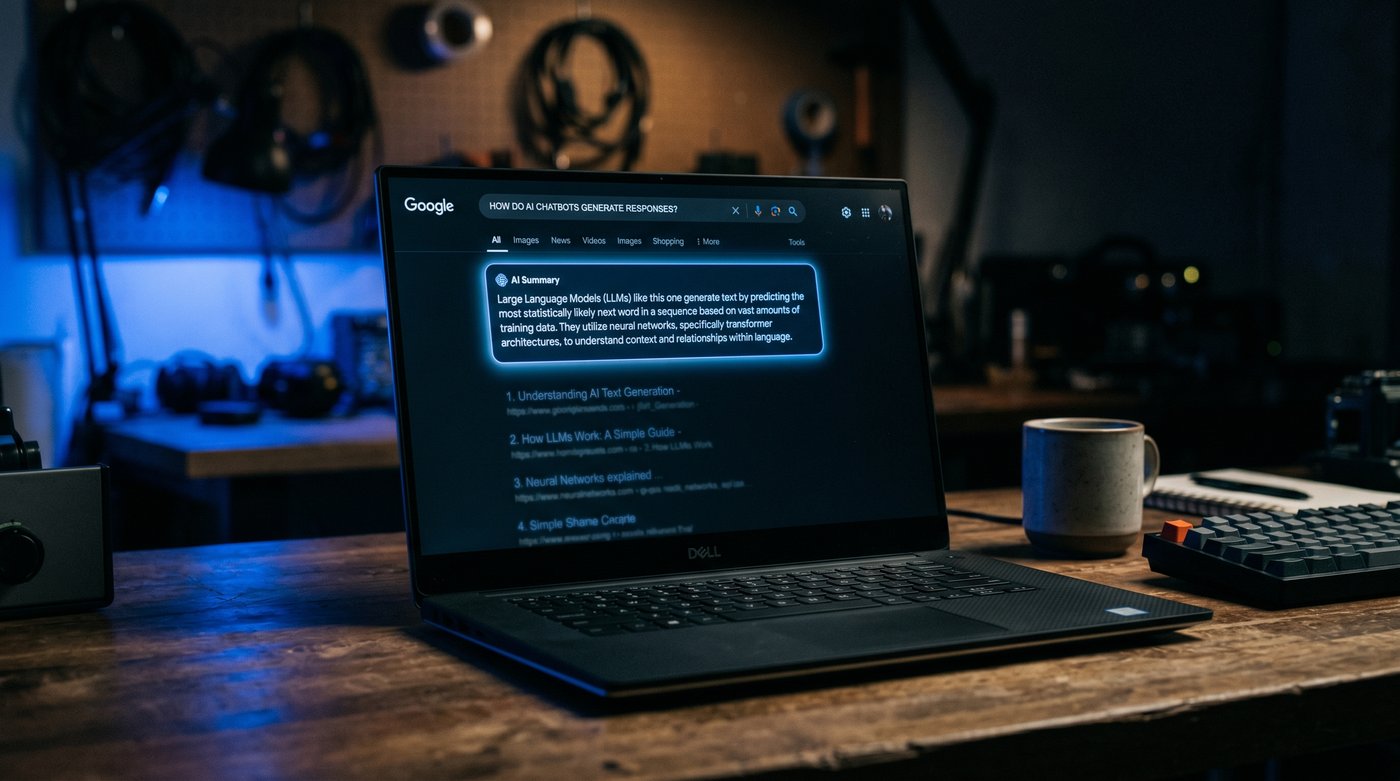
Organic click-through rates on AI-triggered searches fell 61% in 2026. Pages cited inside AI Overviews gained 35% more clicks compared to non-cited peers. These two numbers define the new search economy. For an e-commerce site running 10,000 monthly visits at a 2% conversion rate, the revenue swing between being cited and not being cited runs to tens of thousands of pounds per month. This post runs the numbers industry by industry and sets out the four-step plan to citation presence.
The Two Numbers That Changed Search in 2026
Two research findings published in May 2026 have reset the economics of organic search.
The first comes from a WebFX analysis of AI Overview click behaviour. Searches that trigger an AI Overview see 61% fewer clicks to organic links than the same queries without an AI Overview. The searcher reads the synthesised answer at the top of the page. They do not scroll down to click a blue link unless they want deeper detail.
The second figure is from the same study. Pages appearing as cited sources inside the AI Overview see a 35% lift in click-through rate compared to their non-cited organic peers. The traffic does not disappear. It concentrates on the brands the AI engine selects.
Put the two numbers together and the result is binary. An uncited page on an AI-Overview-triggering query loses 61% of the clicks it used to get. A cited page gains 35% on top. The total swing between those two outcomes is 96 percentage points per query. And the gap compounds month by month as AI Overviews extend to a wider share of search volume.
We saw this play out in our own portfolio. Garden Ornaments arrived with 727 monthly organic visits in October 2025. Seven months of content and on-page citation work brought that number to 6,370, a 776% lift, without adding a single new referring domain. The shift was from organic-only to AI-cited. When the citation layer engages, the maths reverses direction.
What the 61% Drop Means in Pounds
The 61% figure becomes concrete when you attach it to a real business.
Take a UK professional services firm with 5,000 monthly organic visits, a 3% conversion rate, and an average contract value of £800.
Before AI Overviews dominated the results page, the traffic picture looked like this:
- 5,000 visits at 3% conversion = 150 leads per month
- 150 leads at £800 = £120,000 monthly revenue from organic
After a 61% CTR drop on uncited queries:
- 5,000 x 0.39 = 1,950 visits per month
- 1,950 at 3% conversion = 58 leads per month
- 58 leads at £800 = £46,400 monthly revenue
The monthly revenue loss is £73,600. No technical errors. No ranking drop. The AI Overview simply absorbed the attention of the searcher before the click happened.
Now run the same calculation for a site that is cited:
After a 35% citation uplift:
- 5,000 x 1.35 = 6,750 visits per month
- 6,750 at 3% conversion = 202 leads per month
- 202 leads at £800 = £161,600 monthly revenue
The difference between cited and uncited, for that one business on that one input set, is £115,200 per month. The question is no longer whether GEO investment is worthwhile. It is whether the business can absorb the cost of not investing.
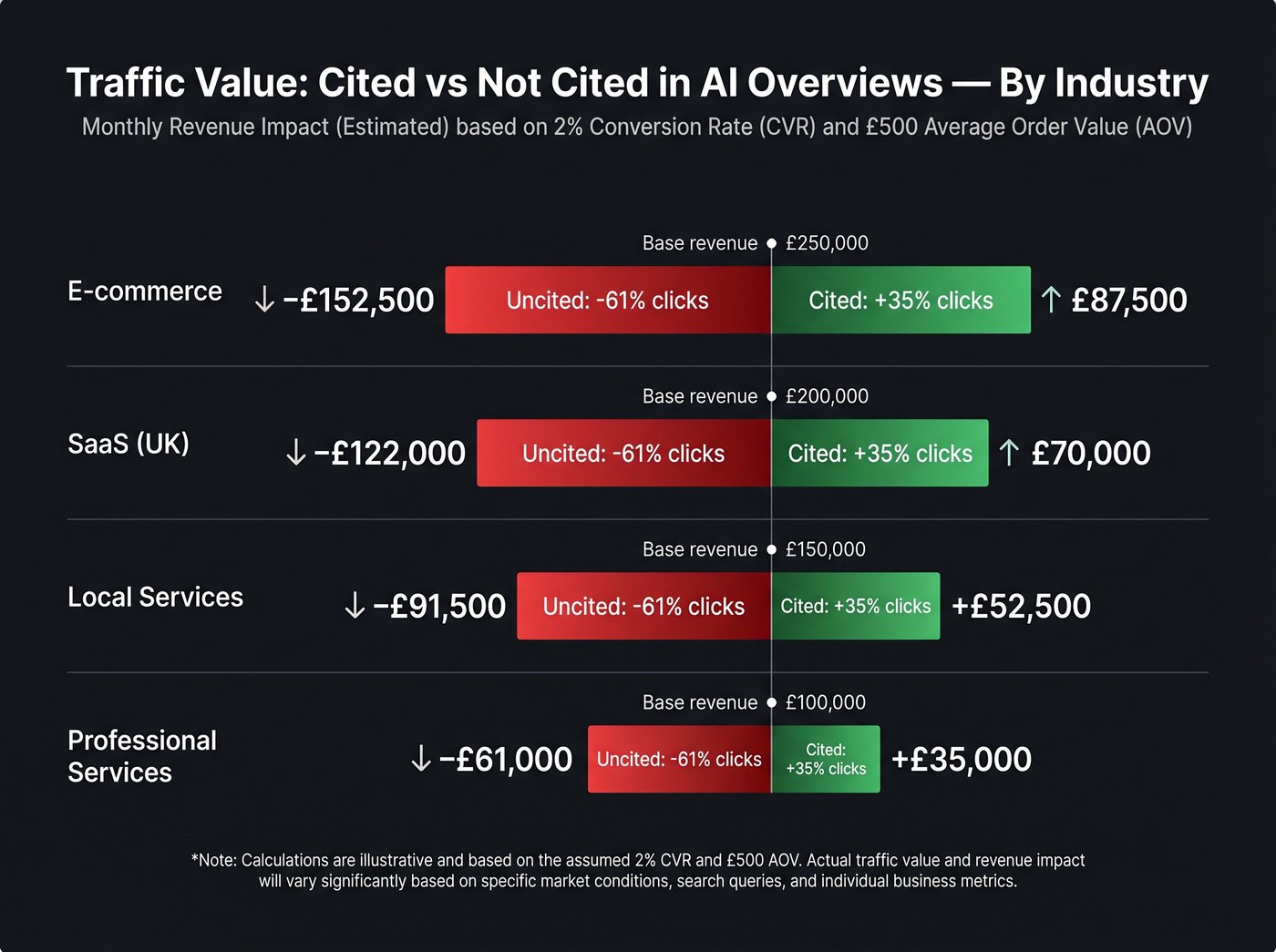
Traffic Value Before and After AI Overview Citation
| Industry | Monthly clicks (pre-AI) | Uncited after AI Overview | Cited inside AI Overview | Monthly value gap (2% CVR, £500 AOV) |
|---|---|---|---|---|
| E-commerce | 20,000 | 7,800 (-61%) | 27,000 (+35%) | £192,000/mo |
| SaaS (UK) | 8,000 | 3,120 (-61%) | 10,800 (+35%) | £76,800/mo |
| Local services | 3,000 | 1,170 (-61%) | 4,050 (+35%) | £28,800/mo |
| Professional services | 5,000 | 1,950 (-61%) | 6,750 (+35%) | £48,000/mo |
These are illustrative calculations using consistent inputs. Your actual conversion rate and order value will shift the numbers up or down. The ratio between cited and uncited outcomes is fixed by the research: 61% loss versus 35% gain. The directional conclusion holds at every scale.
One thing the table does not show is compounding. A cited brand builds topical authority and AI engine trust over months. An uncited brand loses both. The gap in the right-hand column is wider at month 12 than at month one.
Why Being Cited Is the Only Winning Move
Ranking in the top ten on Google no longer guarantees traffic. It never guaranteed revenue. But it used to guarantee visibility. That has changed.
A May 2026 analysis found that 47% of AI citations come from pages ranking below position five in standard organic results. The AI layer is not simply re-ranking the top three. It is reaching into the page two zone when those pages have better citation-grade content than the pages ranking above them.
This is the finding that makes GEO strategically distinct from SEO. The domain authority correlation for AI citations dropped to r=0.18 by May 2026. Links still matter for baseline trust. They do not govern citation order. What governs citation order is content quality: extractable answer blocks, multimodal elements, dated freshness within 30 days, named authorship, and FAQ schema.
Old SEO was a competition for rank. New GEO is a competition for extraction. A page can hold position one and still be invisible in the AI surface if its content does not pull cleanly into a synthesised answer. A page at position six with a BLUF summary, FAQ schema, and a current byline gets cited instead.
This is also visible in the Garden UK case study on this site. Garden UK reached a Domain Rating of 15 from zero, grew referring domains from 27 to 149 (a 452% increase), and earned ten ranking keywords on a fresh domain inside 30 days. The approach was building citation-grade content from day one rather than waiting for classic authority to accumulate first. GEO and SEO are not in conflict. GEO simply produces results faster on the metrics that now drive revenue.
The Four-Step Recovery Framework
The following four steps apply in order. Skipping ahead produces weaker results because each step feeds the one after it.
Step 1: Establish a baseline.
Before spending on anything, measure where your brand currently appears across the five main AI engines: ChatGPT, Perplexity, Gemini, Claude and Google AI Overviews. The free AI Visibility Check at /check/ runs this scan in under five minutes and emails a full report. Without a baseline you cannot prioritise where the recovery budget goes.
Step 2: Fix extractability on your top ten pages.
Every priority page needs a 50 to 75 word factual answer block directly below the H1. This is the single highest-leverage change available. AI engines pull citations from dense, datestamped passages in the first third of the page. If your top pages open with a brand statement or a product carousel, the AI surfaces skip them.
Add FAQ schema with at least five questions and answers to every commercial page. Pages with structured FAQ schema are weighted roughly 40% higher in ChatGPT source selection, per the May 2026 data. The same pattern holds in AI Overviews. The 9-point ChatGPT citation playbook covers the full implementation.
Multimodal is step 2b. May 2026 research puts the correlation between multimodal page elements and AI Overview selection at r=0.92, the highest single factor measured. Text-only pages now lose to pages with images, charts, and comparison tables. The implementation guide covers the seven elements to add and the schema markup for each.
Step 3: Build review-platform presence.
Sites with active Trustpilot, G2 or Capterra profiles have roughly 3x higher ChatGPT citation probability than sites with no review-platform footprint. The retrieval layer treats active review profiles as evidence that a brand is real and verifiable. A Trustpilot profile with a small number of genuine reviews outperforms no presence every time. The Trustpilot and G2 citation analysis covers which platforms matter by industry and how to seed presence without manufactured reviews.
Step 4: Maintain freshness.
Content updated in the last 30 days receives 3.2x the AI citation rate of content older than 90 days. This is not about rewriting from scratch. It means refreshing the GEO summary block, updating the statistics, and changing the visible “last updated” date in the byline. Set a quarterly refresh schedule for every priority page. Publish new content monthly to signal that the site is an active, current source of information.
For teams that need this work to run without internal bandwidth, the monthly GEO plans at /services/monthly-seo/ include scheduled page refreshes and new content as standard.
What to Stop Doing
Three things consume budget without improving citation presence.
Stop publishing content that contains no owned data. Any article that could have been written by any agency with an LLM subscription will not be cited. It fails the March 2026 Information Gain gates before it even goes live. Before publishing, ask: “Is there a number in this page that exists nowhere else?” If the answer is no, add one or hold the piece.
Stop ignoring the Perplexity window. Perplexity cites content within 48 hours of publication when the 1,000-impression threshold is hit in the first 30 minutes of distribution. Most sites publish and wait. The 48-hour playbook requires an active distribution push at the moment of publication, not passive indexing. Missing this window means waiting weeks for citation to occur naturally.
Stop assuming llms.txt is a substitute for content quality. May 2026 data from 300,000 domains shows no measurable citation impact from llms.txt, despite 10.13% adoption. Ship it as a future-proofing measure if you want. Do not treat it as a priority over the extractability and multimodal work that actually moves citation rate now.
Where to Start
The entry point is measurement. The free AI Visibility Check scans ChatGPT, Perplexity, Gemini, Claude and AI Overviews and emails a full citation report in under five minutes. It identifies where your brand is cited and, more usefully, the competitor brands being cited in your place.
If the audit reveals a credible gap, the Authority Blueprint defines the priorities and 90-day plan before production begins.
If you are working with a smaller budget, the UK SMB GEO budget guide explains what to do internally before outside help is economical.
The maths presented above will not change direction. Organic CTR on AI-triggering queries is down 61% and the trend is extending to more query types each quarter. The cited brands are absorbing the traffic that the uncited ones are losing. The UK agency comparison and the GEO pricing overview for 2026 are the two most-read pages on this site if you are weighing providers. The plain-English glossary of GEO, SEO, AEO and LLMO is the right starting point if you want to clarify what each term means before committing to a plan.
The 61% and 35% figures are not projections. They are measured outcomes from the current search environment. The decision to act on them is the only variable still in play.